
 Paul Kelly
The Best AI Makes Errors Impossible, Not Just Less Likely
Here's what you'll learn when you read this story:
• How AI transforms quality control from periodic review to continuous operational oversight.
• Why leading utilities are using AI to eliminate defects before they impact customers or revenue.
• How intelligent validation, governance, and auditability create stronger billing operations at scale.
For decades, utility billing operations have focused on humans detecting errors after they occur. AI is changing that standard entirely.
The future of utility billing is not simply about finding mistakes faster. It is about designing workflows where many errors never happen in the first place.
This principle comes from Lean operations management and a methodology called Poka Yoke, or “mistake-proofing.” [1] The idea is simple: the best operational systems are designed to prevent errors before they move downstream into larger operational problems. [2]
Historically, manual-driven utility billing systems could only apply this concept in limited ways: validating account numbers, preventing duplicate billing runs, or rejecting invalid rate codes. These controls were valuable, but they existed primarily at isolated checkpoints within the billing cycle.
AI changes the scale of what error prevention can become.
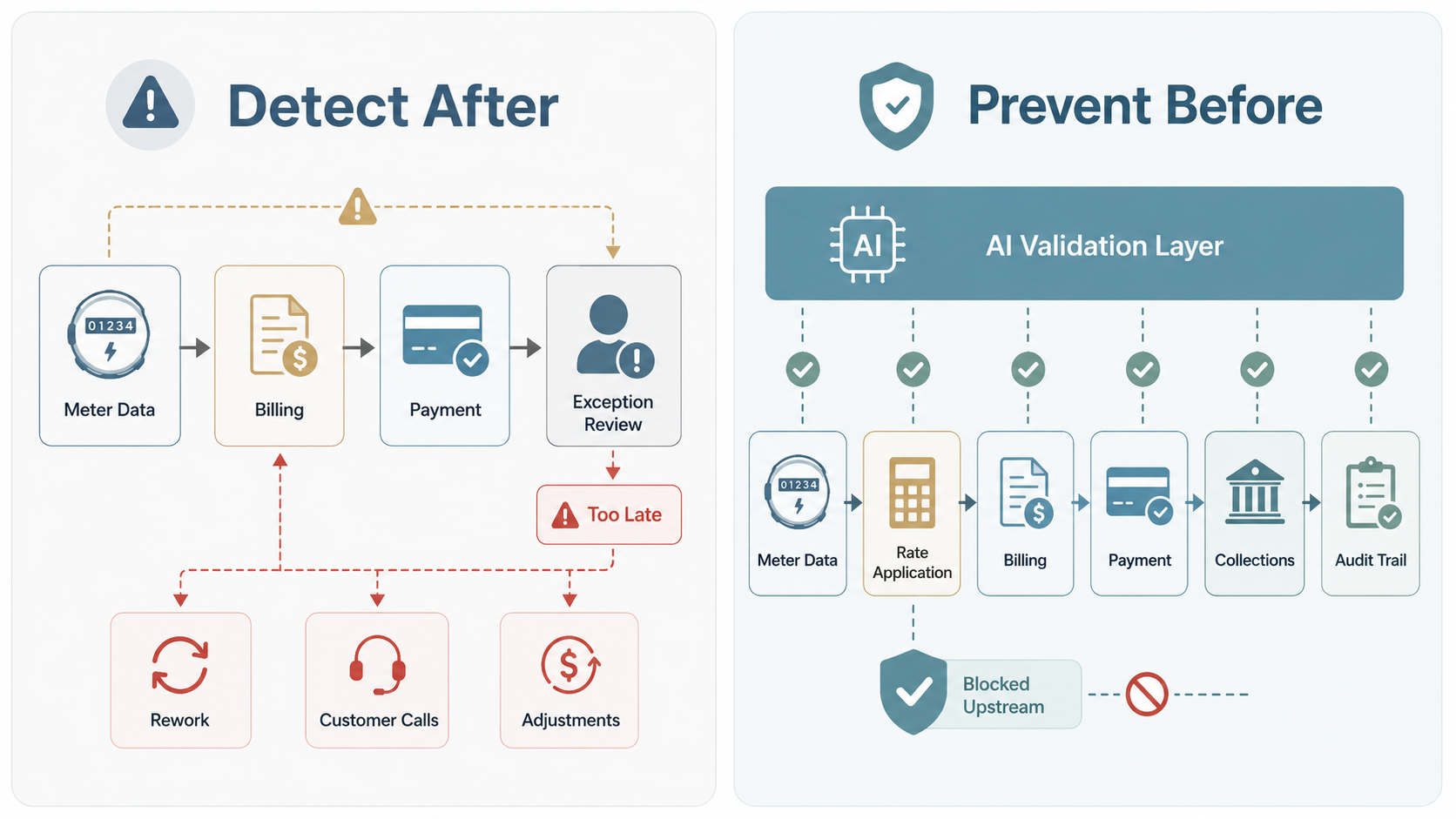
Instead of applying validation and surfacing errors at only a few stages, AI-native utility billing platforms can continuously monitor and validate workflows across every account, every transaction, and every billing cycle in real time. [3]
That shift is transformational.
In traditional billing environments, quality control is largely a statistical exercise, combined with “gut instinct,” to detect and resolve obvious problems. Specialists review samples, audit reports, and exception queues because reviewing every transaction manually is impossible at scale. [4]
AI enables comprehensive quality control by enabling automated analysis of each record in fractions of a second.
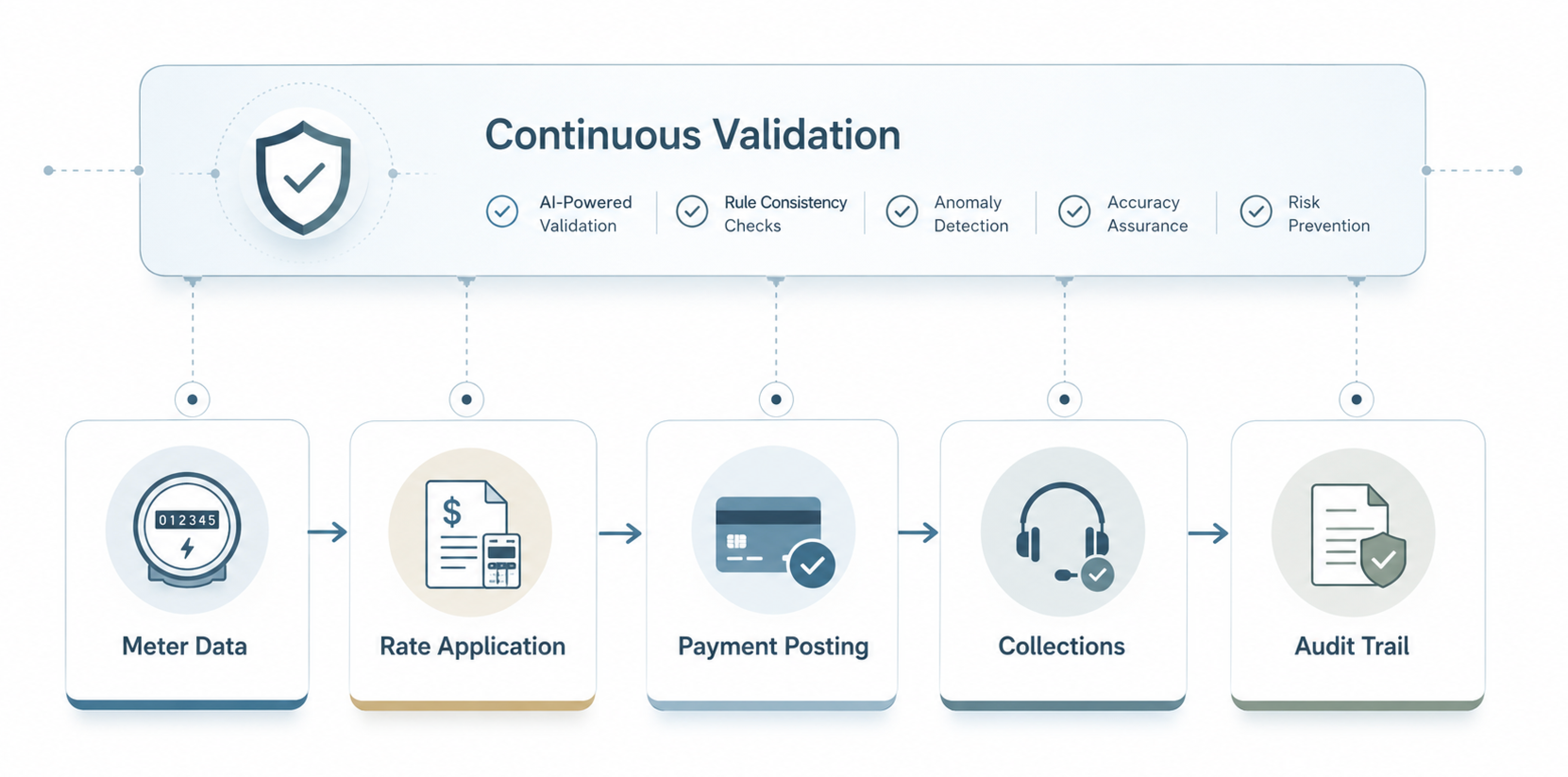
AMI data can be validated continuously against historical usage patterns, seasonal trends, weather conditions, occupancy shifts, and adjacent meter behavior before billing even occurs. AI can identify subtle anomalies that would never trigger traditional exception thresholds but could eventually lead to disputes, revenue leakage, or incorrect bills.

Payment processing becomes more intelligent as well. AI can validate whether a payment aligns with expected account behavior, payment arrangements, or historical patterns before posting occurs, helping prevent misapplied payments and avoidable customer disputes.
"The future of utility billing is not about finding mistakes faster. It is about designing workflows where mistakes never happen in the first place."
Rate application is another critical area. Incorrect rate assignments often create some of the most expensive and time-consuming billing corrections utilities face. [5] AI-driven validation can continuously confirm rate structures, tariff eligibility, service classifications, and effective dates before bills are generated, reducing errors before they ever reach customers.

Collections workflows also benefit from AI-based safeguards. Before collections actions are initiated, AI can validate disputes, payment arrangements, regulatory protections, and account status conditions to ensure inappropriate actions are prevented automatically.
Perhaps most importantly, AI creates a continuous audit trail across the entire billing operation. Every automated action can be logged with the decision logic, data sources, validation criteria, and escalation pathways associated with it. That level of transparency strengthens compliance, improves operational visibility, and creates far greater confidence in automation outcomes.
This is where AI becomes far more than a productivity tool.
It becomes an operational quality system.
The utilities gaining the greatest long-term advantage from AI are not simply automating workflows faster. They are redesigning workflows to reduce defects, eliminate preventable errors, and strengthen operational consistency at scale.
MultiBilling was built around this operational philosophy. AI in utility billing should not simply accelerate existing processes. It should improve the integrity of the entire billing operation by embedding intelligence, validation, and governance directly into the workflow itself.
Because the highest-performing utility billing operations of the future will not be the ones that correct the most errors.
They will be the ones designed to prevent those errors from occurring at all.


Schedule a personalized live demo of the new MultiBilling platform today and explore how AI-driven workflow orchestration, operational intelligence, and governed automation can transforming your utility billing operations.
Citations:
[1] Shingo, Shigeo. Zero Quality Control: Source Inspection and the Poka-Yoke System. Productivity Press, 1986.
[2] Womack, James P., and Daniel T. Jones. Lean Thinking: Banish Waste and Create Wealth in Your Corporation. Simon & Schuster, 2003.
[3] National Institute of Standards and Technology. Artificial Intelligence Risk Management Framework (AI RMF 1.0). U.S. Department of Commerce, 2023.
[4] Montgomery, Douglas C. Introduction to Statistical Quality Control. 8th ed., Wiley, 2019.
[5] U.S. Energy Information Administration. Electric Power Monthly & Utility Data Systems Overview. EIA, 2024.
https://www.eia.gov/electricity/monthly/