
 Paul Kelly
AI Agents Need Instructions. ITIL Provides a Best Practice Framework To Write Them.
Here's what you'll learn when you read this story:
• Why AI governance is becoming essential to safe and scalable utility billing operations.
• How ITIL principles provide a proven foundation for managing AI-driven billing systems.
• The connection between structured IT operations and successful, scalable AI adoption in utilities.
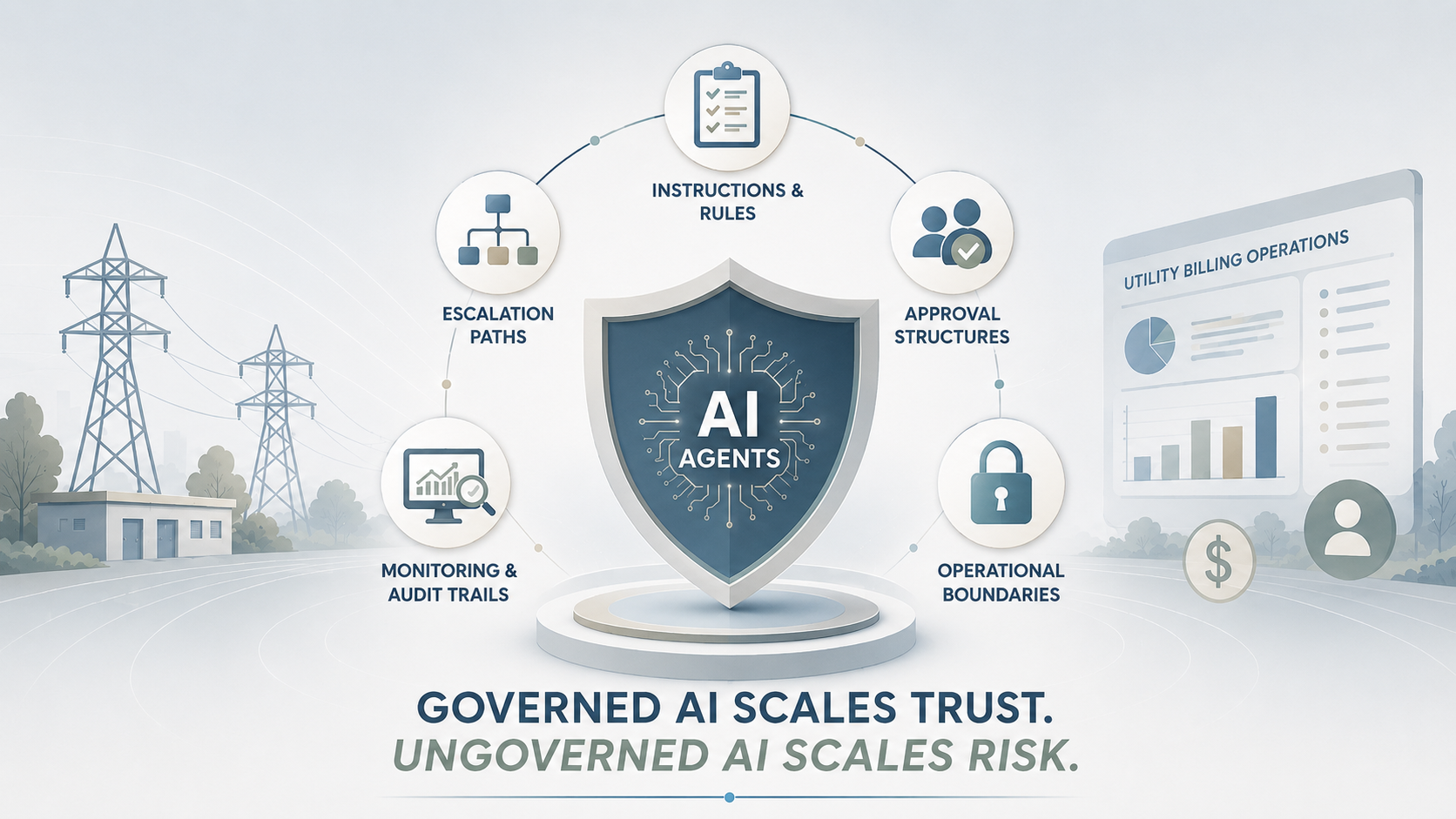
As AI becomes more integrated into utility billing operations, one thing is becoming increasingly clear: AI agents require governance. [1] They need instructions, escalation paths, approval structures, monitoring standards, and operational boundaries. In many ways, they require the same operational discipline that has governed enterprise technology systems for decades.
That is why ITIL is becoming increasingly important in the AI era.
ITIL - short for Information Technology Infrastructure Library, is one of the world’s most widely adopted frameworks for managing IT operations and service delivery. [2] Originally developed to help organizations run complex technology environments more reliably, ITIL provides structured best practices for handling incidents, managing system changes, deploying new capabilities, maintaining service quality, and governing operational workflows.

At its core, ITIL is designed to answer a simple but critical question: how do organizations operate complex systems consistently, safely, and at scale?
That question now sits at the center of AI deployment in utility billing.
An AI agent handling billing exceptions must know what to do when a situation matches established rules — and what to do when it does not. It needs escalation procedures, audit trails, rollback protocols, approval workflows for changes to decision logic, and clear authority boundaries for when human intervention is required.
These are governance challenges, not just technology challenges. And they map directly to the operational structure ITIL was designed to provide.
Utilities with strong operational governance already have a significant advantage in AI adoption because many of the disciplines required for AI management already exist inside mature ITIL-based environments.
Several core ITIL functions align almost perfectly with AI-enabled billing operations.
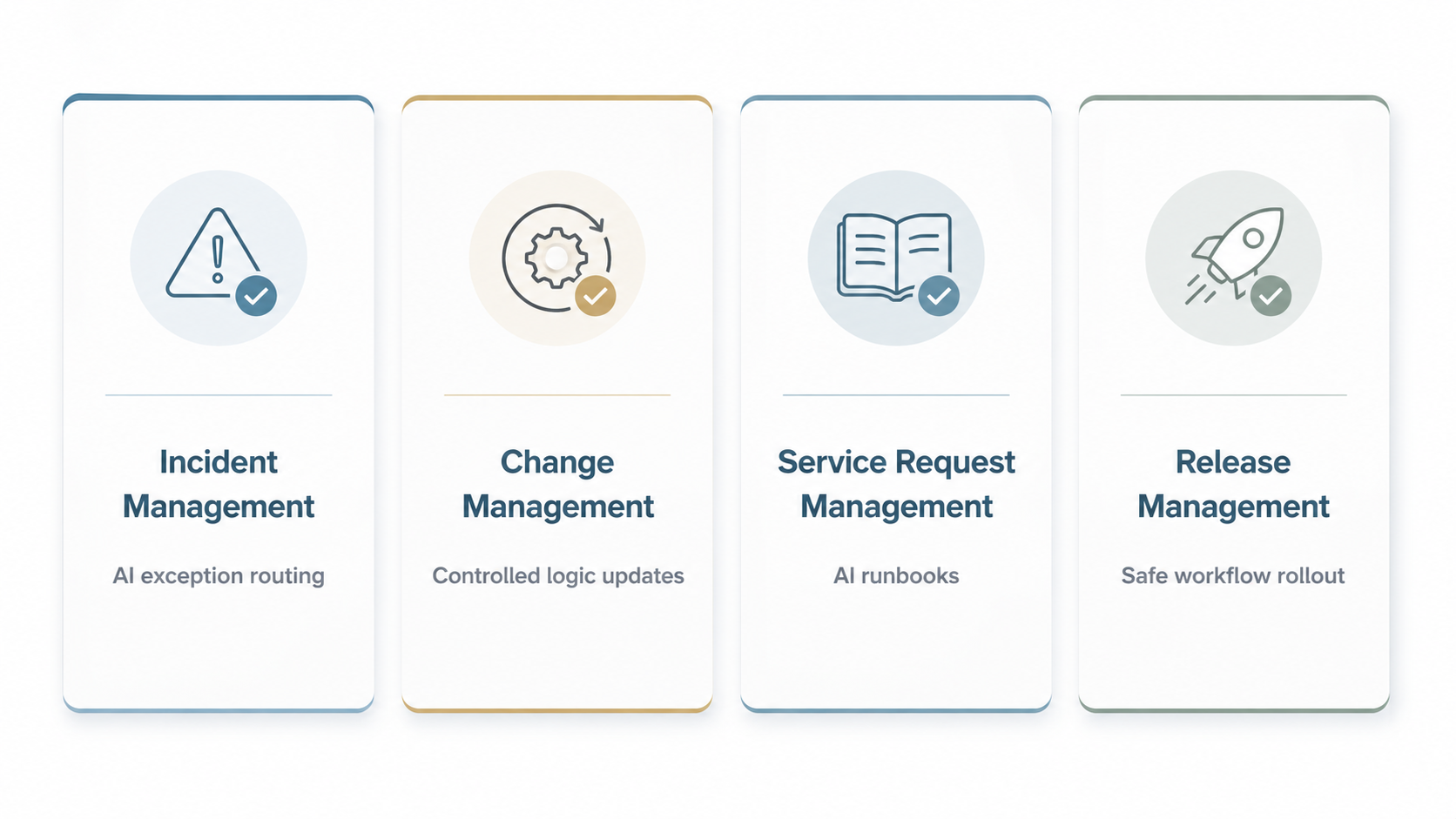
Incident Management focuses on how organizations detect, classify, escalate, and resolve operational problems. In an AI environment, this becomes AI exception management, defining how unresolved billing scenarios, anomalies, or high-risk events are routed to the right teams quickly and consistently. [3]
Change Management governs how updates to production systems are reviewed, tested, approved, and deployed. In AI operations, this applies directly to changes in billing logic, automation rules, thresholds, and workflow configurations. Without strong change governance, AI can scale operational mistakes just as quickly as it scales efficiency.
Service Request Management standardizes how repeatable operational tasks are handled. In AI-enabled utility billing, this becomes the AI runbook, a documented set of instructions defining what workflows AI can execute, what quality standards apply, and when escalation is required.
Release Management controls how new technology capabilities are introduced into live environments. In AI operations, this governs how new automation features, integrations, or AI-driven workflows are tested, monitored, and rolled out safely.

The importance of governance becomes obvious when issues occur. A billing logic change that unintentionally impacts hundreds of accounts can either become a contained operational event or a customer-facing crisis, depending on whether proper monitoring, escalation, and rollback controls are in place.
The difference is not the AI itself. It is the operational discipline surrounding it.
This is why the utilities seeing the greatest success with AI are not treating it as a standalone technology initiative. They are integrating AI into broader operational governance frameworks built around accountability, quality control, workflow management, and continuous improvement. [4]
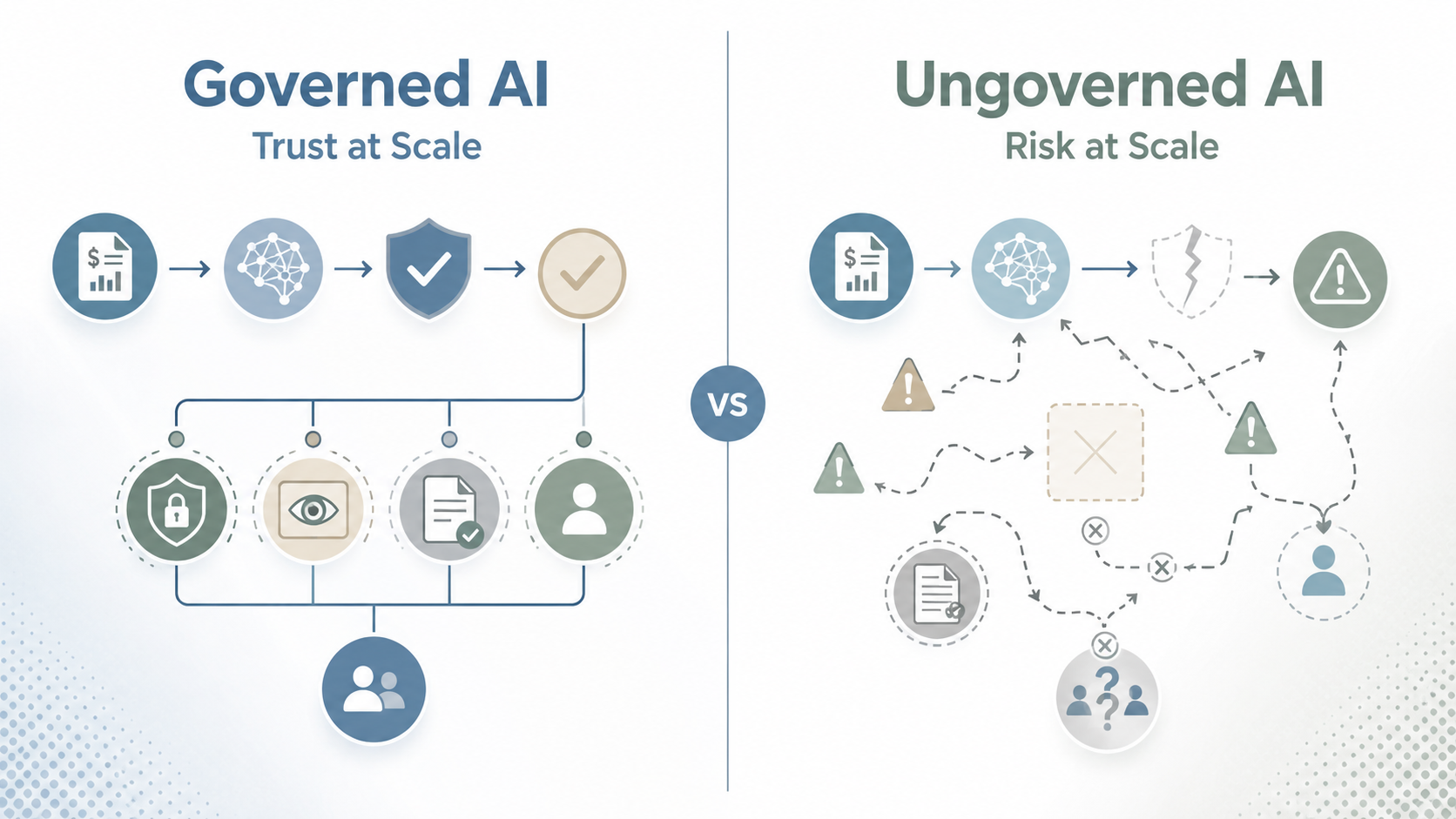
"Governed AI scales trust. Ungoverned AI scales risk."
MultiBilling was designed around this operational reality. AI-driven utility billing requires more than automation alone, it requires governed workflows, measurable standards, controlled deployment practices, and scalable operational oversight that utilities can trust in production environments.
Because as AI becomes more powerful, governance becomes more important, not less.
And the utilities that combine AI capability with operational discipline will be the ones best positioned to lead the next generation of utility billing modernization.


Schedule a personalized live demo of the new MultiBilling platform today and explore how AI-driven workflow orchestration, operational intelligence, and governed automation can transforming your utility billing operations.
Citations:
[1] - National Institute of Standards and Technology (NIST). Artificial Intelligence Risk Management Framework (AI RMF 1.0). U.S. Department of Commerce, 2023. https://www.nist.gov/itl/ai-risk-management-framework
[2] - AXELOS. ITIL® Foundation: IT Service Management Best Practices. AXELOS, 2019. https://www.axelos.com/itil
[3] - ITIL Official Guidance / AXELOS. ITIL 4 Service Management Practices: Incident Management, Change Enablement, Release Management, Service Request Management. https://www.axelos.com/itil
[4] - McKinsey & Company. The State of AI: Operational Models and Scaling AI in Enterprises. McKinsey Global Institute, 2023. https://www.mckinsey.com/capabilities/quantumblack/our-insights