
 Paul Kelly
Quality Reduces Costs. Everyone Got It Backwards. AI Proves It.
Here's what you'll learn when you read this story:
• Why the most successful AI initiatives start with improving quality, consistency, and operational discipline - not reducing headcount.
• How leading utilities are using AI to improve billing accuracy, customer experience, and workflow performance before pursuing cost savings.
• The connection between Lean principles, operational excellence, and AI-native utility billing operations.
In 1982, W. Edwards Deming introduced a principle that transformed modern operations management: improve quality first, and costs will fall as a result. [1] Decades later, the AI era is proving that principle more clearly than ever especially in utility billing operations.
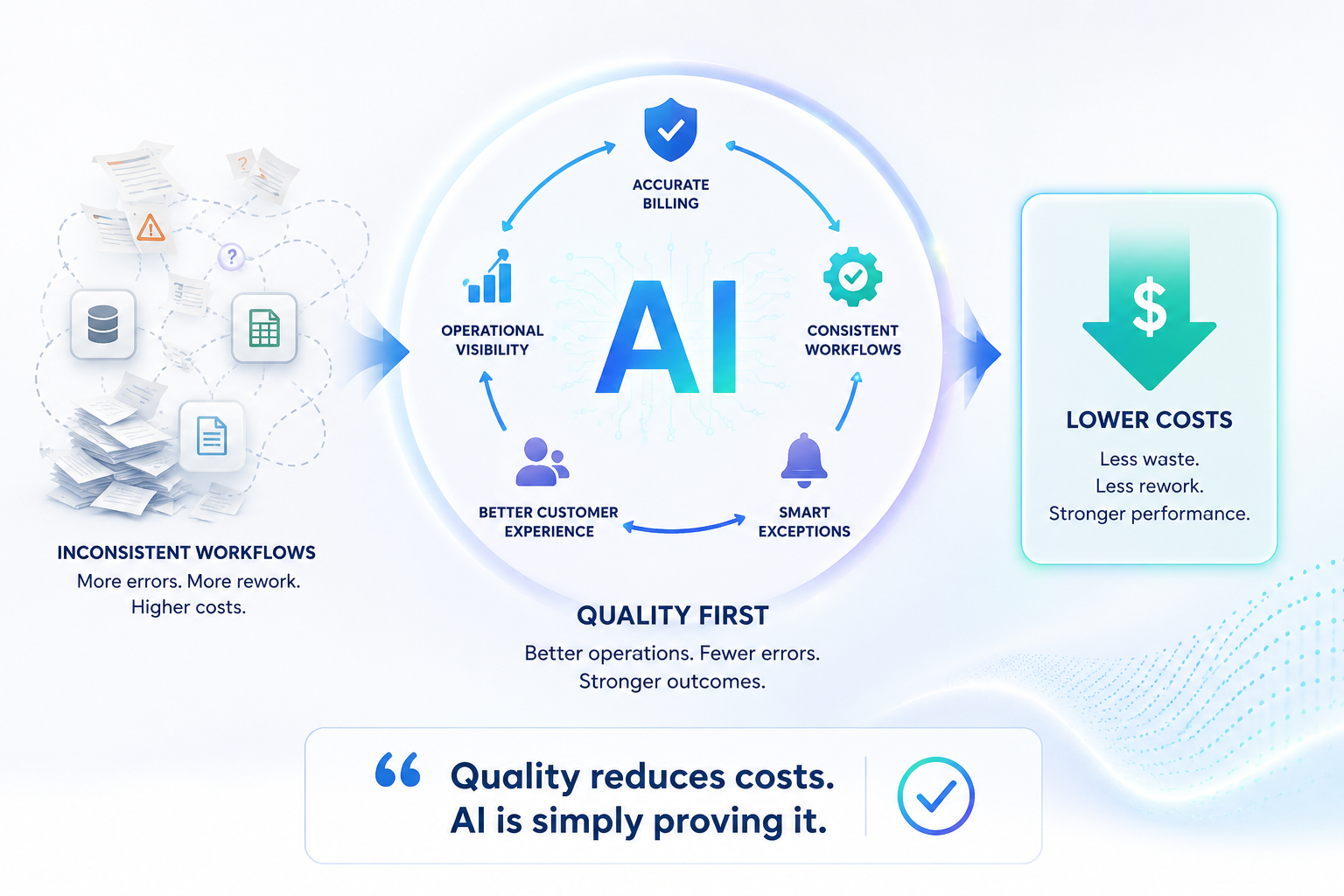
We see a clear pattern emerging across the industry: the utilities achieving the greatest success with AI are not using it simply to cut costs. They are using it to improve billing accuracy, workflow consistency, customer communication, and operational visibility. The cost savings follow naturally from those improvements.

That distinction matters because AI does not automatically improve operations. If deployed into inconsistent or poorly documented workflows, it simply accelerates existing inefficiencies. But when deployed into standardized, quality-focused operations, AI can dramatically reduce rework, billing errors, exception backlogs, delays, and manual processing. [2]
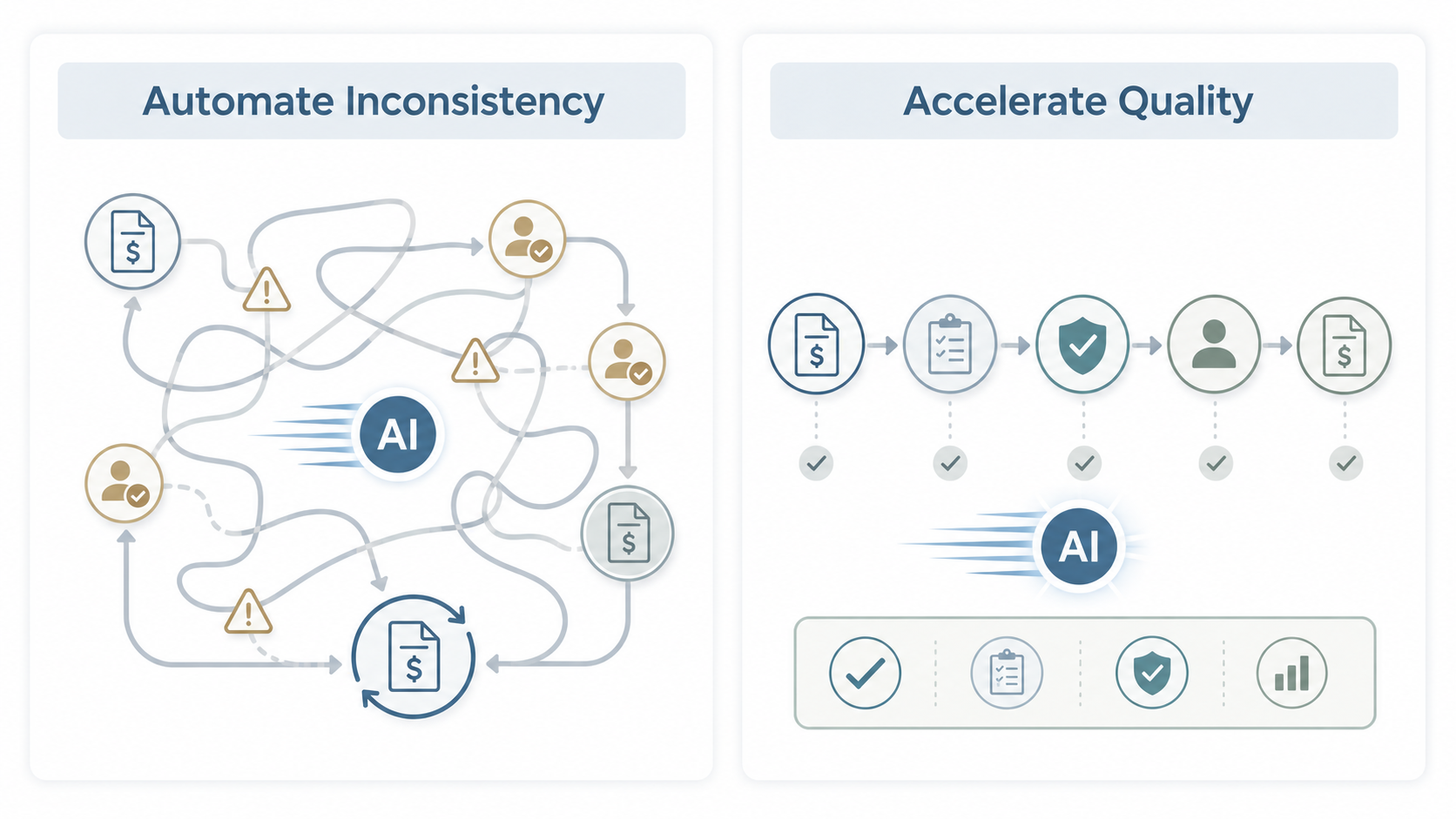
In utility billing, operational waste often appears as billing corrections, unresolved exceptions, disconnected systems, duplicated approvals, and employees spending valuable time on repetitive administrative work instead of applying their expertise. AI changes that equation.
With the right operational foundation, AI can validate billing data in real time, automate reconciliation workflows, route exceptions intelligently, assemble decision context instantly, and eliminate many forms of manual re-entry and repetitive processing. The result is fewer disputes, faster collections, stronger customer experiences, and more scalable operations.

At Munibilling , this is the philosophy behind our AI-native utility billing platform, MultiBilling. We believe AI works best when paired with operational discipline, process clarity, and governance. That is why frameworks like Lean Six Sigma remain so important. AI is not a replacement for operational excellence, it is an accelerator of it. [3]
The utilities leading the next generation of modernization are not starting with automation alone. [4] They are documenting workflows, defining quality standards, identifying operational friction, and creating measurable processes before deploying AI at scale.
"Quality reduces costs. AI is simply proving it."
Because the goal is not simply faster work or lower costs. The goal is better work, more accurate, more consistent, more resilient operations that improve both customer experience and financial performance.
Deming’s principle was always correct: quality reduces costs. The AI era is simply making that truth impossible to ignore.


Schedule a personalized live demo of the new MultiBilling platform today and explore how AI-driven workflow orchestration, operational intelligence, and governed automation can transform your utility billing operations.
Citations:
[1] - Deming, W. Edwards. Out of the Crisis. MIT Press, 1986.
[2]- National Institute of Standards and Technology (NIST). Artificial Intelligence Risk Management Framework (AI RMF 1.0). U.S. Department of Commerce, 2023. https://www.nist.gov/itl/ai-risk-management-framework
[3] - Lean Enterprise Institute. Lean Thinking and Six Sigma (DMAIC Framework Overview). https://www.lean.org
[4] - McKinsey & Company. The State of AI: How Organizations Are Rewiring to Capture Value. McKinsey Global Institute, 2023. https://www.mckinsey.com/capabilities/quantumblack/our-insights