
 Larry Foster
The Fifth Industrial Revolution
Here's what you'll learn when you read this story:
• See why the Fifth Industrial Revolution is about more than automation, it's about changing how billing operations are designed.
• Understand how utility billing evolved from manual ledgers to connected digital systems, and the challenges that came with each stage.
• Learn how AI-native operations can reduce operational friction, improve decision-making, and elevate the role of utility teams.
The previous industrial revolutions reshaped nearly every aspect of daily life for those who lived through them. While the technologies changed, the pattern remained consistent: each era redefined how industries managed complexity, from production and infrastructure to customer systems and financial operations. That history matters because it provides a clear framework for understanding what AI is changing today and why this shift may prove fundamentally different from the ones that came before it.
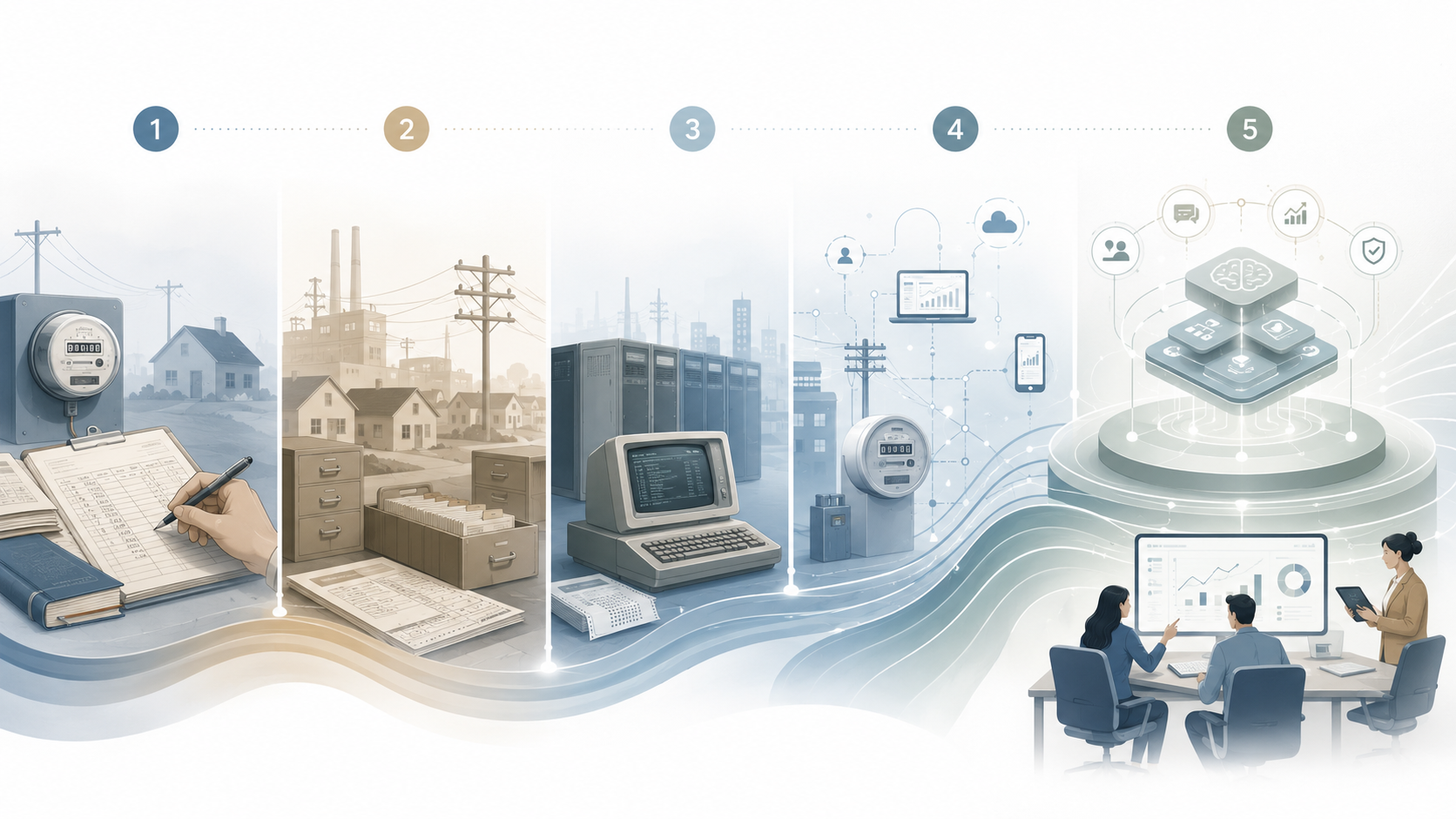
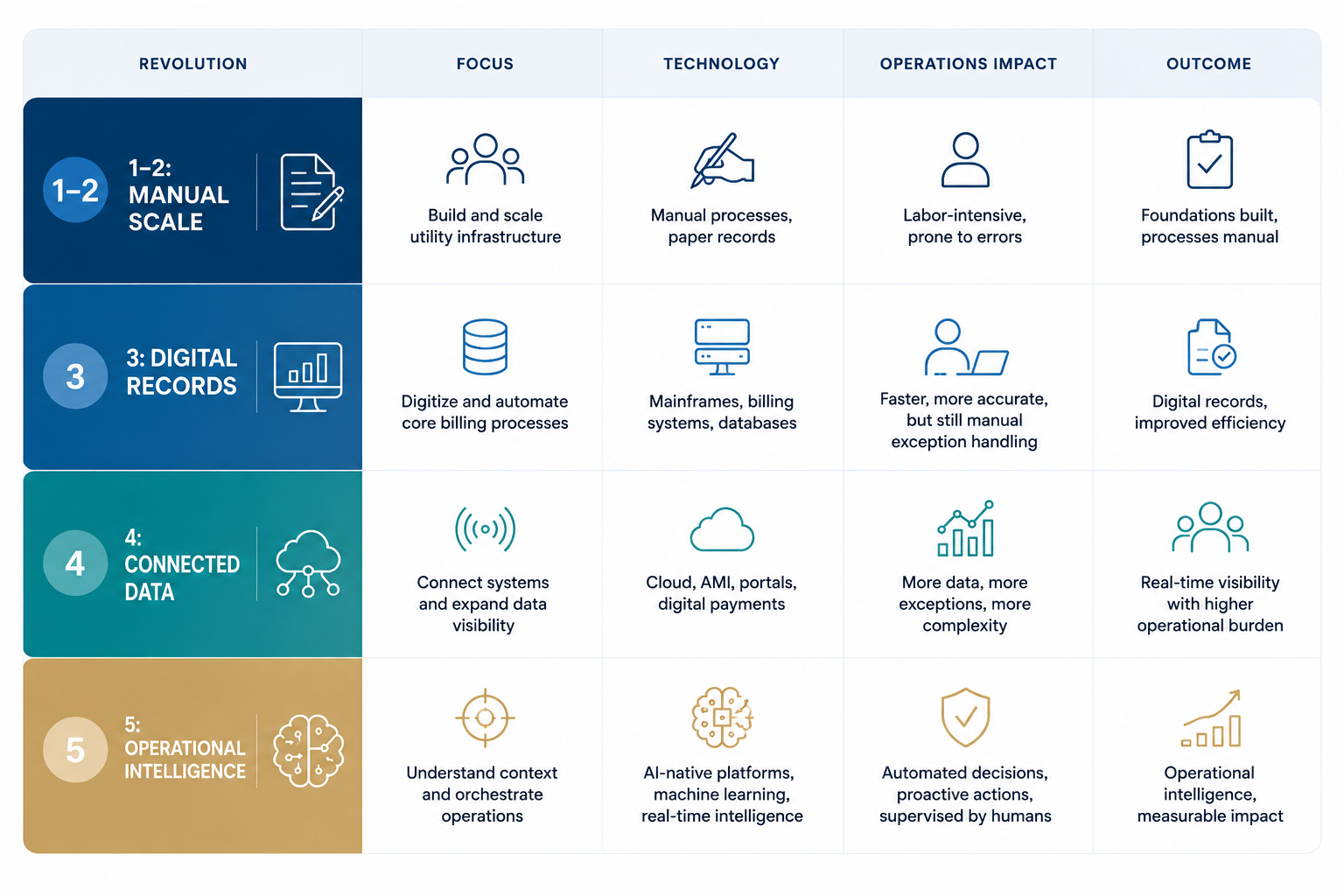
The First and Second Industrial Revolutions established the foundation of modern utilities. As water, gas, and electric infrastructure expanded, utilities needed organized methods to track usage, manage customer accounts, and collect payments at scale. Billing operations were entirely manual. Meter reads, ledger entries, calculations, collections, and customer records all depended on human labor and paper-based processes. These early revolutions created the operational architecture utilities would follow for generations. [1]

The Third Industrial Revolution introduced computerization and automation into utility billing. Mainframes and early billing systems dramatically improved calculation speed, recordkeeping accuracy, and billing cycle efficiency. Manual ledgers became digital records, and paper workflows moved into software environments. Yet despite these improvements, the core operational model remained largely unchanged. Humans still managed exception handling, reconciled discrepancies, interpreted anomalies, and coordinated workflows between disconnected systems. Technology accelerated the work, but it did not fundamentally reduce the operational burden placed on billing teams.
The Fourth Industrial Revolution expanded digital connectivity and dramatically increased the amount of operational data utilities had to manage. AMI networks, cloud platforms, customer portals, digital payments, and integrated systems created more visibility than ever before. But they also introduced far greater operational complexity. Utilities gained real-time data streams, interval consumption data, integrated payment systems, and broader customer engagement channels while simultaneously creating more exceptions, more integrations, more reconciliation work, and more operational coordination challenges. [2]
"AI-native platforms do not simply process transactions faster- they understand operational context."
In many ways, the Fourth Revolution improved utility billing while also increasing the amount of cognitive work required to manage it. Billing teams had more tools, but also more dashboards, more workflows, more alerts, and more systems requiring human coordination. Operations became more data-driven, but the responsibility for interpreting and managing that complexity still depended heavily on people.
The Fifth Industrial Revolution changes that model entirely.
For the first time, the technology itself can absorb much of the cognitive translation work that has historically burdened utility billing operations. AI-native platforms do not simply process transactions faster; they understand operational context, classify exceptions, coordinate workflows, monitor conditions continuously, and trigger actions automatically within governed frameworks.
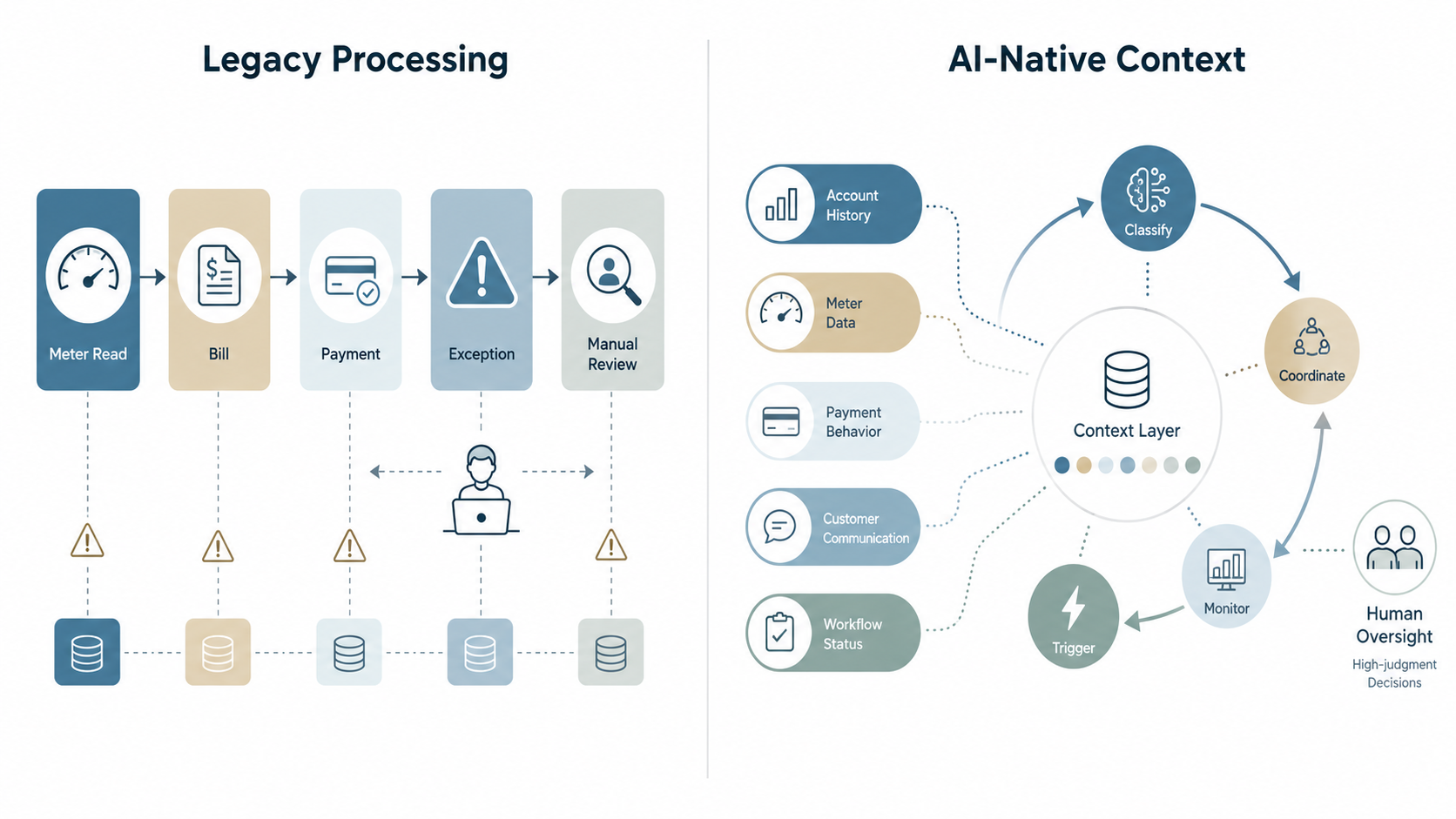
At MuniBilling, we believe this is the defining difference between legacy modernization and true operational transformation. Adding AI features onto older software may improve efficiency incrementally, but it does not redesign the operational model itself. AI-native architecture fundamentally changes how billing operations function by reducing the manual coordination work that previous generations of technology continued to create. [3]

In the Fifth Revolution utility billing operation, AI will validate accounts continuously, classify billing anomalies in real time, automate routine exception handling, monitor payment risk proactively, correlate AMI data with operational conditions, and orchestrate workflows across departments with full auditability and governance. Instead of teams spending most of their time translating information between systems, employees focus on oversight, customer engagement, strategic analysis, and operational improvement.
This does not eliminate the importance of people in utility billing. It elevates their role. Human expertise becomes more valuable because AI handles the repetitive operational execution that previously consumed staff capacity. Billing professionals shift from transaction processing to governance, customer stewardship, and strategic decision-making. [4]
Every previous industrial revolution improved utility billing by accelerating existing workflows. The Fifth Revolution is different because it redesigns the workflows themselves. The utilities that recognize this shift early and build around AI-native operational architecture instead of retrofitting legacy processes will define the next generation of operational performance, customer experience, and revenue assurance.
That is the future MultiBilling was built to lead.


Schedule a personalized live demo of the new MultiBilling platform today and explore how AI-driven workflow orchestration, operational intelligence, and governed automation can transforming your utility billing operations.
Citations:
[1] “What Every Utility Company Must Know About IT Infrastructure.” SilverBlaze Solutions, 2025,
https://www.silverblaze.com/blog/what-every-utility-company-must-know-about-it-infrastructure/
[2] International Energy Agency. Data Centres and Digitalisation in Energy. IEA, 2024.
https://www.iea.org/reports/digitalisation-and-energy
[3] Whitten, Chuck, et al. “Unsticking Your AI Transformation.” Bain & Company, accessed 26 May 2026
[4] Organisation for Economic Co-operation and Development. AI, Automation and the Future of Work. OECD Publishing, 2024.
https://www.oecd.org/en/topics/policy-issues/future-of-work.html