
 Paul Kelly
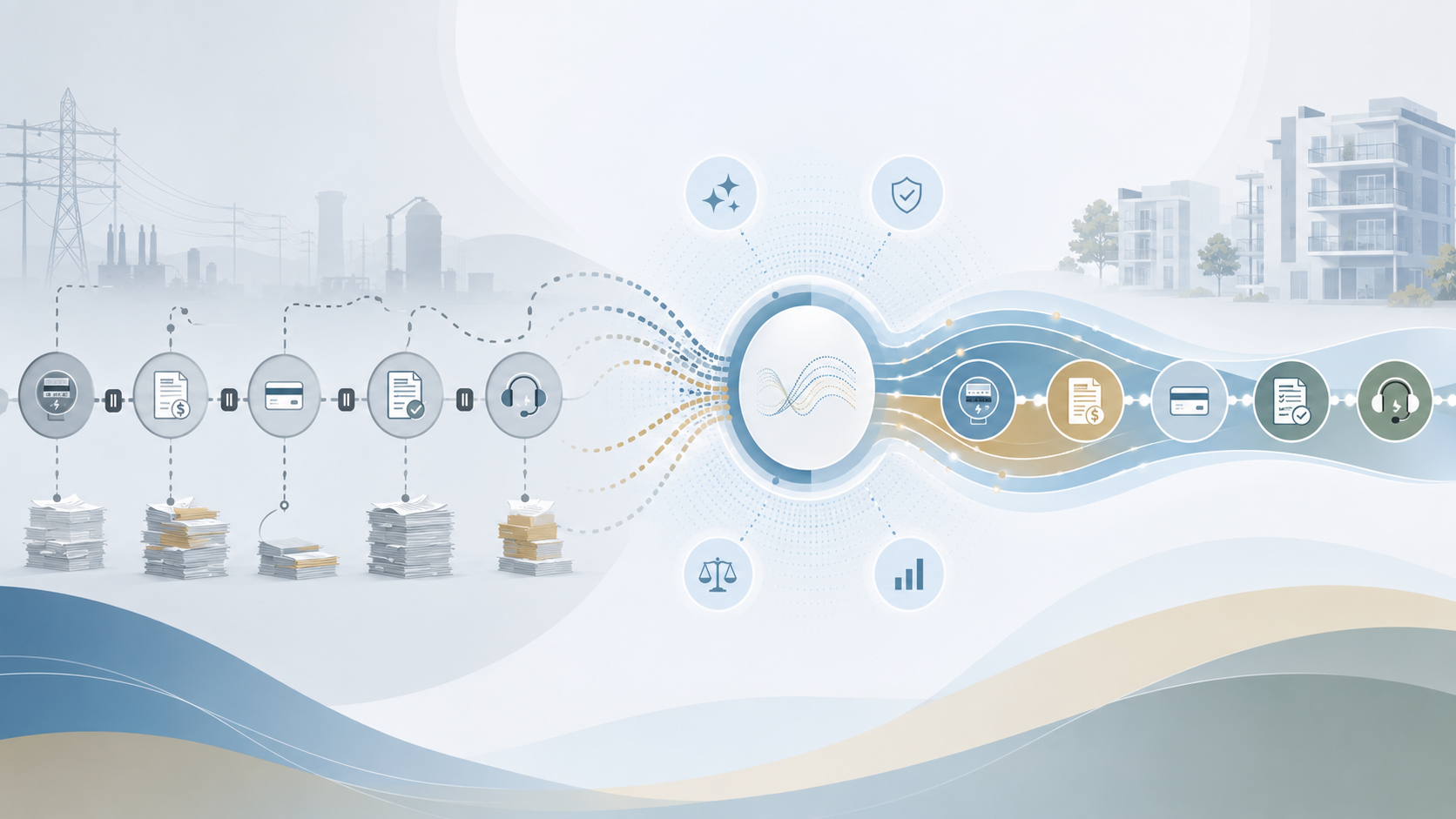
The Billing Cycle Was Never Supposed to Take That Long
Here's what you'll learn when you read this story:
• Why the future of utility billing is about improving flow, not simply increasing speed.
• What leading utilities are doing to create continuous, governed workflows that scale more effectively.
• How AI helps eliminate the bottlenecks, handoffs, and rework that slow billing operations.
Most utility billing leaders know how long their billing cycle takes. The more important question is: how long should it take?
In many utility billing environments, the actual work required to validate reads, generate bills, process payments, and reconcile accounts represents only a fraction of the total cycle time. [1] The rest is operational friction, manual handoffs, exception queues, rework, and workflows built around the limitations of legacy systems.
That gap is where one of the biggest AI opportunities in utility billing exists today.

For years, utilities accepted long billing cycles because traditional systems relied on batch processing and disconnected workflows. [2] AI-native platforms will change that entirely. Data can be validated in real time, exceptions can be classified automatically, and workflows can be triggered continuously instead of waiting for scheduled processing windows. [3]
In Lean operations management, this is called “Flow”, work moving continuously through a process without unnecessary interruption or delay. [4] In utility billing, most delays are not caused by the work itself. They are caused by the places where work stops moving.
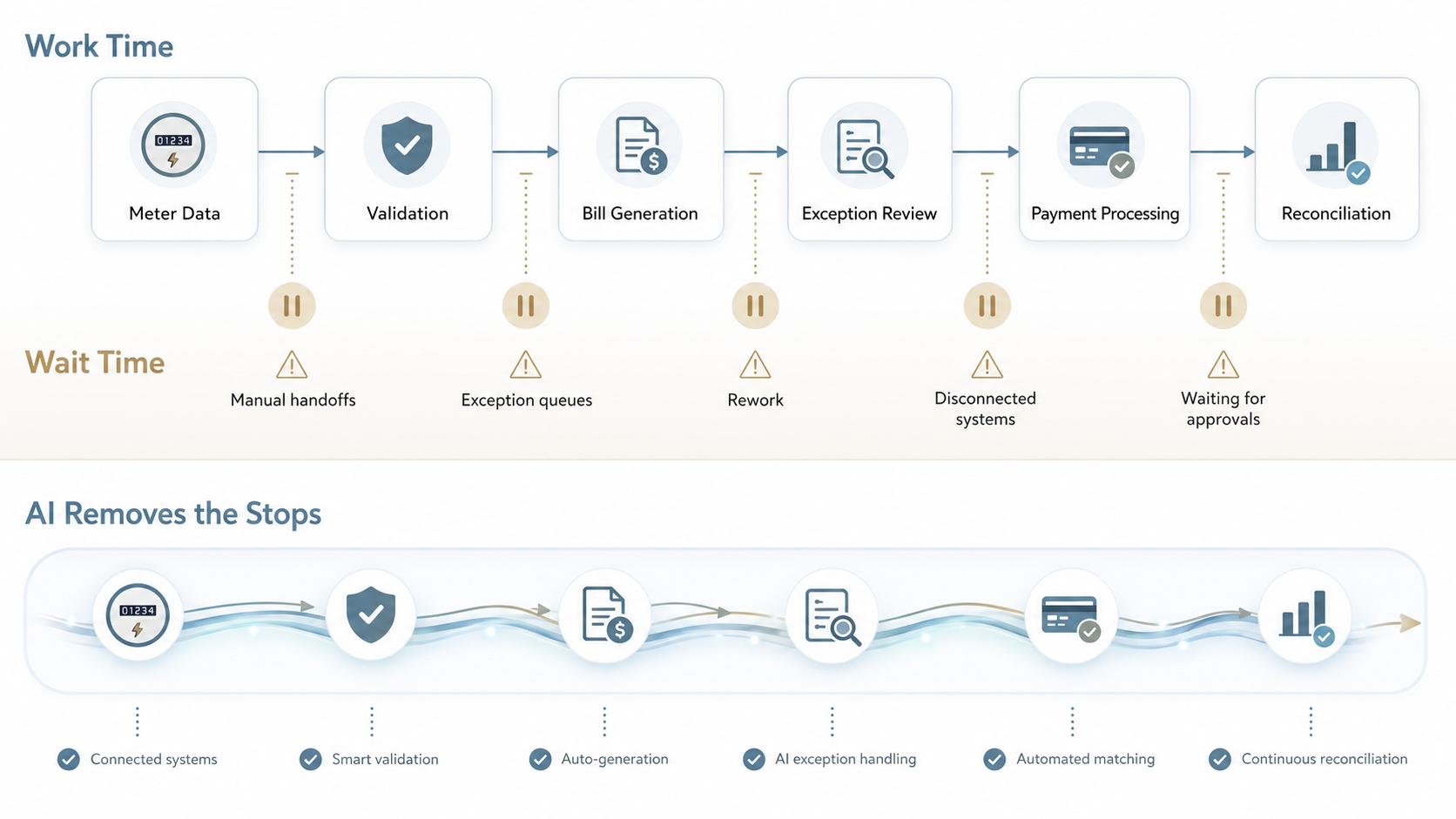
One of the largest bottlenecks has historically been manual system handoffs. Meter data, billing, payments, and reconciliation often exist across multiple disconnected processes and interfaces governed by manual notifications, creating delays and opportunities for error. AI-driven integrations reduce that friction by allowing data to move automatically across the lifecycle of billing through governed workflows. [5]
"The future of utility billing is not about making the billing cycle move faster. It is about building operations where work flows the way it was always supposed to."
Exception management is another major challenge. Traditional billing teams spend significant time reviewing routine exceptions manually because processing volume exceeds human capacity. [6] AI changes that dynamic by resolving standard exceptions automatically while escalating only the cases that truly require human judgment.
Rework from billing defects creates even more operational drag. A single billing error can trigger customer disputes, corrections, accounting adjustments, and audit reviews downstream. [7] AI-driven validation improves first-pass accuracy by identifying issues before they move deeper into the billing cycle.
The result is not simply faster billing. It is more efficient and forward-thinking operations. [8]
The utilities seeing the greatest results with AI are not starting with the most impressive automation features. [9] They are identifying where workflows break down, where delays accumulate, and where manual coordination limits scalability, then applying AI strategically to remove those constraints.

MultiBilling was built around this operational model. AI should not simply accelerate outdated workflows. It should create continuous, governed billing operations that improve accuracy, reduce friction, and allow utility teams to focus on higher-value work.
Because the future of utility billing is not about making the billing cycle move faster for the sake of speed alone.
It is about building operations where work flows the way it was always supposed to.


Schedule a personalized live demo of the new MultiBilling platform today and explore how AI-driven workflow orchestration, operational intelligence, and governed automation can transforming your utility billing operations.
Citations:
[1] - Womack, James P., and Daniel T. Jones. Lean Thinking: Banish Waste and Create Wealth in Your Corporation. Simon & Schuster, 2003.
[2] - Capgemini Research Institute – Intelligent Orchestration
Capgemini Research Institute. Redefining Enterprise Intelligence: This Is What Intelligent Orchestration Really Delivers. Capgemini, 2025.
[3] – TechRadar – AI Workflow Automation Features
Duncan, Craig. “Want to Improve ITSM Workflows and Efficiencies? Here Are the Top 5 AI Features to Look For.” TechRadar Pro, 2026.
[4] – Rother, Mike, and John Shook. Learning to See: Value Stream Mapping to Add Value and Eliminate MUDA. Lean Enterprise Institute, 2003.
[5] - Capgemini – AI Agents and Intelligent Orchestration
Capgemini. “Redefining Enterprise Intelligence: This Is What Intelligent Orchestration Really Delivers.” Capgemini, 2025.
[6] - Reddit Discussion – AI Workflow Automation ROI
“Are AI Workflow Automation Services Actually Reducing Operational Costs for Businesses in 2026?” Reddit, 21 May 2026.
[7] - Anthropic COBOL Workflow Modernization Article
Weatherbed, Jess. “‘Modernizing a COBOL System Once Required Armies of Consultants… AI Changes This.’” TechRadar Pro, 2026.
[8] - Deloitte Digital Utilities Transformation
Deloitte. Digital Utilities Transformation. Deloitte, 2025.
[9] - Reddit Discussion – AI Workflow Automation Challenges
“Are AI Workflow Automation Services Actually Reducing Operational Costs for Businesses in 2026?” Reddit, 21 May 2026.