Douglas Strickland
Utility Billing Glossary: 25 Terms Every Municipal Clerk Should Know
Utility billing has a language all its own. Between rate structures, meter data, delinquency workflows, and the software that ties it together, a municipal clerk is expected to speak fluently across accounting, operations, and customer service—often without a formal handoff or training manual.
This glossary breaks down 25 of the most important utility billing terms in plain language. Whether you are new to the billing office or training someone who is, use it as a quick reference for the concepts that come up most often in day-to-day municipal utility work.
Billing And Rate Fundamentals
1. Billing Cycle: The recurring period over which usage is measured and invoiced—commonly monthly, bi-monthly, or quarterly. Many utilities stagger customers across multiple cycles (or "cycle days") to spread meter reading and billing work evenly across the month rather than processing every account at once.
2. Rate Structure: The set of rules that determines how much a customer is charged for a service. Rate structures can be flat, tiered, seasonal, or based on customer class (residential, commercial, industrial), and they often combine several components into a single bill.
3. Base Charge: A fixed fee applied to every account regardless of how much service is used. Also called a service charge, readiness-to-serve charge, or customer charge, it helps cover the utility's fixed costs of maintaining infrastructure and account access.
4. Consumption Charge: The portion of a bill tied directly to how much a customer uses—for example, dollars per thousand gallons of water or per kilowatt-hour of electricity. Combined with the base charge, this makes up most residential utility bills.
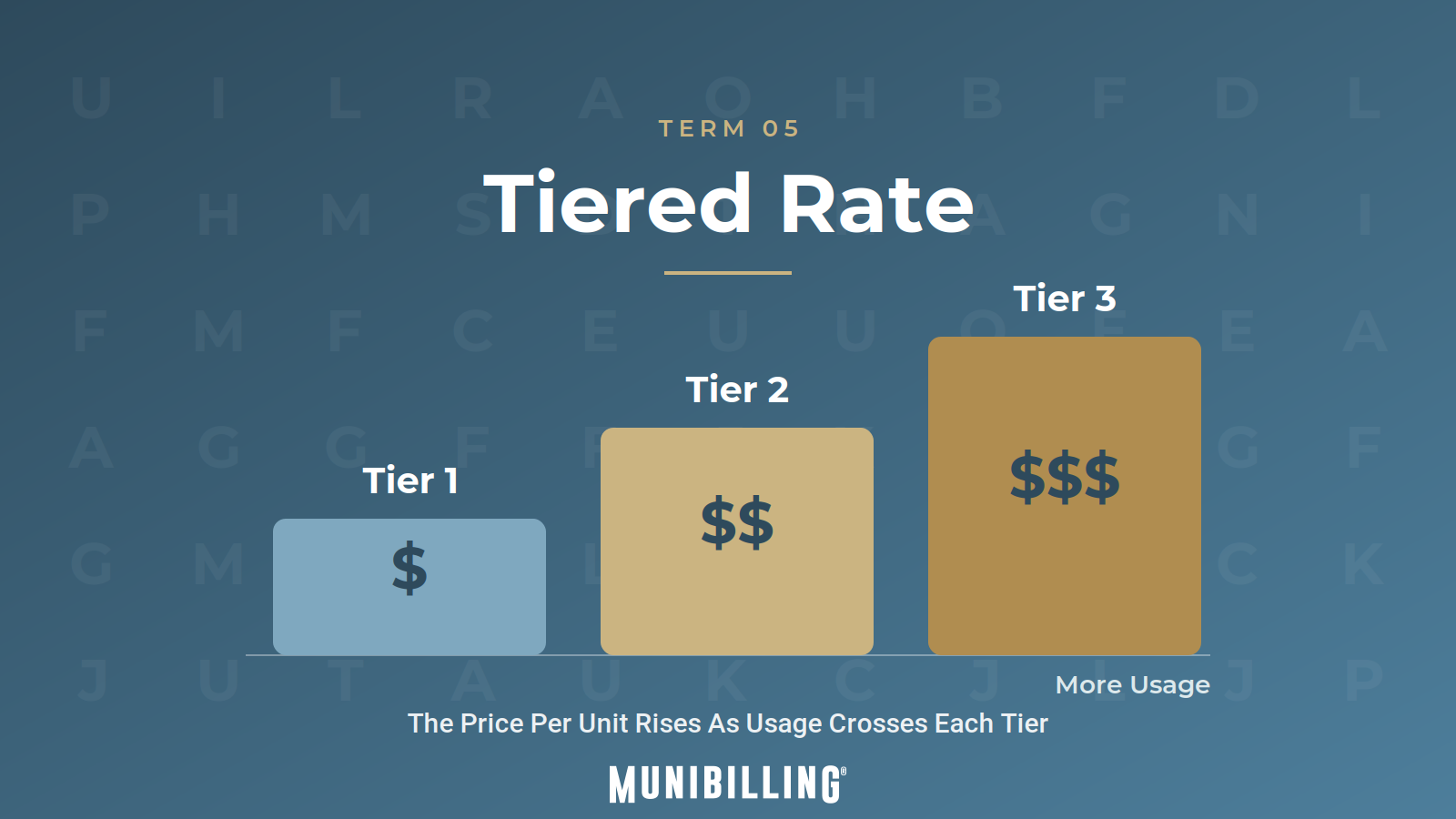
5. Tiered Rate (Block Rate): A rate structure where the price per unit changes as usage crosses defined thresholds. Increasing block rates charge more per unit at higher usage tiers to encourage conservation, while declining block rates do the opposite for high-volume users.
6. Customer Class: A grouping of accounts that share a rate structure and billing rules, such as residential, commercial, industrial, or irrigation. Assigning the correct customer class is essential for billing accuracy and rate compliance.
Metering And Usage
7. Meter Read: The recorded measurement of how much service an account has used, captured manually, by drive-by radio read, or automatically. The meter read is the starting point for nearly every usage-based charge on a bill.
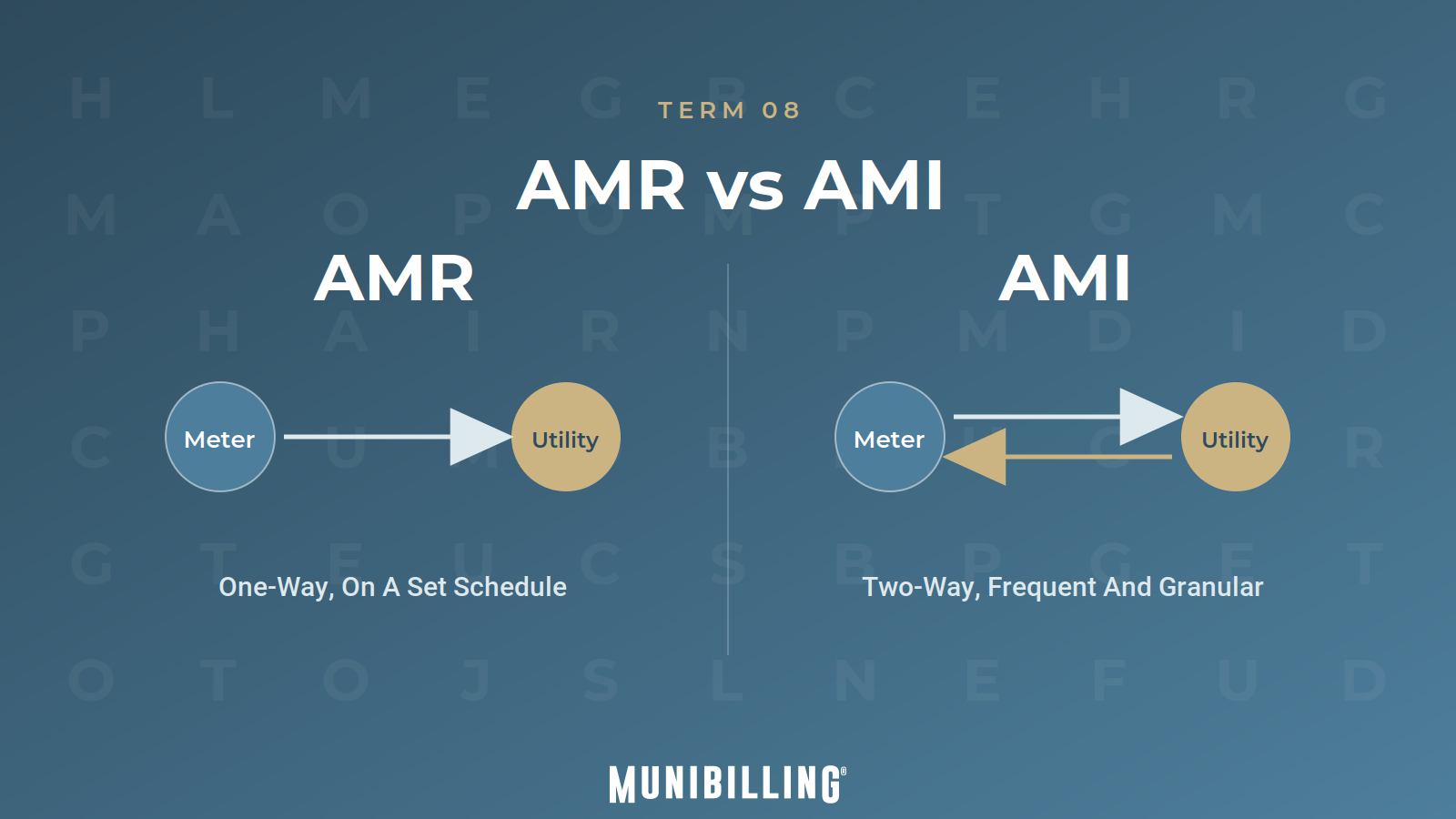
8. AMR / AMI: Automated Meter Reading (AMR) and Advanced Metering Infrastructure (AMI) are technologies that collect meter data remotely. AMR typically transmits reads one direction on a set schedule, while AMI supports two-way communication and more frequent, granular usage data.
9. Estimated Read: A usage figure calculated from historical patterns when an actual read is unavailable—due to a broken meter, access issue, or missed route. Estimates keep billing on schedule but should be trued up with an actual read as soon as possible.
10. Consumption: The total quantity of a service used during a billing period, expressed in units such as gallons, cubic feet, kilowatt-hours, or therms. Unusual consumption—unexpected spikes or drops—is often the first sign of a leak, meter fault, or data error.
11. Multiplier A factor applied to a raw meter read to calculate actual consumption, common with large commercial meters or compound metering. Getting the multiplier right is critical; a wrong one can inflate or understate a bill dramatically.

Payments And Collections
12. Accounts Receivable (AR): The total amount owed to the utility by its customers at any given time. Monitoring AR and its aging helps a municipality understand its cash position and identify collection issues before they grow.
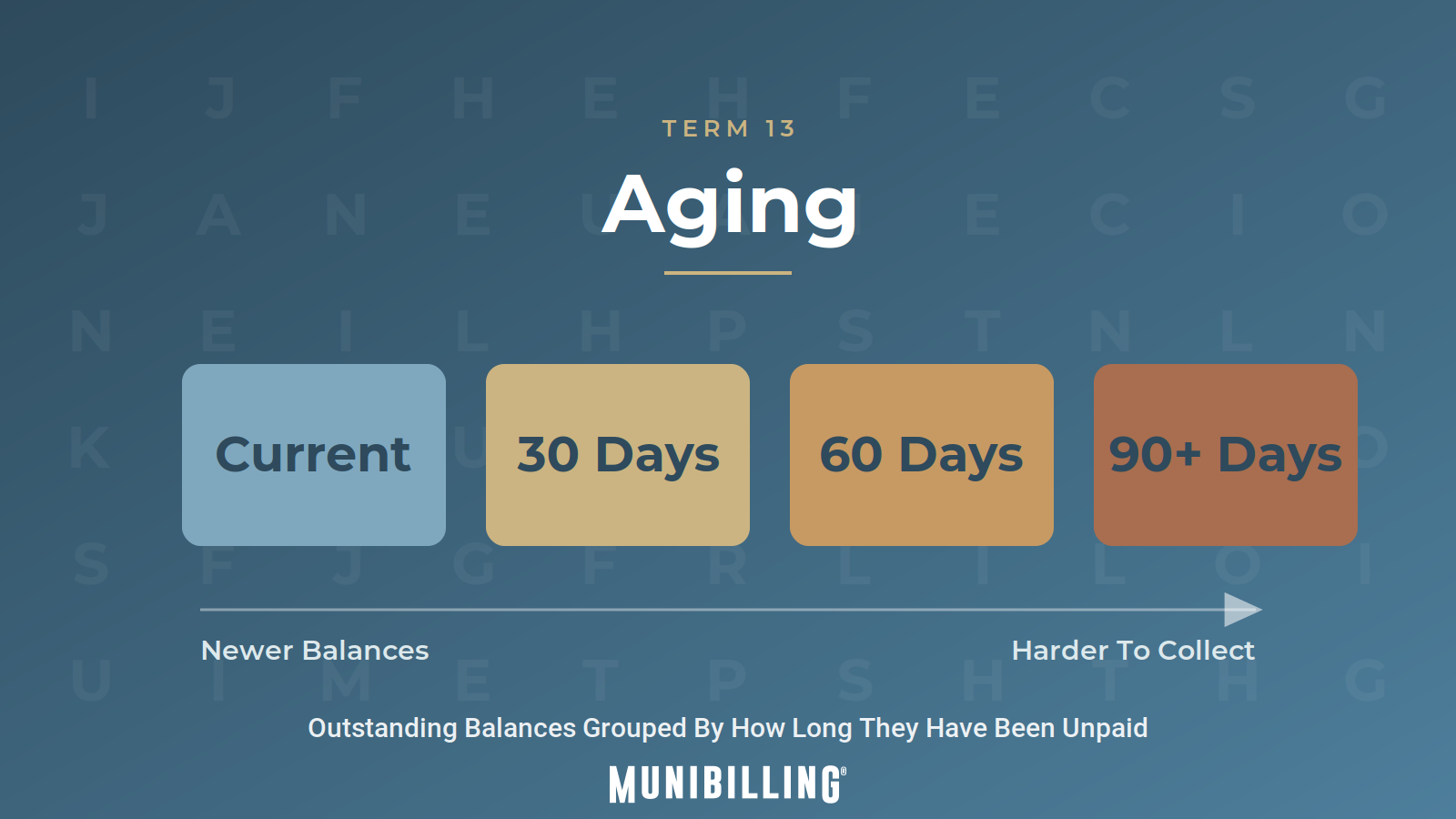
13. Aging: A report that groups outstanding balances by how long they have been unpaid—typically current, 30, 60, and 90-plus days. Aging is one of the clearest indicators of collection health across the customer base.
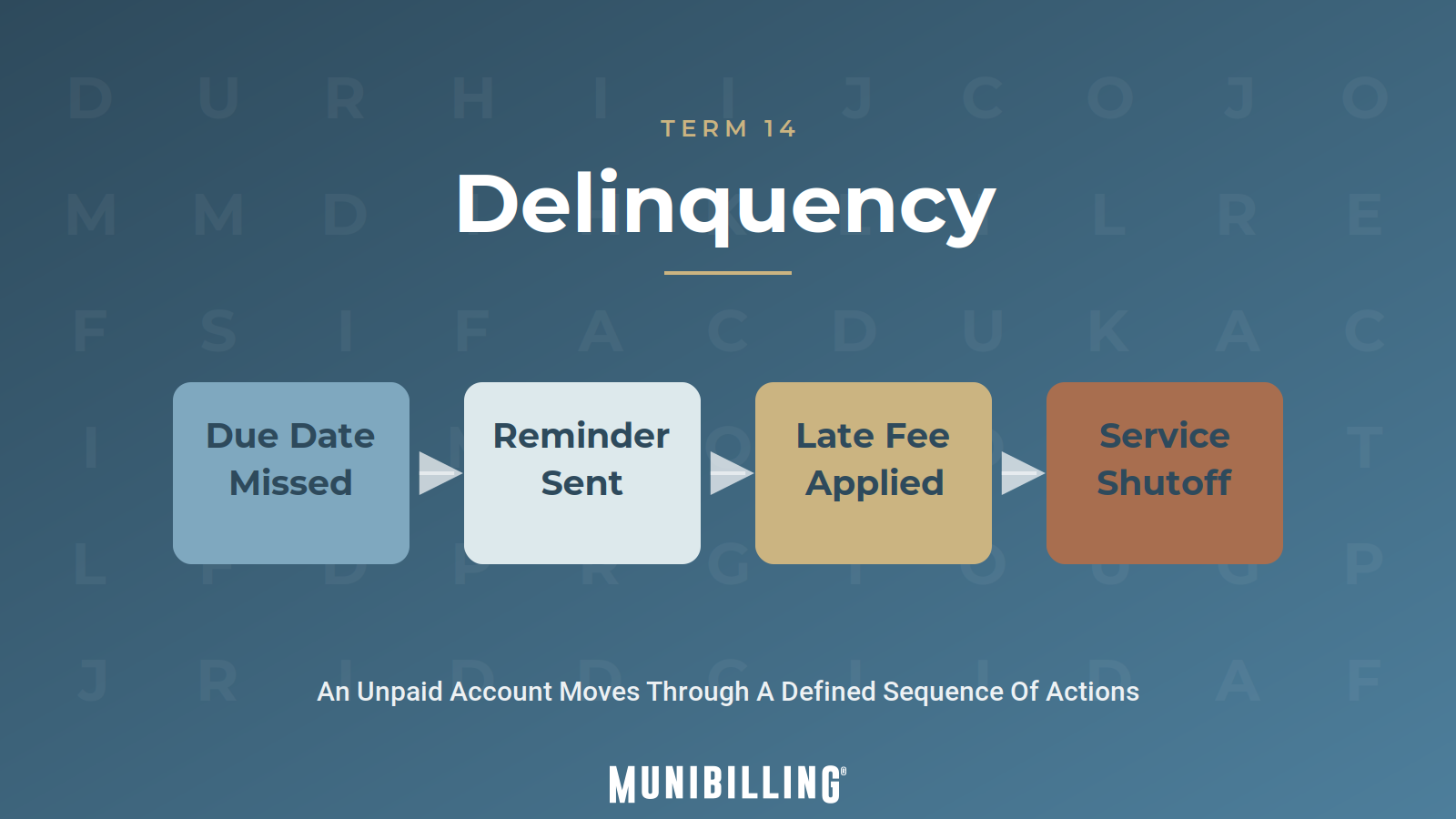
14. Delinquency: The status of an account that has not paid by its due date. Delinquency workflows often trigger a defined sequence of reminders, late fees, and eventually service actions if the balance remains unpaid.
15. Late Fee (Penalty): A charge added to an account when payment is not received by the due date, usually a flat amount or a percentage of the past-due balance. Late fee rules should follow the utility's adopted policy and any applicable state requirements.
16. Shutoff (Disconnection): The suspension of service for nonpayment, governed by local policy and state law. Because shutoffs carry legal and public-health implications, most utilities follow strict notice requirements and, increasingly, moratorium rules during certain seasons.
17. Payment Arrangement: A structured agreement that lets a customer pay a past-due balance over time while keeping service active. Well-managed arrangements reduce shutoffs and improve collections without adding manual tracking burden.
18. Autopay: A recurring payment method that automatically charges a customer's bank account or card each cycle. Autopay improves on-time payment rates and reduces the volume of manual payments the billing office handles.
Accounts And Service
19. Service Order (Work Order): A request to perform a field or account action—such as a turn-on, turn-off, meter change, or re-read. Connecting service orders to the billing system keeps account status, final bills, and field work in sync.
20. Move-In / Move-Out: The process of opening or closing an account when a customer starts or stops service at a location. High move-in and move-out volume—common in rentals and student housing—makes accurate, timely processing especially important.
21. Final Bill: The closing invoice generated when a customer moves out, reflecting usage through the move-out date and any remaining charges, deposits, or credits. Prompt final billing protects revenue and reduces uncollected balances.
22. Deposit: A refundable amount collected from certain customers to protect the utility against nonpayment. Deposit rules often vary by customer class and credit history, and deposits are typically applied or refunded when an account closes.
Systems And Reporting
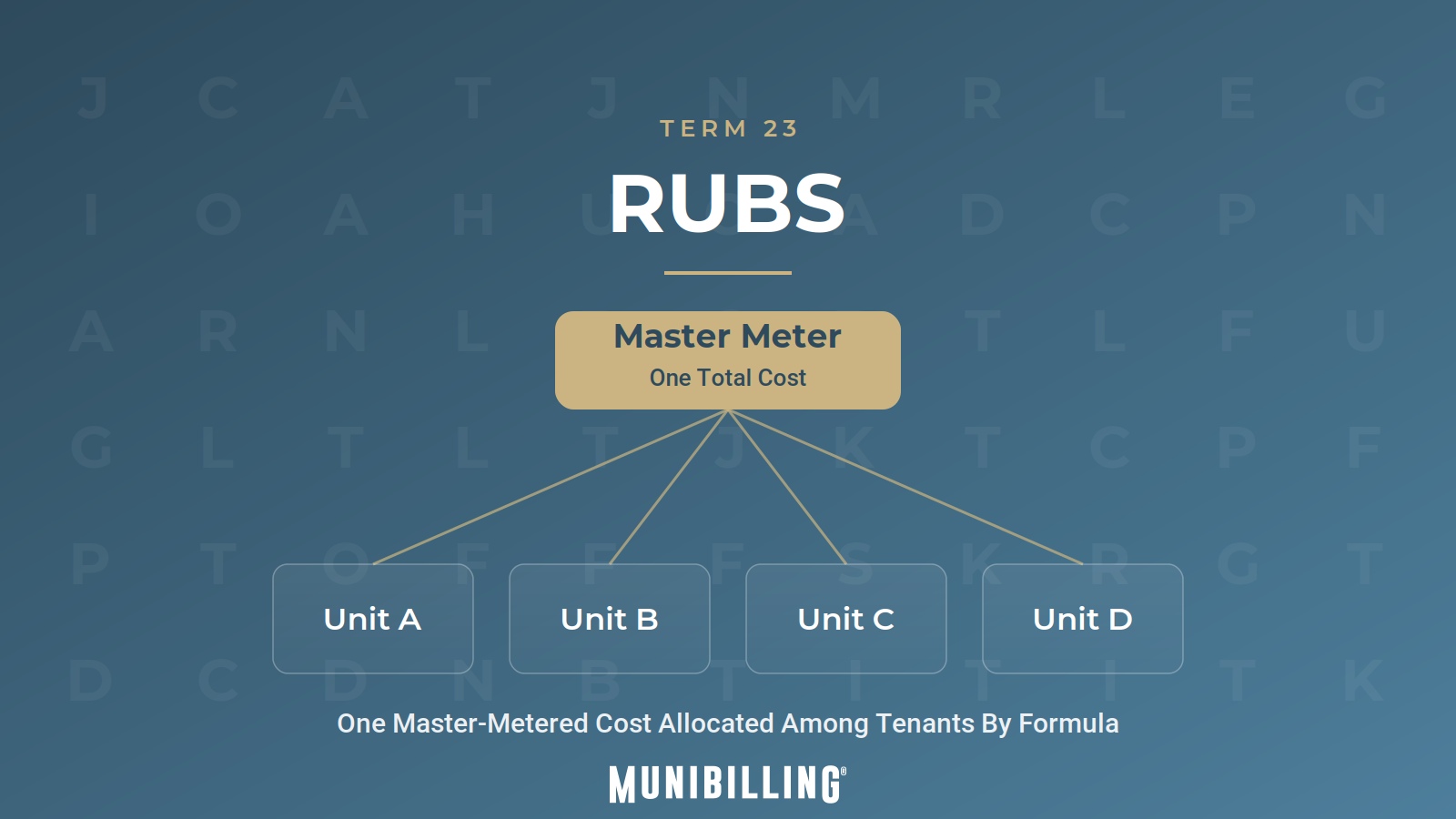
23. RUBS: Ratio Utility Billing System—a method of allocating a master-metered utility cost among tenants using a formula, such as square footage or occupancy, rather than individual meters. RUBS is common in multifamily and mobile home communities where submetering every unit is impractical.
24. Utility Billing Software: The platform used to manage rates, meter data, invoicing, payments, and reporting for utility accounts. Modern cloud-based utility billing software connects these functions and integrates with payment, customer portal, and accounting systems to reduce manual work.
25. Customer Portal: A self-service online tool where customers can view bills, check usage, make payments, and manage account details. Strong portal adoption reduces call volume, speeds collections, and gives residents the on-demand access they increasingly expect.

Keep The Glossary Handy
Utility billing sits at the intersection of accounting, operations, and customer service and the vocabulary reflects that. Clerks who are comfortable with these terms move faster, catch errors sooner, and communicate more clearly with residents, auditors, and leadership.
As billing systems modernize, many of these once-manual concepts - estimated reads, delinquency workflows, final bills, RUBS allocations are increasingly handled by connected software that reduces errors and keeps information in one place.
See how MuniBilling can help your billing office work smarter. Schedule a demo to explore modern, cloud-based utility billing built for municipalities.