
 Paul Kelly
Draw the Work Before You Delegate It
Here's what you'll learn when you read this story:
• Why mapping your workflows may be the most important step in preparing for AI adoption.
• How value stream mapping exposes the bottlenecks, handoffs, and inefficiencies that limit operational performance.
• Where hidden operational friction exists and how AI can help eliminate it.
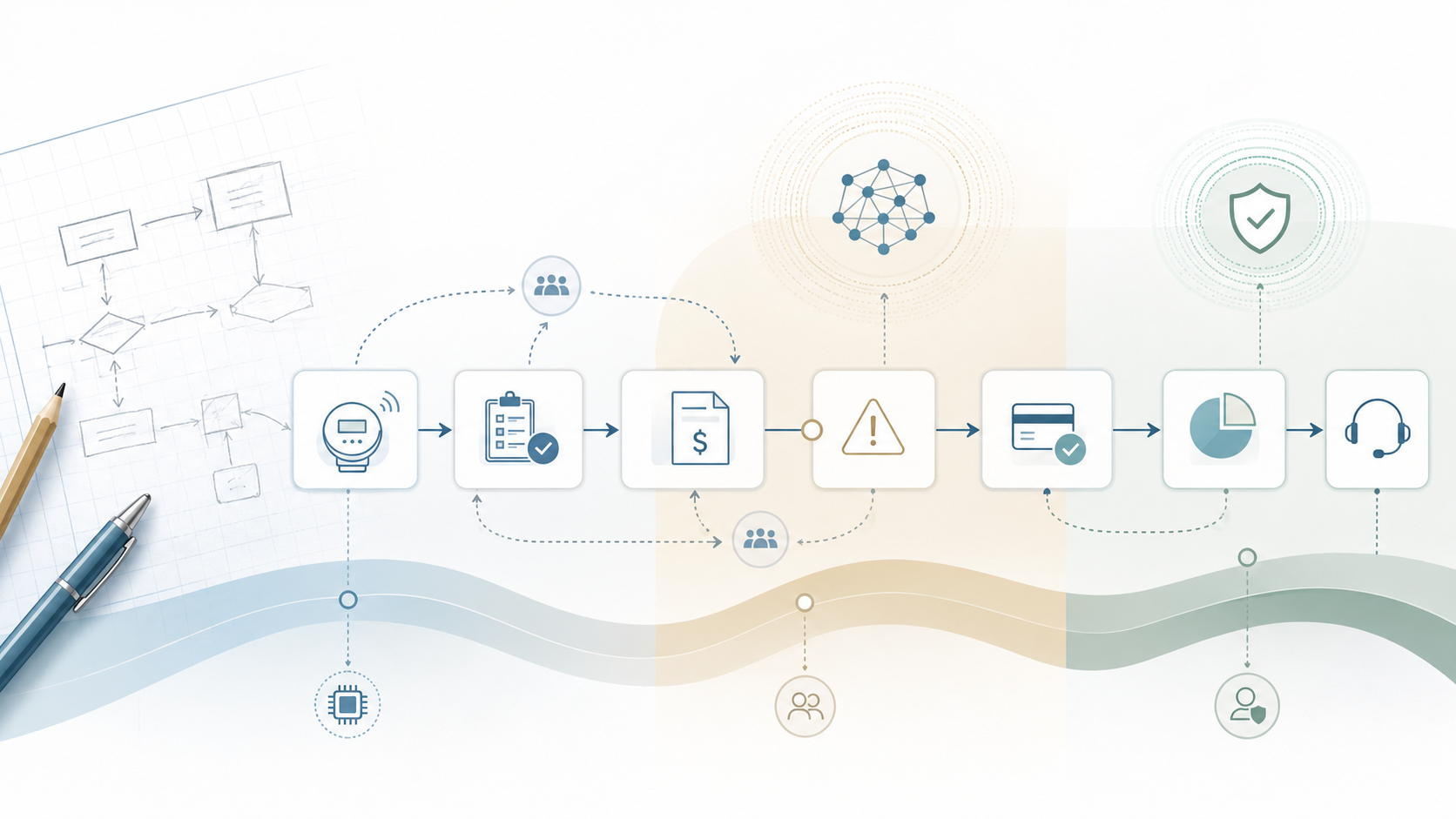
Before a utility deploys AI, automates workflows, or invests in new operational platforms, there is one exercise that creates more long-term value than any software demonstration or vendor presentation: draw the work.
Not summarize it. Not describe it at a high level. Map it visually - every step, every handoff, every decision point, every place where information moves between people or systems. In Lean Six Sigma, this is called value stream mapping. [1] In the AI era, it has become the foundation for successful AI deployment.
One of the biggest mistakes organizations make is trying to automate workflows they have never fully documented. AI cannot reliably execute processes that exist only through institutional knowledge, unwritten workarounds, or informal decision-making. [2] Before AI can improve a billing operation, the operation itself must be defined clearly enough to be repeatable, measurable, and governed.
That is what a value stream map accomplishes.

A value stream map captures how work actually flows through a utility billing operation from meter data collection and validation to bill generation, exception handling, payment processing, reconciliation, and customer support. More importantly, it reveals where operational friction truly exists.
In many utility environments, leadership assumes delays occur within the visible stages of the billing cycle. But when workflows are mapped in detail, the largest inefficiencies often appear elsewhere: exception queues waiting for manual review, reconciliation bottlenecks, disconnected systems requiring re-entry, and employees spending valuable time assembling information instead of making decisions.
These are precisely the types of operational gaps AI is best positioned to address.
Every workflow step can be evaluated through three categories that define how AI should interact with the process.
The first is delegation - work AI can execute fully within defined rules and measurable quality standards. Tasks like data validation, payment application, standard exception classification, and routine billing verification often fall into this category. These are high-volume, rules-based processes where AI improves both speed and consistency while maintaining full auditability.

The second is augmentation - workflows where AI assembles context, surfaces recommendations, and accelerates human decision-making, while employees retain final authority. Complex billing exceptions, payment arrangements, customer disputes, and account reviews often fit here. In these situations, AI reduces administrative burden so staff can focus on decision quality rather than information gathering.
The third is protection - work where human interaction itself remains essential. Sensitive customer conversations, regulatory escalations, policy exceptions, and high-trust situations require empathy, judgment, and accountability that should remain human-led. [3] AI supports these workflows with context and information, but the relationship stays with the employee.
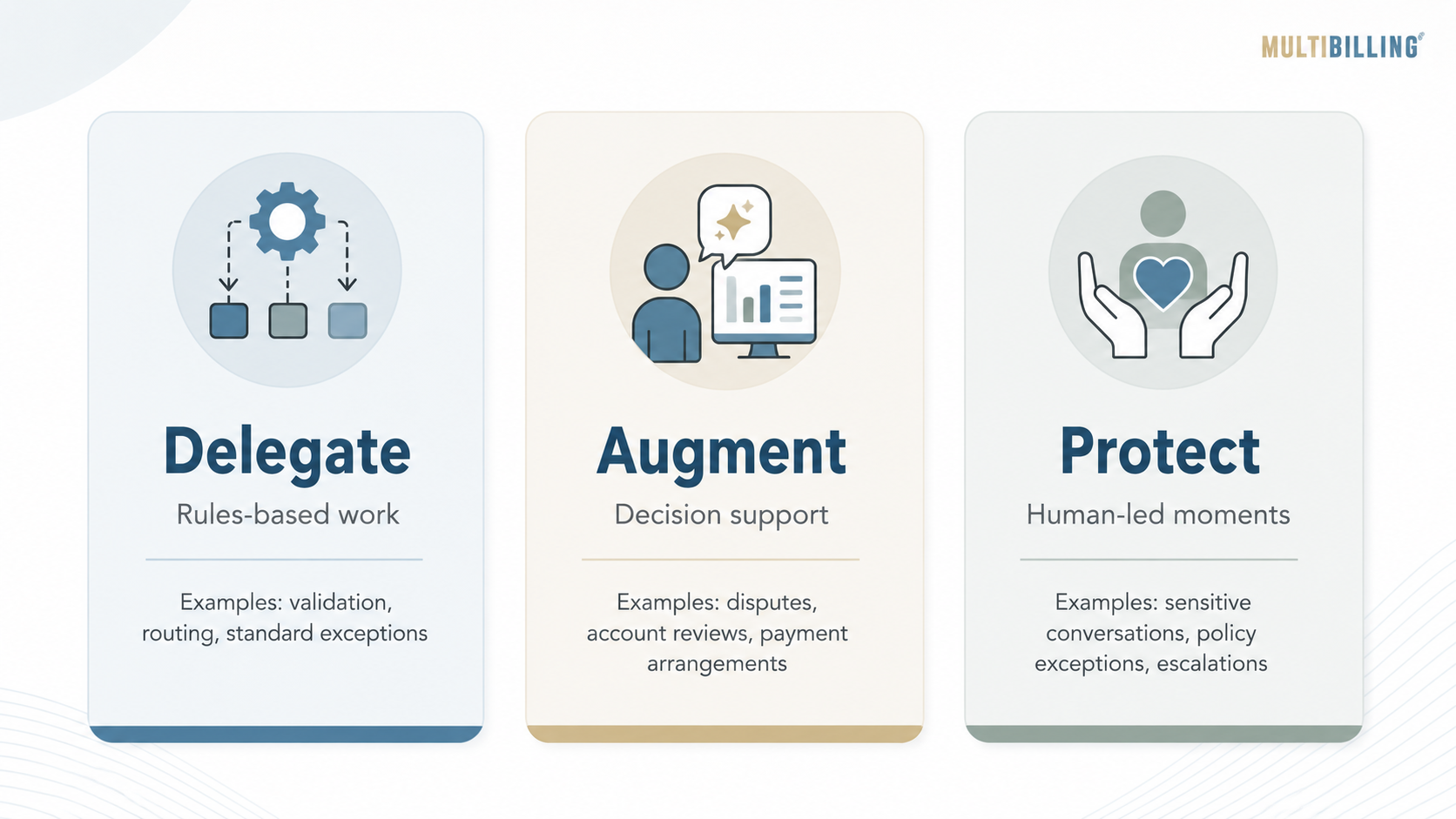
This framework shifts AI strategy away from simple automation and toward operational design.
The utilities seeing the greatest success with AI are not asking, “How much work can we replace?” They are asking, “Where can AI improve quality, reduce friction, and allow our teams to focus where human expertise matters most?”
That distinction separates tactical automation from true operational modernization.
"Before work can be delegated to AI, it first has to be understood clearly enough to be drawn."
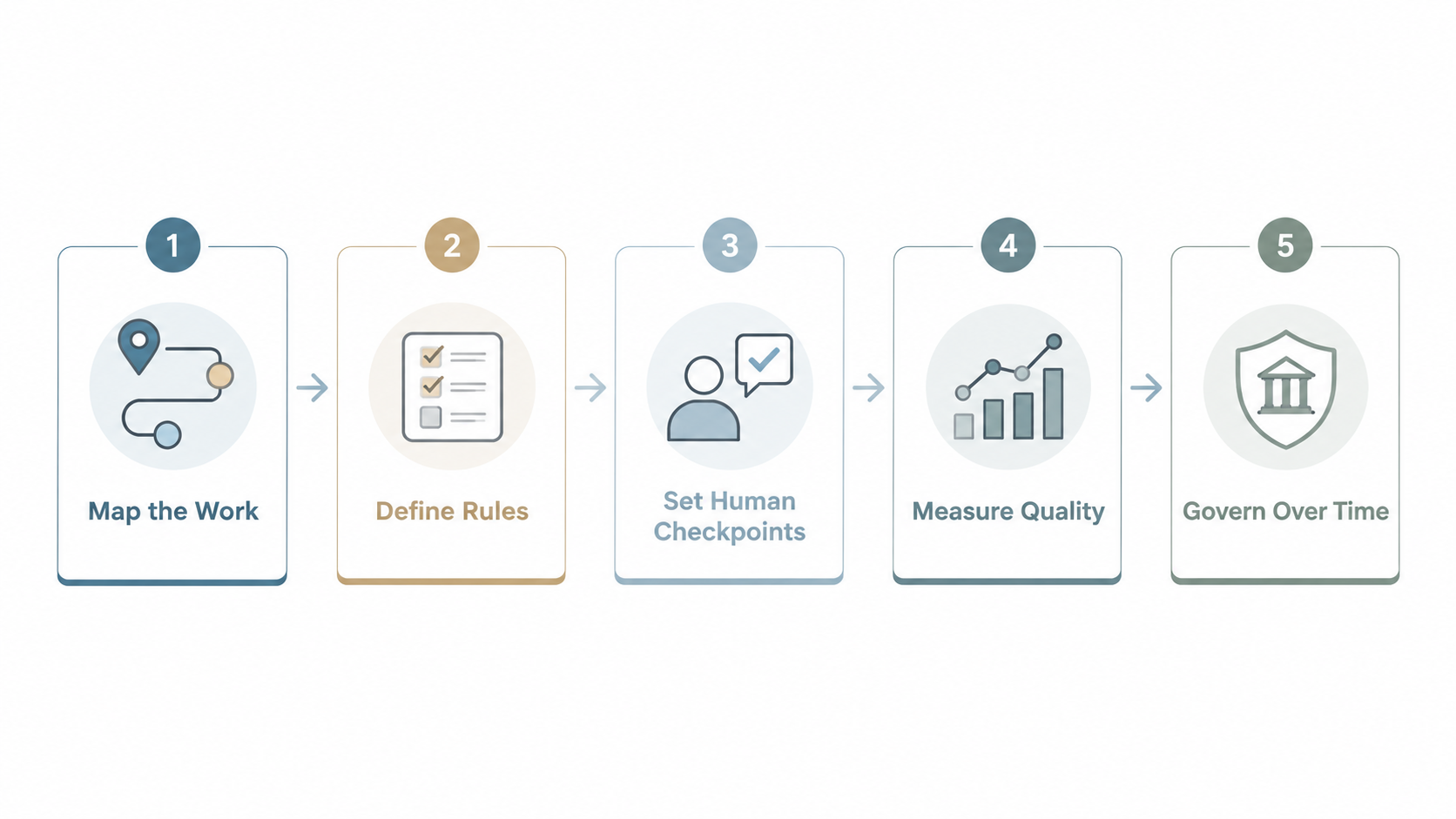
Once workflows are mapped clearly, organizations can begin building AI runbooks - structured operational instructions that define what AI handles, when humans intervene, how quality is measured, and how workflows are governed over time. This is where Lean principles, operational governance, and AI deployment begin to converge. [4]
MultiBilling was designed around this operational philosophy. As an AI-native utility billing platform, the focus is not simply automating tasks, but helping utilities create scalable, governed, and measurable operations that can evolve alongside AI.
Utilities investing in this level of operational clarity are building far more than efficiency improvements. They are creating billing operations that are more resilient, scalable, auditable, and adaptable to future technological change.
Because before work can be delegated to AI, it first has to be understood clearly enough to be drawn.
And in the future of utility billing, that operational visibility may become one of the industry’s most valuable competitive advantages.


Schedule a personalized live demo of the new MultiBilling platform today and explore how AI-driven workflow orchestration, operational intelligence, and governed automation can transform your utility billing operations.
Citations:
[1] - National Institute of Standards and Technology (NIST). Artificial Intelligence Risk Management Framework (AI RMF 1.0). U.S. Department of Commerce, 2023. https://www.nist.gov/itl/ai-risk-management-framework
[2] - Lean Enterprise Institute. Value Stream Mapping Overview. https://www.lean.org/lexicon/value-stream-mapping
[3] - Deloitte. Human-Centered AI and “Human-in-the-Loop” Decision-Making in AI Systems. Deloitte Insights, 2024. https://www2.deloitte.com/insights
[4] - McKinsey & Company. The State of AI: Operational Models and Scaling AI in Enterprises. McKinsey Global Institute, 2023. https://www.mckinsey.com/capabilities/quantumblack/our-insights