
 Larry Foster
The Department That Feels It First
Here's what you'll learn when you read this story:
• See why successful AI adoption is not about deploying AI everywhere, but applying it where it creates the greatest impact.
• Understand how AI-native operations are changing the roles of utility professionals across every department.
• Explore why AI governance, workflow design, and operational strategy matter more than automation alone.
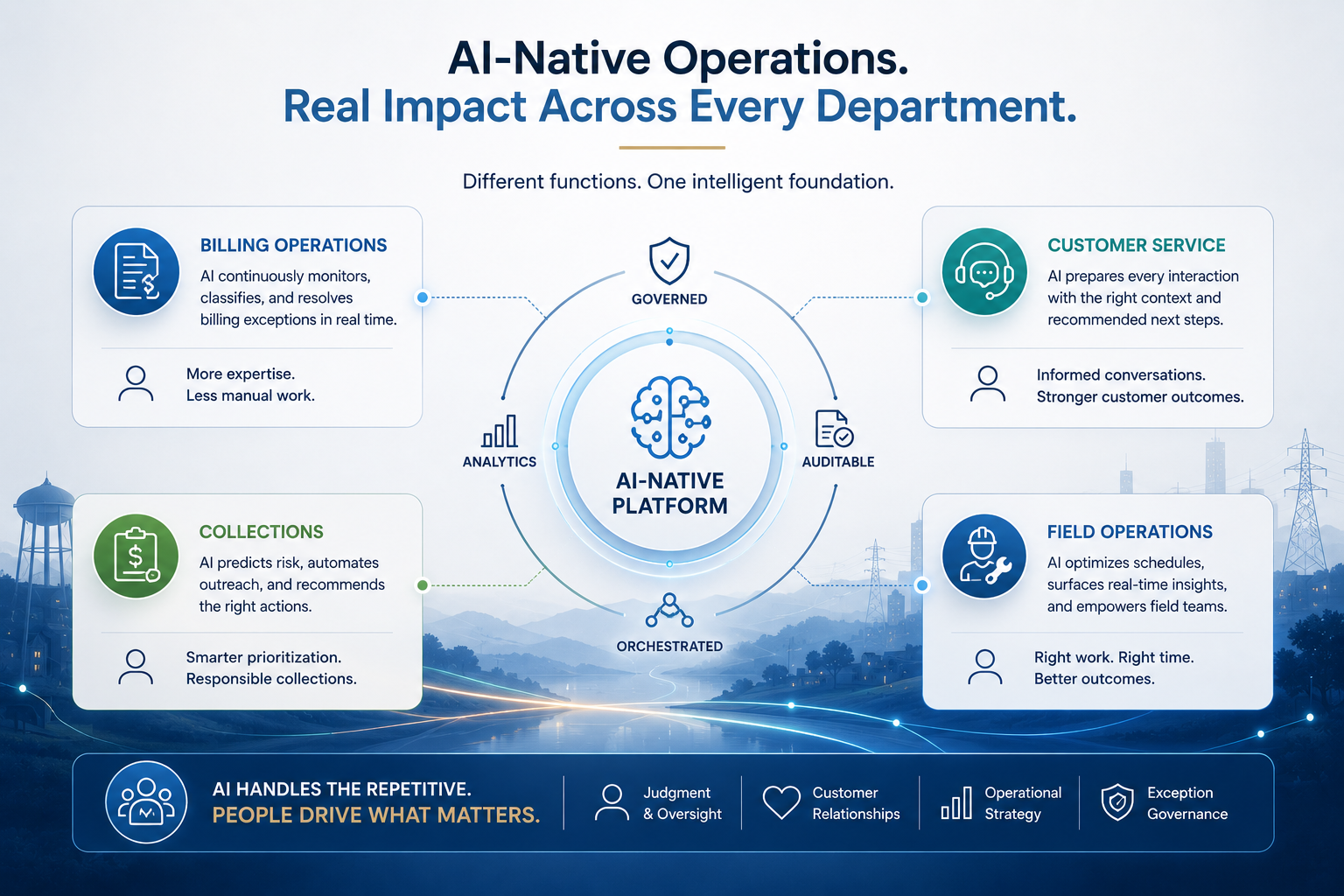
The Fifth Industrial Revolution is not transforming every utility billing department in the same way or at the same pace. Billing operations, customer service, collections, and field operations each face different operational pressures, different opportunities for automation, and different governance requirements. The organizations that lead this transition will not be the ones that deploy AI everywhere at once. They will be the ones that understand where AI creates the most immediate operational value, where human expertise remains essential, and how to design governance structures that make AI trustworthy from the start.
At MuniBilling, we see this transformation already taking shape across modern utility operations. The departments experiencing the fastest gains are the ones with structured workflows, high transaction volume, and repetitive operational decision-making. Billing Operations is the clearest example. Billing workflows generate large volumes of predictable, rules-based activity that AI can analyze, classify, and coordinate in real time. Instead of specialists manually reviewing long exception queues after overnight processing, AI-native operations continuously monitor billing activity, classify anomalies instantly, resolve high-confidence issues automatically, and escalate only the truly ambiguous cases for human review. Billing teams spend less time gathering information and more time applying expertise where judgment actually matters. [1]
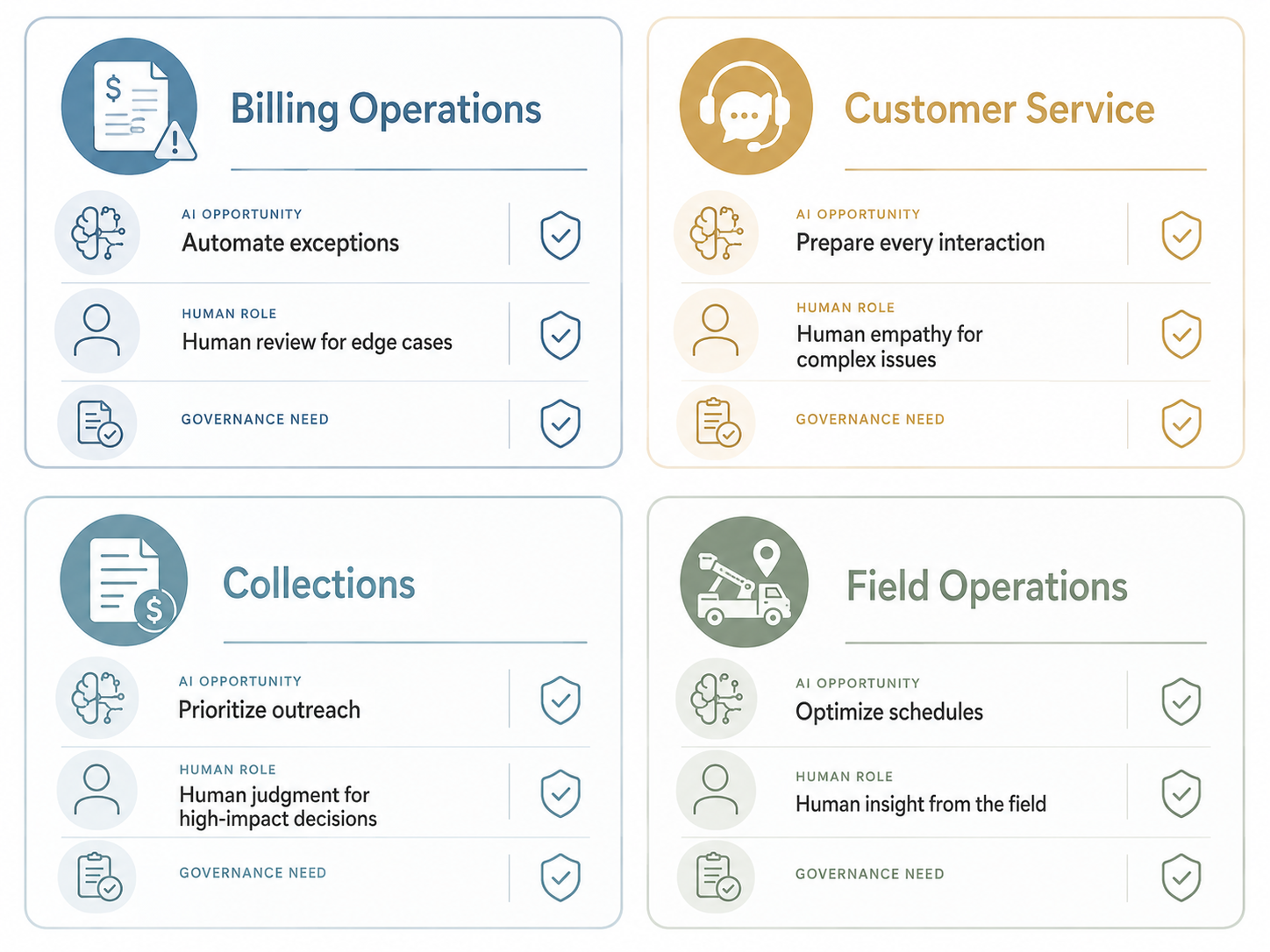
This shift changes the role of billing professionals from exception processors into operational governors. Specialists oversee workflow performance, validate edge cases, and manage continuous improvement while AI handles the repetitive coordination of work at scale. MultiBilling was built specifically to support this operational model with embedded auditability, AI governance, workflow orchestration, and real-time analytics integrated directly into the platform architecture. [2]
"The organizations that lead this transition will be the ones that understand where AI creates the most immediate operational value."
Customer Service is evolving differently because its most valuable work has always been deeply human. The goal of AI in customer service is not to replace representatives. It is to prepare them. AI-native customer service operations assemble account history, billing context, consumption trends, prior interactions, and recommended resolution paths before the conversation begins. Representatives enter each interaction informed instead of reactive. Routine requests can be handled through automated self-service channels, while human representatives focus on the conversations that require empathy, judgment, reassurance, and problem-solving.
For utilities, this distinction matters enormously. Customers rarely remember a routine balance inquiry. They remember the moments when something went wrong and how the organization responded. MultiBilling’s AI-driven operational model helps utilities reduce handle times, improve first-contact resolution rates, and elevate the quality of customer interactions without removing the human presence customers depend on during complex or sensitive situations. [3]

Collections operations represent another area where AI can create substantial operational improvements, but only when governance and human oversight remain central to the process. Predictive analytics can identify delinquency risk earlier, automate reminders, recommend payment arrangements, and prioritize outreach based on account behavior patterns. However, utility collections cannot operate as purely automated financial workflows. Every delinquency portfolio contains customers experiencing very different circumstances, and responsible utility operations require human judgment for the decisions that carry meaningful customer impact.
That is why MultiBilling’s approach to AI governance is foundational rather than optional. Automated workflows operate within clearly defined approval boundaries, role-based permissions, and audit-controlled escalation paths. AI can improve consistency, accelerate response times, and reduce administrative burden, while human oversight remains embedded at the moments where accountability and judgment matter most. [4]
Field Operations may experience the most underestimated transformation of all. Advanced metering infrastructure reduced much of the routine work historically associated with meter reading, but it also created entirely new opportunities for operational intelligence. AI-native field operations are no longer driven solely by static work orders or scheduled reads. They are driven by real-time operational insight.

With AI-assisted scheduling, technicians receive optimized routing based on geography, asset conditions, anomaly severity, and service priorities. Mobile workflows provide full account and infrastructure context before arrival. Observations captured in the field immediately feed maintenance analytics, anomaly detection systems, and operational planning models. Field teams become a continuous intelligence layer for the utility rather than a disconnected operational function.
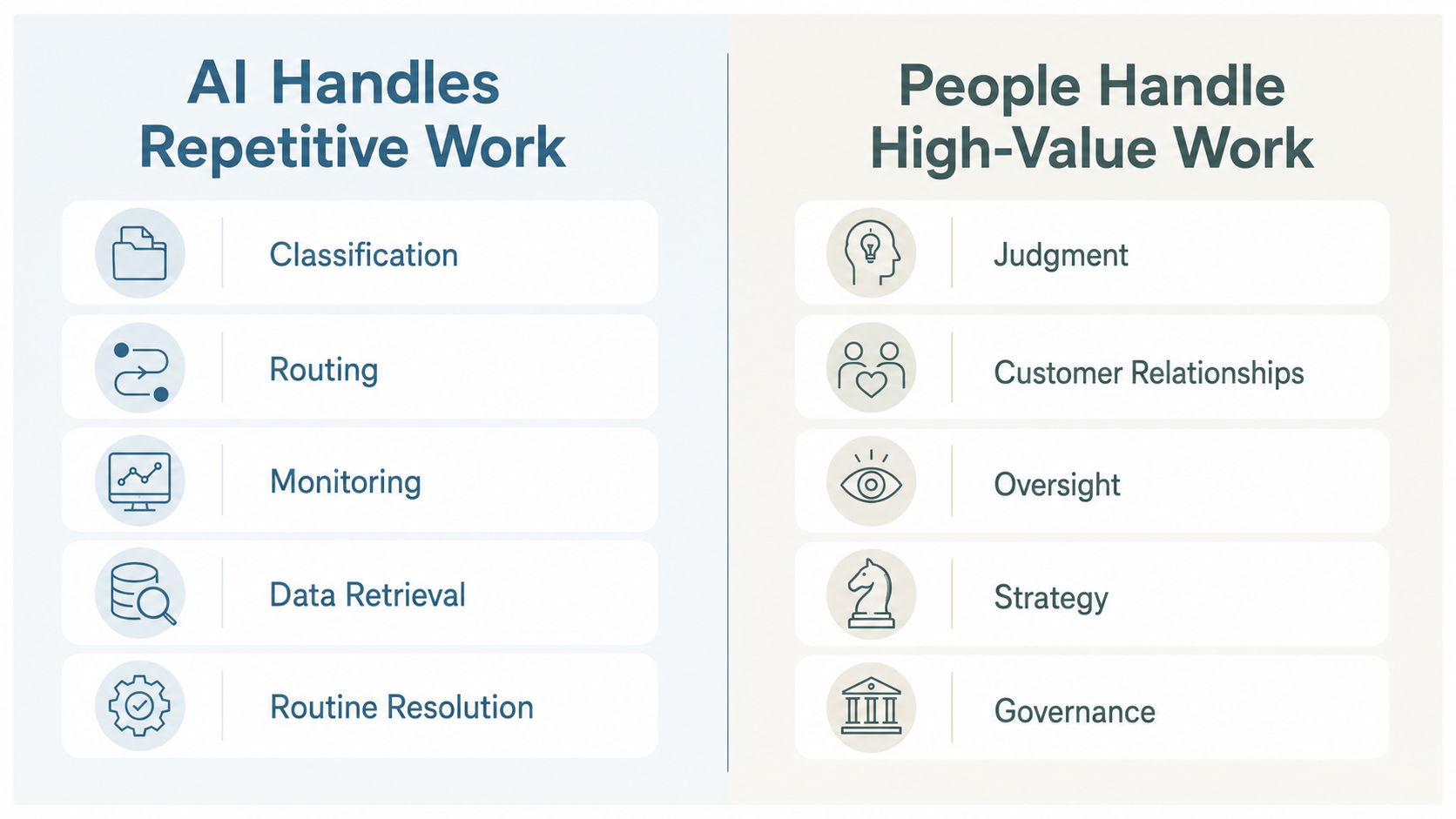
Across every department, the pattern is consistent. AI absorbs repetitive coordination, retrieval, and translation work. Human teams focus on judgment, oversight, customer relationships, operational strategy, and exception governance. The role of the utility professional does not disappear. It evolves upward. [5]
This is where the difference between AI-native architecture and legacy software becomes impossible to ignore. Legacy systems treat AI as an add-on feature layered onto workflows that were designed decades before AI existed. MultiBilling was designed differently. AI governance, workflow orchestration, auditability, analytics, and operational intelligence were built into the foundation from the beginning because the future of utility billing will not be defined by isolated AI features. It will be defined by operational systems designed around AI as a core capability.
The utilities that recognize this shift early will not simply become more efficient. They will become more responsive, more scalable, more proactive, and more trusted by the communities they serve.


Schedule a personalized live demo of the new MultiBilling platform today and explore how AI-driven workflow orchestration, operational intelligence, and governed automation can transforming your utility billing operations.
Citations:
[1] Shaping the Future with AI and Enterprise Transformation.” Infosys, https://www.infosys.com/industries/retail/insights/shaping-future-ai-enterprise-transformation.html
[2] Gartner Survey Finds Artificial Intelligence Will Touch All Information Technology Work by 2030.” Gartner Newsroom, 2025,
https://www.gartner.com/en/newsroom/press-releases/2025-11-10-gartner-survey-finds-artificial-intelligence-will-touch-all-information-technology-work-by-2030
[3] PwC. Experience Is Everything: Here’s How to Get It Right. PwC Consumer Intelligence Series, 2024.
https://www.pwc.com/ng/en/assets/pdf/experience-is-everything.pdf
[4] Putrus, Robert. “Responsible AI: From Emerging Technology to Executive Governance Imperative.” ISACA, 2026
https://www.isaca.org/resources/news-and-trends/isaca-now-blog/2026/responsible-ai-from-emerging-technology-to-executive-governance-imperative
[5] International Labour Organization. Generative AI and Job Transformation. ILO Research Brief, 2025.
https://www.ilo.org/publications/generative-ai-and-jobs-2025-update