
 Paul Kelly
The Job That Gets Better When AI Gets Better
Here's what you'll learn when you read this story:
• How AI is reshaping utility billing by automating routine tasks while elevating the strategic value of human expertise.
• Why leading utilities are redefining roles around governance, insight interpretation, and continuous operational improvement.
• How emerging skills and new career paths are forming as billing operations become more intelligent and automated.
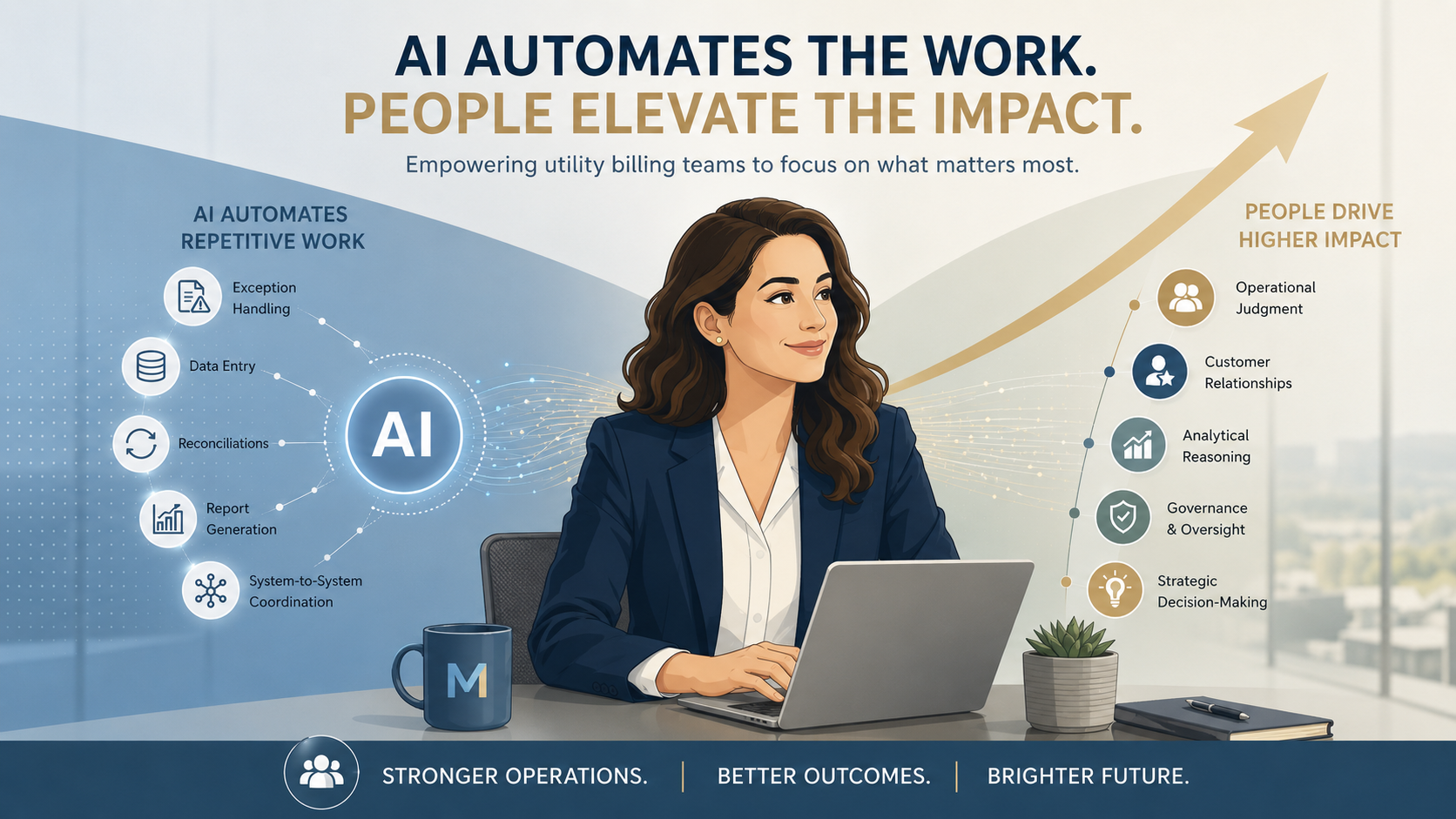
Artificial intelligence is transforming utility billing operations, but the biggest change is not the elimination of people. It is the elevation of people. The repetitive work that once consumed billing teams: manual exception handling, data entry, reconciliations, report generation, and system-to-system coordination are increasingly being automated by AI-native platforms. What grows in value instead are the uniquely human skills that AI cannot replace: operational judgment, customer relationship management, analytical reasoning, governance, and strategic decision-making. [1]
The utility organizations leading this transition are not treating workforce change as a disruption to survive. They are treating it as a competitive advantage to build. As AI handles more execution-level tasks, billing professionals are gaining the opportunity to focus on higher-value operational work that improves customer experience, strengthens revenue assurance, and drives continuous process improvement. [2]

This shift is already reshaping the modern utility billing role. The most valuable professionals in AI-augmented operations are not simply the ones who know how to use new software. They are the people who understand how billing operations function deeply enough to guide, govern, and improve AI-driven workflows over time.
That requires a new combination of operational and analytical skills.
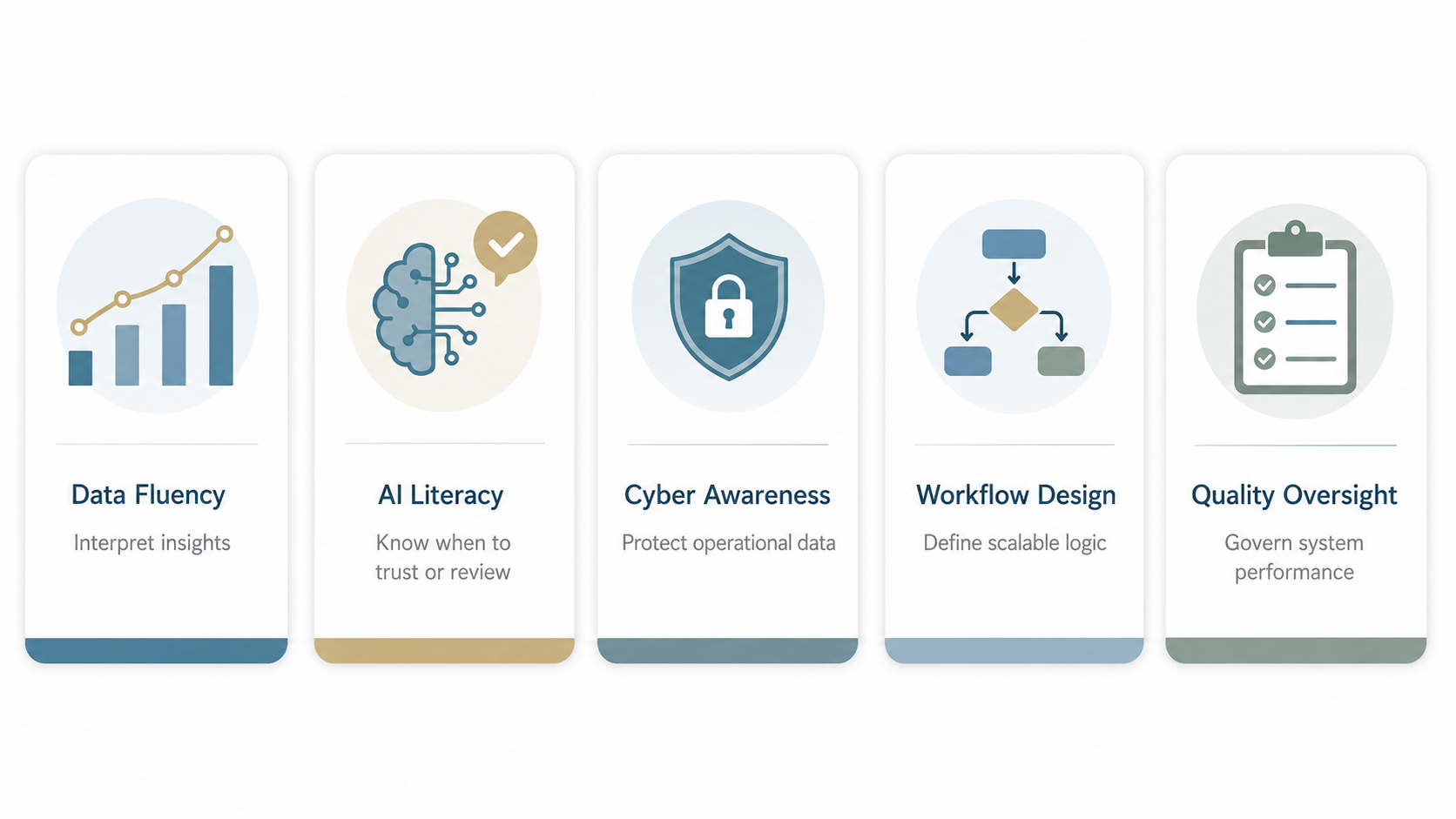
Data fluency has become essential. Modern billing professionals must be able to interpret AI-generated insights, identify meaningful trends, recognize anomalies, and determine which signals require action. AI can surface patterns, but human expertise determines which patterns matter and what operational response should follow.
AI literacy is equally important. Effective organizations understand that AI should not operate without oversight, but it also should not be ignored. The strongest billing teams know when to trust automation, when to investigate further, and when human intervention is necessary. [3] This balance between automation and governance is what creates trustworthy AI operations rather than simply faster ones.
Cybersecurity awareness is now operationally critical as well. AI-native billing environments depend on secure, reliable data. Every employee interacting with billing systems plays a role in protecting account information, workflow integrity, and customer trust. Strong cyber hygiene is no longer only an IT responsibility. It is part of modern operational discipline.
“The biggest change AI brings to utility billing is not the elimination of people. It is the elevation of people.”
Another emerging skill is workflow automation design. The future of utility billing depends on professionals who can clearly define operational logic, document workflows, and translate institutional knowledge into scalable automation processes. The organizations moving fastest with AI are the ones capturing operational expertise and converting it into governed, repeatable systems.

Quality oversight also evolves in the AI era. Instead of reviewing every individual transaction manually, billing professionals increasingly govern system-level performance. The focus shifts from processing work to ensuring that AI-driven decisions remain accurate, consistent, compliant, and aligned with operational standards.
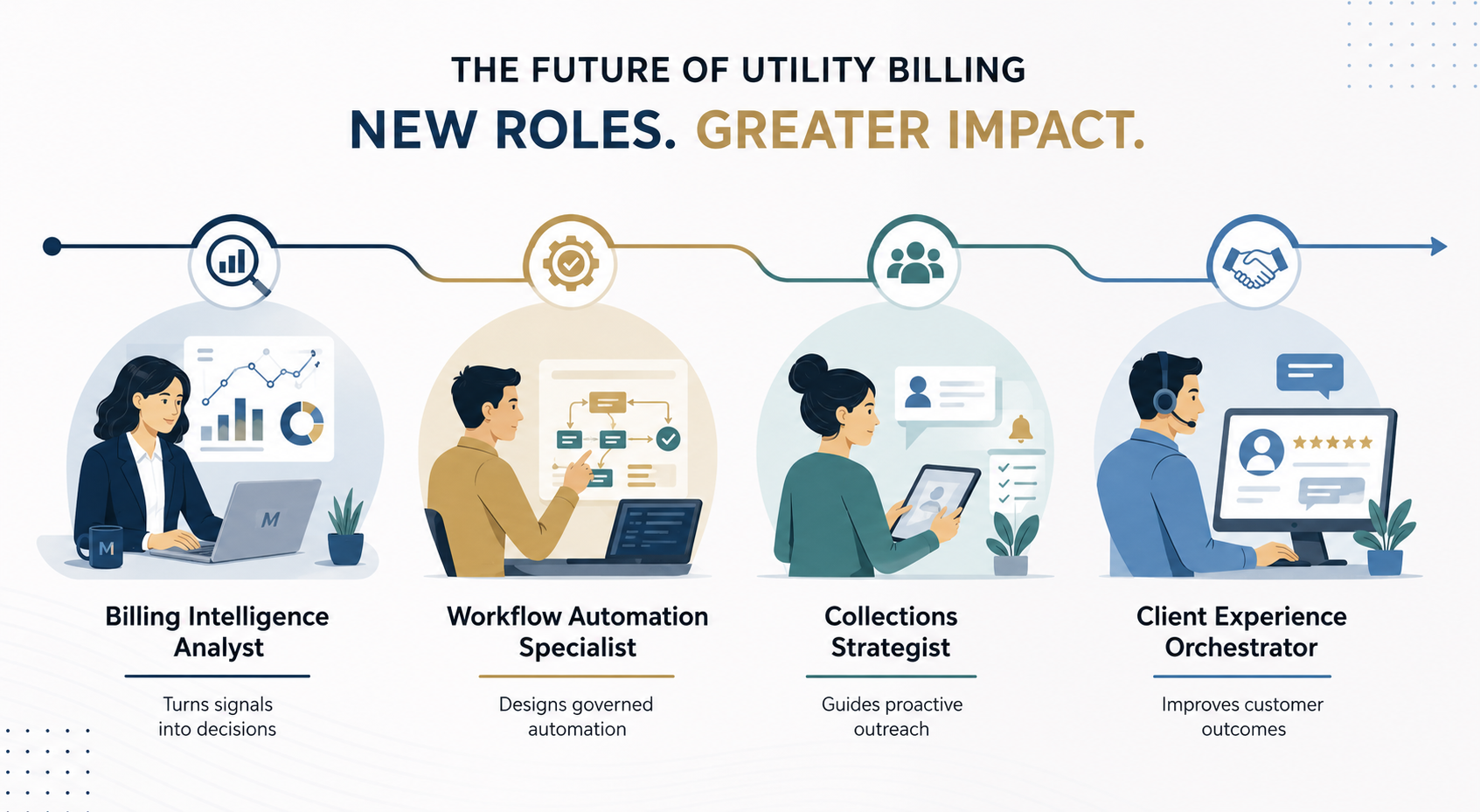
These changes are creating entirely new career paths across the utility billing industry. Roles such as Billing Intelligence Analyst, Workflow Automation Specialist, Collections Strategist, and Client Experience Orchestrator are emerging as organizations modernize operations with AI-native platforms. [4] These are not technology-only roles. They combine operational expertise, analytical thinking, governance, and customer strategy.
This is where the future of utility billing is being built.
The organizations creating the strongest long-term advantage are investing in people and technology simultaneously. They are building teams capable of governing AI systems, improving workflows continuously, and turning operational intelligence into better outcomes for utilities and customers alike.
MultiBilling was designed for this future. As an AI-native utility billing platform, MultiBilling helps utilities automate repetitive operational work while strengthening the human expertise that drives long-term success. The goal is not to remove people from the billing process. It is to allow skilled professionals to spend more time on the decisions, relationships, and operational improvements where human judgment creates the greatest value.
The future of utility billing will belong to organizations that combine AI capability with operational expertise. Technology may accelerate the work, but people who understand the work will continue to define where the industry goes next.


Schedule a personalized live demo of the new MultiBilling platform today and explore how AI-driven workflow orchestration, operational intelligence, and governed automation can transforming your utility billing operations.
Citations:
[1] McKinsey Global Institute. The State of AI: How Organizations Are Rewiring to Capture Value. McKinsey & Company, 2024.
[2] World Economic Forum. The Future of Jobs Report 2025. World Economic Forum, 2025.
[3] National Institute of Standards and Technology. Artificial Intelligence Risk Management Framework (AI RMF 1.0). U.S. Department of Commerce, 2023.
[4] World Economic Forum. The Future of Jobs Report 2025. World Economic Forum, 2025.