
 Jai Lewis
Why Integrated Utility Billing Software Matters
Disconnected utility systems create friction at every step of the customer relationship. When payments, service changes, and account management live in separate tools, staff spend their time reconciling data instead of serving customers. Integrated utility billing software solves this by unifying every function into one platform, which reduces errors, speeds up resolution, and gives customers a single, reliable experience.
What Is Integrated Utility Billing Software?
Integrated utility billing software is a single platform that combines meter reading, billing, payments, service orders, and account management into one connected system. Instead of moving data between disconnected tools, all utility functions share the same records in real time.
This differs from a patchwork approach, where a utility might run billing in one program, payments through a third-party processor, and service requests on a separate ticketing system. Each handoff between those systems introduces delay, duplicate data entry, and opportunities for error.
Why Do Disconnected Utility Systems Cause Billing Problems?
Disconnected systems cause billing problems because data does not move automatically between them. A change made in one system does not update the others, so records fall out of sync.
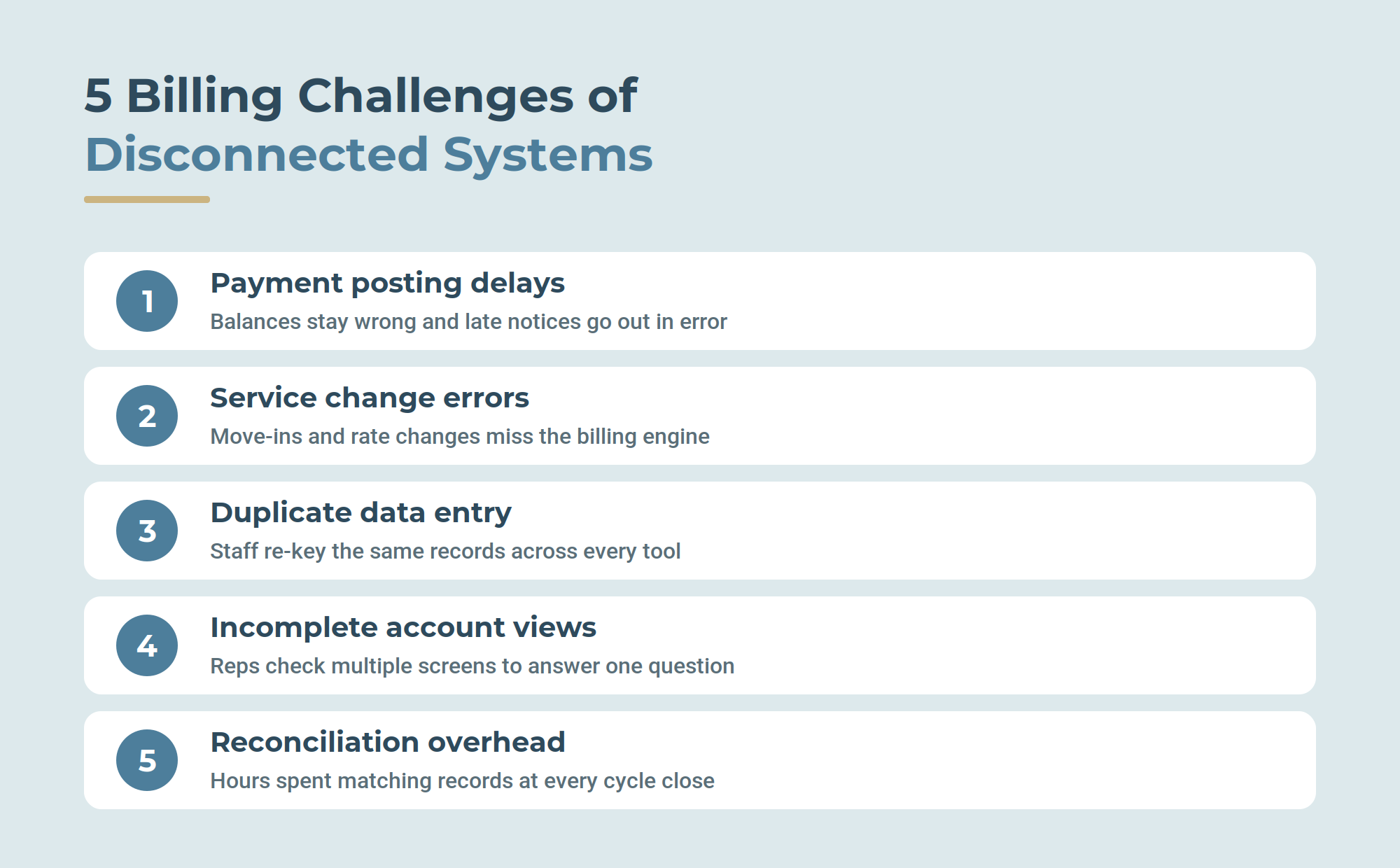
Common utility billing challenges from disconnected systems include:
- Payment posting delays. Payments processed in a separate system take time to appear on the customer account, leading to incorrect balances and unnecessary late notices.
- Service change errors. When a move-in, move-out, or rate change is entered in one place but not reflected in billing, customers receive inaccurate bills.
- Duplicate data entry. Staff re-key the same information across systems, which wastes time and multiplies mistakes.
- Incomplete account views. Customer service representatives cannot see the full picture, so simple questions require checking multiple screens or calling other departments.
- Reconciliation overhead. Teams spend hours matching records between systems at the end of each cycle.
How Does Integrated Billing Software Improve Utility Operations?
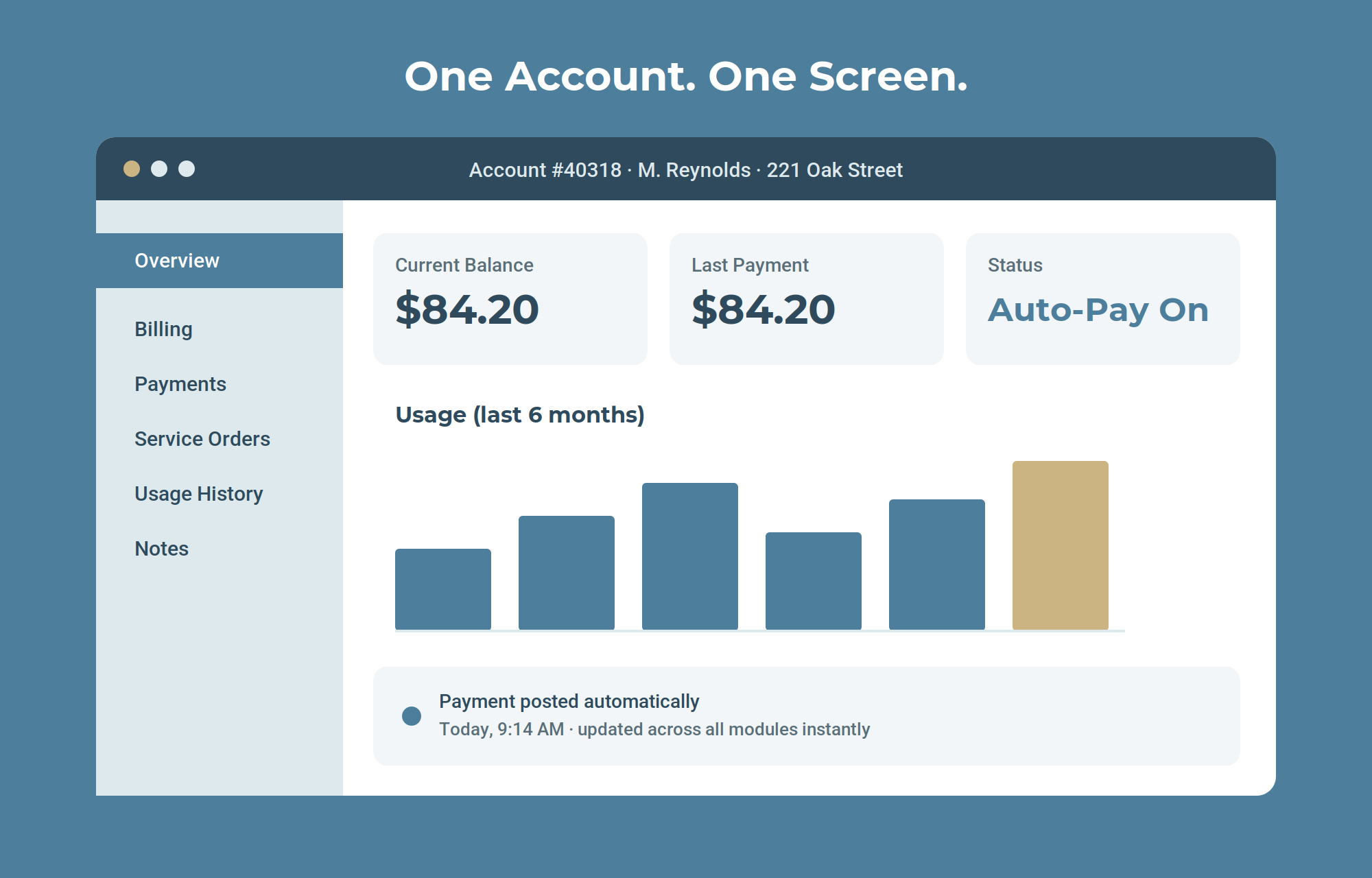
Integrated billing software improves operations by keeping every function connected to the same source of truth. When one record updates, every part of the system reflects the change immediately.
The main benefits include:
Accurate billing. Because meter data, rate changes, and service orders all feed the same billing engine, bills reflect current account status without manual reconciliation.
Faster customer service. Representatives see payments, usage history, service requests, and account notes on a single screen, so they resolve questions in one interaction.
Automated utility payments. Online, recurring, and phone payments post directly to the account, reducing late notices and lowering the cost of processing.
Streamlined service changes. Move-ins, move-outs, and transfers flow through one workflow that updates billing automatically.
Simpler utility administration. Reporting draws from unified data, so leaders get an accurate view of collections, aging, and revenue without stitching together exports.
What Should Utility Leaders Look For in Billing Software?
Utility operations and customer service leaders should evaluate billing software on how well it connects core functions rather than how many features it lists.
Key evaluation criteria:
- Unified account records that combine billing, payments, and service history in one place.
- Automated payment processing across web, mobile, phone, and recurring options.
- Configurable rate management that handles tiered rates, seasonal changes, and multiple service types.
- Self-service customer portals that reduce call volume by letting customers view bills and pay online.
- Real-time reporting built on a single data source.
- Scalability to grow with the utility without adding disconnected tools.
Integrated vs. Disconnected Utility Systems
|
Function |
Disconnected Systems |
Integrated Software |
|
Payment posting |
Delayed, manual reconciliation |
Real-time, automatic |
|
Service changes |
Re-entered across tools |
Single workflow updates all |
|
Customer view |
Fragmented across screens |
Unified account record |
|
Reporting |
Manual exports and merges |
Real-time from one source |
|
Error rate |
Higher from duplicate entry |
Lower from shared data |
The Bottom Line
Integrated utility billing software matters because it removes the friction that disconnected systems create. By unifying payments, service changes, and account management, utilities reduce errors, serve customers faster, and give staff more time for meaningful work. For utility operations and customer service leaders weighing a change, the question is not whether to modernize but how much longer disconnected systems will keep costing time and accuracy.

Frequently Asked Questions
What is integrated utility billing software? Integrated utility billing software is a single platform that combines meter reading, billing, payments, service orders, and account management so all utility functions share the same records in real time, rather than operating as separate disconnected tools.
Why do disconnected utility systems cause billing errors? Disconnected systems cause errors because data does not sync automatically between them. A change in one system, such as a payment or service update, is not reflected in the others, leading to incorrect balances, inaccurate bills, and duplicate data entry.
How does integrated billing software help customer service? It gives representatives a single view of payments, usage, service requests, and account notes, so they can answer questions and resolve issues in one interaction instead of checking multiple systems.
What are automated utility payments? Automated utility payments are online, recurring, and phone payments that post directly to the customer account without manual entry, which reduces late notices and lowers processing costs.
What should utility leaders look for when choosing billing software? Leaders should prioritize unified account records, automated payment processing, configurable rate management, self-service customer portals, real-time reporting, and the ability to scale without adding disconnected tools.

Schedule a personalized live demo of the new MultiBilling platform today and explore how AI-driven workflow orchestration, operational intelligence, and governed automation can transforming your utility billing operations.