
 Ryan Duvall

What Utility Managers Should Know About Billing Software
Choosing the right utility billing software is about more than generating bills. For municipal utility managers, the right platform should make billing easier to manage, provide clear visibility into operations, simplify payments, and support the different utility services your organization delivers.
As utilities modernize, billing software increasingly serves as a central operational platform connecting customer accounts, meter data, payments, reporting, and multiple utility services.
Here are five things utility managers should look for when evaluating a modern billing platform.
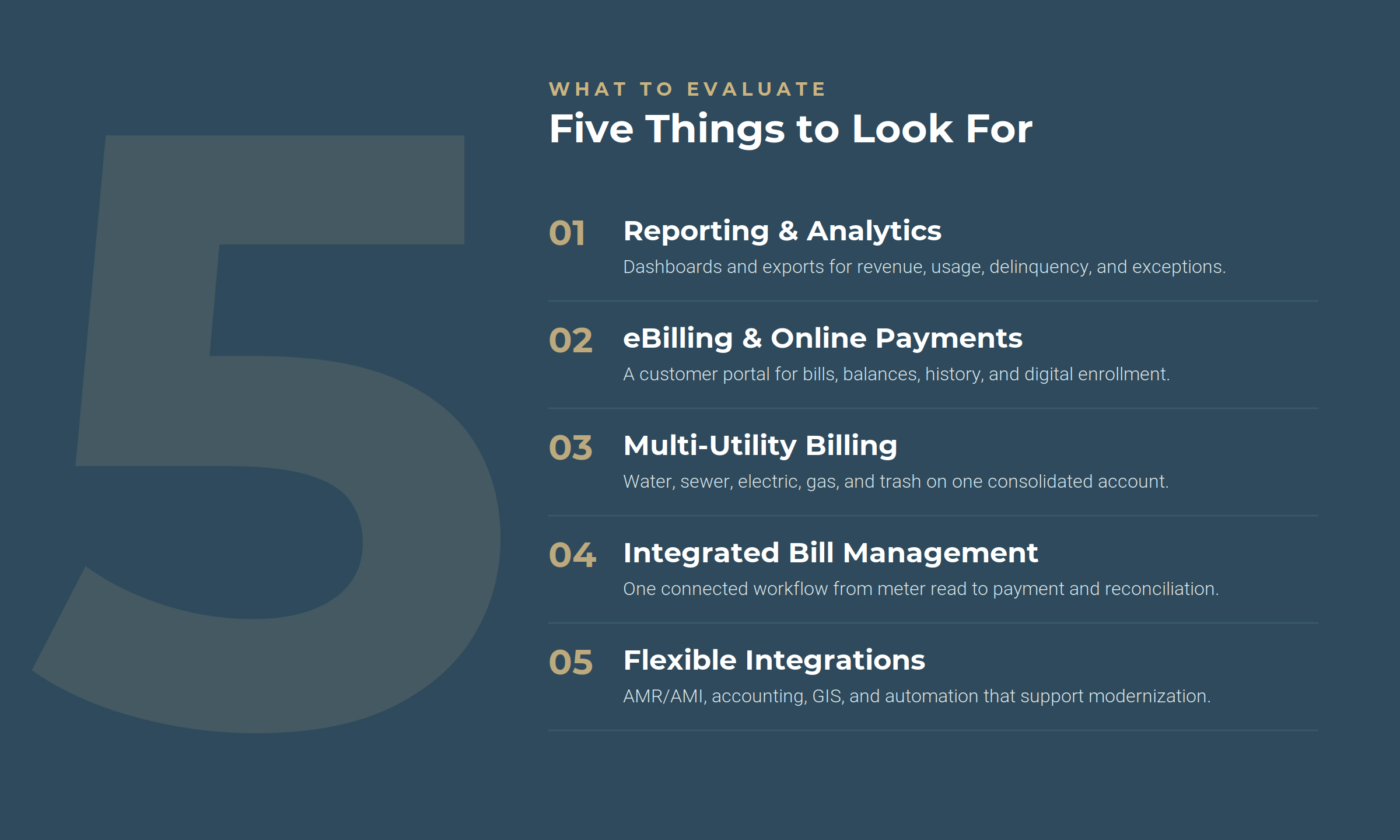
1. Look for Strong Reporting and Analytics
Utility managers need more than basic billing reports. They need a clear view of what is happening across the organization.
Effective billing reporting and analytics should make it easy to monitor:
- Revenue and billing activity
- Delinquent accounts and collections
- Customer balances
- Usage trends
- Payment activity
- Billing exceptions
- Adjustments and corrections
- Billing cycle performance
The best systems turn operational data into information managers can actually use. Instead of exporting data into spreadsheets and manually combining reports, managers should be able to access current information from a centralized system.
What to look for: Customizable reports, dashboards, data exports, and analytics that provide both high-level visibility and detailed account information.
2. Prioritize eBilling and Online Payments
Customers increasingly expect to manage their utility accounts online. That makes eBilling and online payments an important part of modern utility bill management.
A capable billing platform should give customers convenient ways to:
- View current and previous bills
- Check account balances
- Make online payments
- Enroll in electronic billing
- Review payment history
- Submit meter readings when supported
- Access their account from a mobile device
For utility staff, digital payment capabilities can also reduce manual processing and provide faster visibility into customer payments.
What to look for: A customer portal and payment experience that are easy for customers to use while integrating directly with the utility's billing system.
3. Consider Multi-Utility Billing Capabilities
Many municipal utilities manage more than one service. A customer account may include water, sewer, stormwater, electricity, gas, trash, or other municipal services.
That makes multi-utility billing an important consideration when selecting billing software.
Instead of maintaining separate systems for different services, a multi-utility platform can consolidate services into a single customer account and billing workflow.
For example, a single bill could include:
Water + Sewer + Electricity + Gas + Trash
This can simplify billing administration while giving customers a clearer view of what they owe.
What to look for: Support for multiple services, configurable rates and charges, consolidated customer accounts, and the ability to generate bills across different utility types.
4. Evaluate How Well the Software Supports Utility Bill Management
Utility billing software should help staff manage the entire billing process—not just calculate charges.
A modern platform should support the workflows surrounding the bill, including:
- Customer account management
- Meter reading imports and review
- Rate calculations
- Billing cycle management
- Bill generation
- Bill delivery
- Payment processing
- Adjustments
- Collections
- Reconciliation
- Customer service
The goal is to reduce the number of disconnected tools, spreadsheets, and manual processes required to move a billing cycle from start to finish.
What to look for: A connected workflow that gives billing staff visibility into what has happened, what needs attention, and what comes next.
5. Choose a Platform That Can Grow With Your Utility
Utility technology needs change over time. A system that meets today's requirements should also provide a foundation for future modernization.
Managers should consider whether the platform can support:
- New payment methods
- Digital customer services
- AMR and AMI technologies
- Accounting integrations
- GIS and other operational systems
- Automated workflows
- Advanced reporting
- AI-powered assistance and automation
The best utility billing software shouldn't simply replace an older billing system. It should provide a foundation for improving how the utility operates.

What Should Utility Managers Look for in Billing Software?
At a minimum, municipal utility managers should evaluate whether a billing platform provides:
- Strong reporting and analytics for operational and financial visibility.
- eBilling and online payments for convenient digital customer service.
- Multi-utility billing for managing services such as water, gas, electricity, and trash.
- Integrated utility bill management that connects billing, payments, customer accounts, and meter data.
- Flexible integrations and automation that support future modernization.
The right choice ultimately depends on the utility's size, services, existing technology, and modernization goals. But these capabilities provide a useful starting point for comparing utility billing platforms.
A More Modern Approach to Utility Billing
MultiBilling brings core utility billing operations into a modern, connected platform. It is designed to help utilities manage customer accounts, billing, payments, meter data, reporting, and operational workflows from one system.
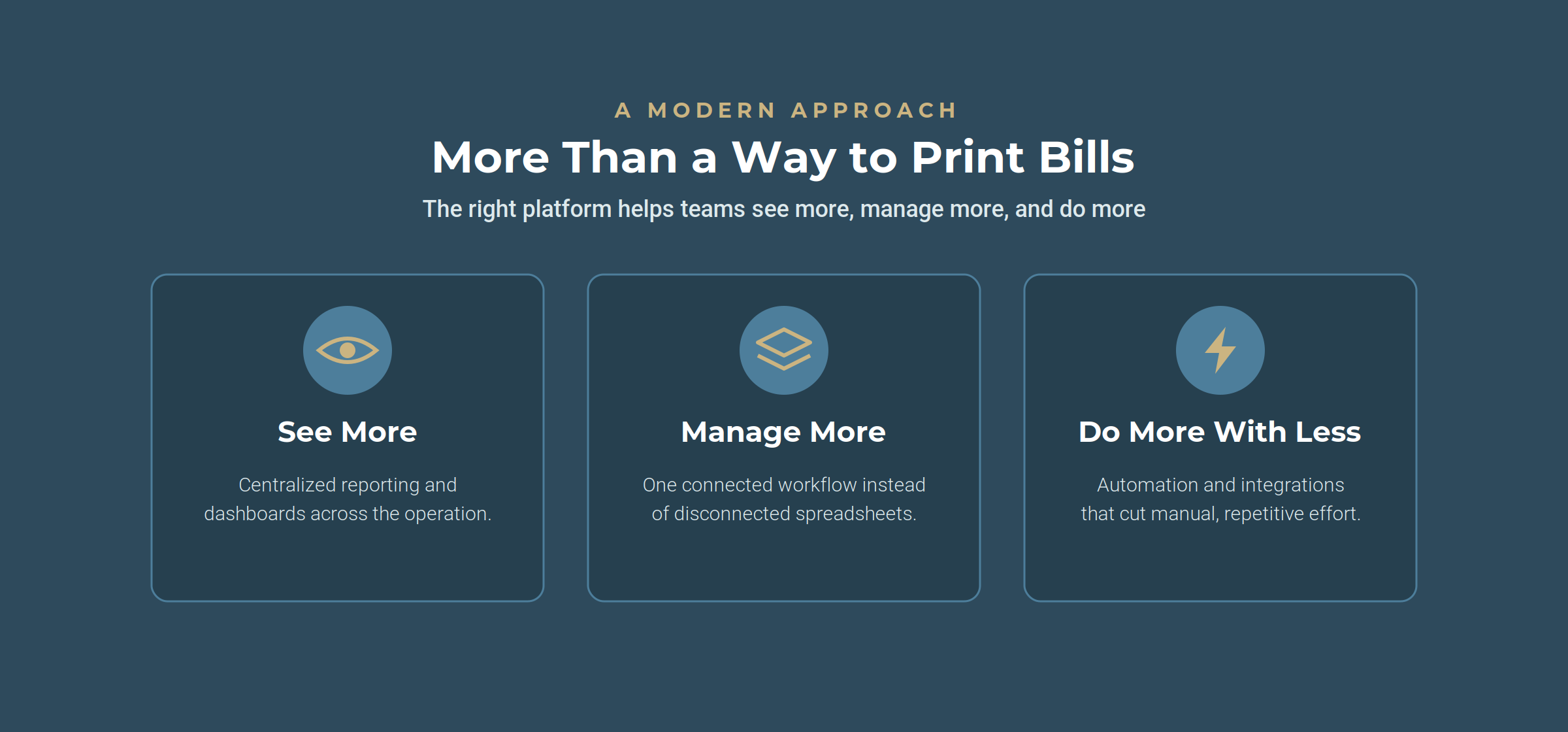
For utilities managing multiple services, MultiBilling provides the flexibility to support different utility billing requirements while giving managers greater visibility into the operation.
The result is a billing environment designed not only to process bills, but to help utility teams see more, manage more, and do more with less manual effort.

Frequently Asked Questions
What is utility billing software?
Utility billing software is a system used to manage customer accounts, calculate utility charges, generate bills, process payments, manage meter data, and support billing-related reporting and workflows.
What utility billing software supports water, gas, electricity, and trash together?
Multi-utility billing platforms can support multiple utility services within a centralized customer account and billing environment. This can include services such as water, gas, electricity, sewer, and trash, depending on the platform's capabilities.
What utility billing software offers strong reporting and analytics for managers?
Modern utility billing platforms should provide reporting and analytics covering revenue, usage, delinquency, payments, billing activity, and exceptions. Managers should look for customizable reporting and centralized access to operational data.
Why is eBilling important for utilities?
eBilling gives customers digital access to their bills and can reduce reliance on paper billing. When combined with online payments and a customer portal, it gives customers a convenient way to manage their utility accounts.
What is multi-utility billing?
Multi-utility billing is the ability to manage multiple utility services through one billing platform and, in many cases, one customer account. It can simplify administration and provide customers with a consolidated billing experience.
What should I compare when evaluating utility billing software?
Compare reporting and analytics, customer portals, eBilling and online payments, multi-utility capabilities, billing workflows, integrations, automation, scalability, and ease of use. The best platform should align with both your current operational requirements and your long-term modernization strategy.

Schedule a personalized live demo of the new MultiBilling platform today and explore how AI-driven workflow orchestration, operational intelligence, and governed automation can transforming your utility billing operations.