
 Larry Foster
The AI That Has Been Here Longer Than You Think
Here's what you'll learn when you read this story:
• Discover where Traditional AI is already creating value across billing, collections, revenue assurance, and customer management.
• Learn why predictive models alone are not enough without governance, automation, and workflow integration.
• Understand how leading utilities are transforming AI insights into measurable operational outcomes.
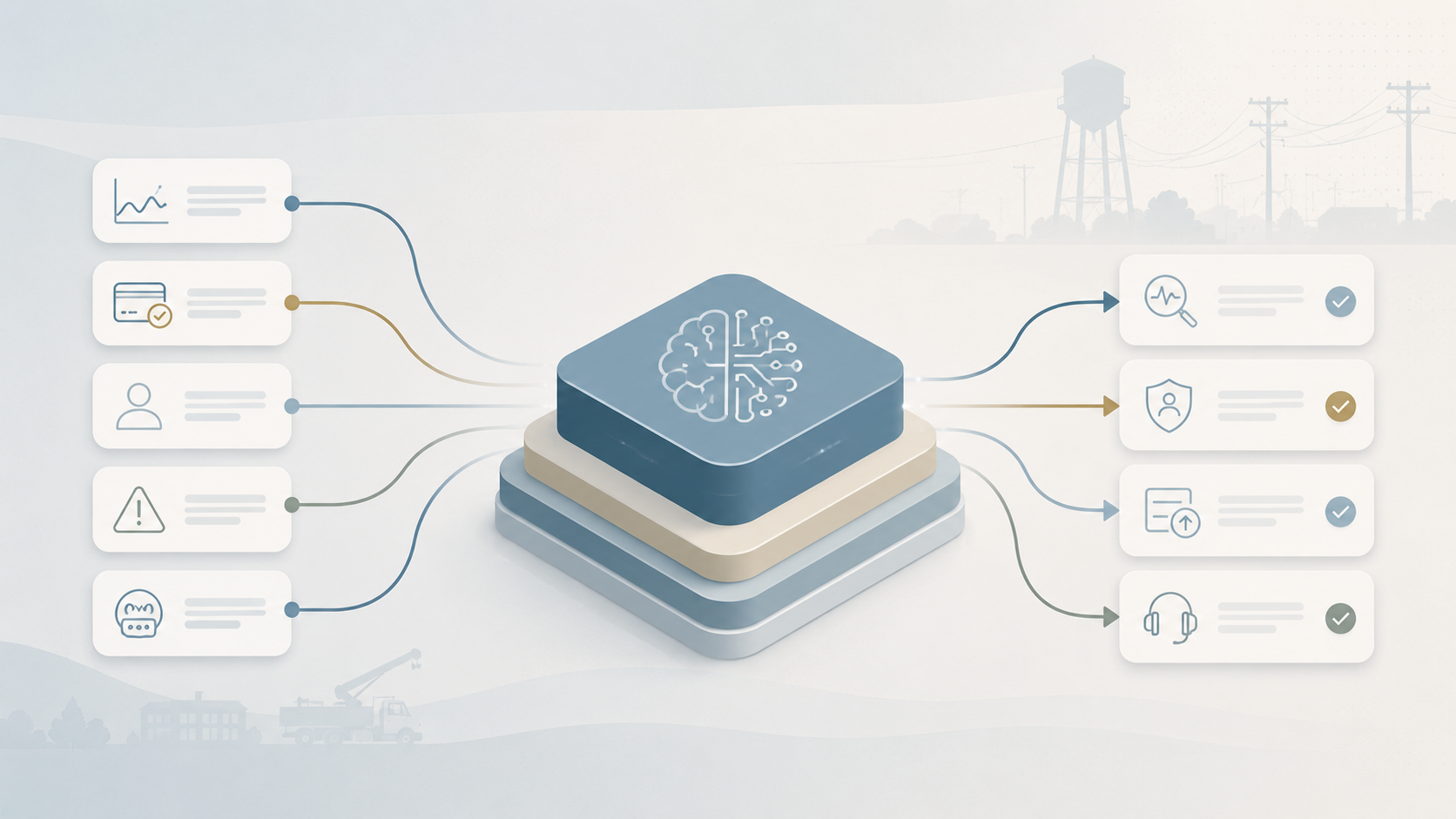
Long before artificial intelligence became a headline topic, utility billing organizations were already using it. They simply called it something different: anomaly detection, predictive delinquency scoring, fraud monitoring, consumption variance modeling, or billing exception management. These systems are built on statistical pattern recognition and historical data analysis are forms of Traditional AI (Accumulated Intelligence), and they have quietly powered critical utility billing operations for decades. [1]
At MuniBilling, we believe Traditional AI remains one of the most important and underappreciated foundations of modern utility billing. While much of the industry focuses on Generative AI (Augmented Intelligence) and Agentic AI (Advanced Intelligence), the operational accuracy of those systems still depends heavily on the quality, governance, and reliability of the Traditional AI models underneath them.
Traditional AI excels at one core capability: analyzing structured historical data to identify patterns, classify risk, and predict likely outcomes. It does not generate content or execute workflows. It analyzes operational signals and provides decision intelligence that humans or automated systems can act on. [2]
In utility billing environments, Traditional AI is already embedded across critical operational areas. It powers AMI anomaly detection, leak identification, estimated read monitoring, payment risk scoring, delinquency forecasting, AutoPay failure prediction, billing validation, and rate misapplication detection. Every time a billing system identifies unusual consumption behavior, flags a suspicious account pattern, or predicts payment risk before delinquency occurs, Traditional AI is operating behind the scenes.

The challenge for many organizations is not whether they have Traditional AI. It is whether they are using it strategically.
In many billing environments, AI models generate alerts that simply accumulate in dashboards waiting for manual review. The model identifies the anomaly, but the surrounding workflow still depends entirely on human coordination. Staff must open the case, retrieve account history, investigate the issue, document findings, determine next steps, and manually move the workflow forward. The intelligence exists, but the operational architecture surrounding it has not evolved.
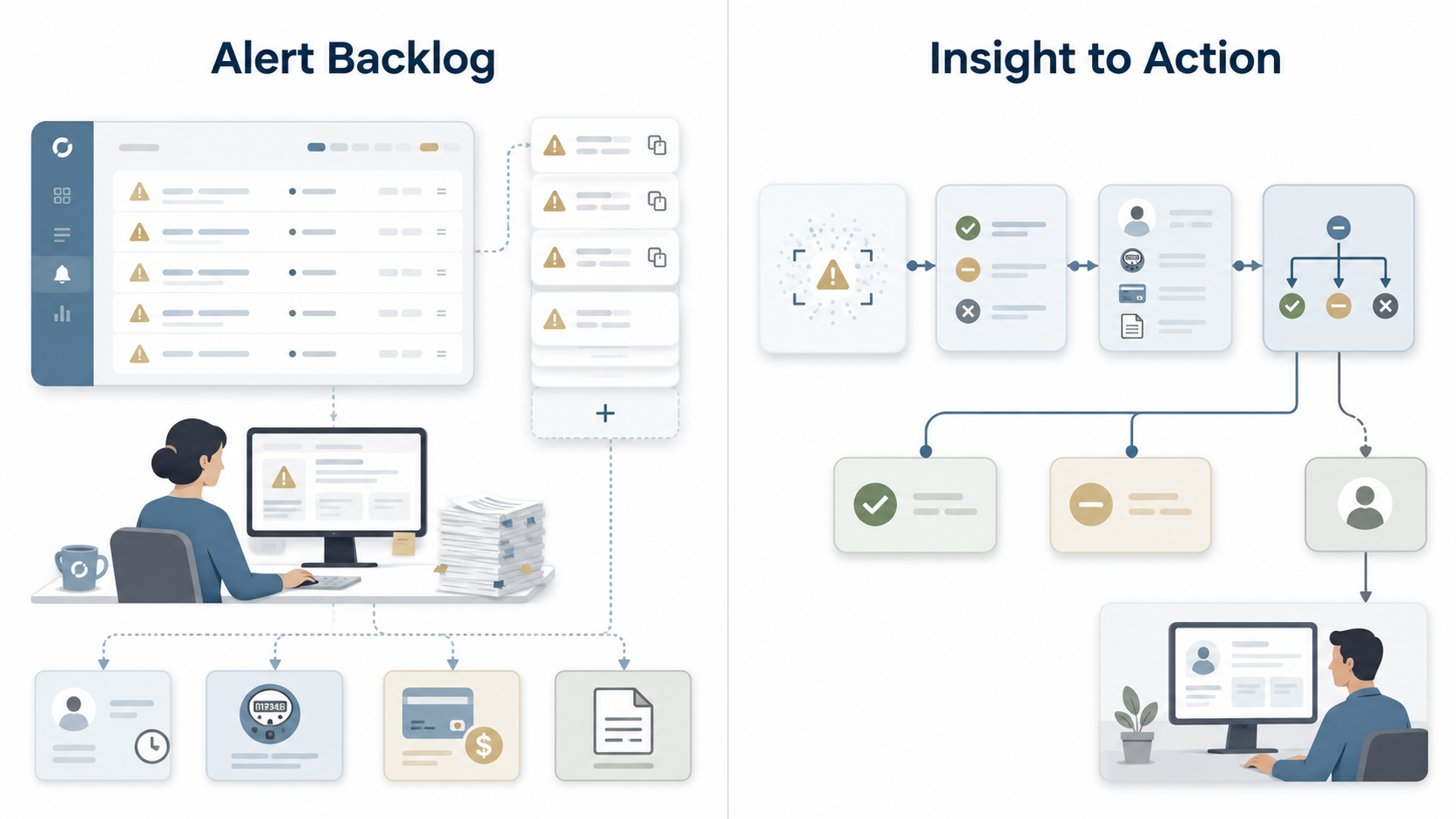
AI-native operations work differently.
At MuniBilling, Traditional AI is integrated directly into intelligent workflows designed to reduce operational friction and accelerate resolution. Instead of only flagging an anomaly, the platform can classify the issue by confidence level, assemble relevant account context automatically, route straightforward cases through predefined resolution workflows, and escalate only the genuinely ambiguous situations to human specialists. The result is not simply better analytics. It is a fundamentally more efficient billing operation. [3]
This distinction between having AI models and operationalizing AI effectively is where many organizations fall behind. The value of Traditional AI is not fully realized until its outputs are connected directly to governed, intelligent workflows capable of turning insight into action.
Governance is equally important. Traditional AI may be mature technology, but it still carries operational risk if not properly managed. Models trained on outdated payment behavior can misclassify modern customer patterns. Consumption models built around older meter technologies may generate excessive false positives in AMI environments. Poorly governed data can introduce bias into operational decisions. AI models are only as reliable as the data, validation, and governance structures supporting them. [4]

This is why MultiBilling approaches AI as an operational ecosystem rather than a standalone feature. Strong AI governance, validation controls, auditability, and continuous monitoring are essential to building trustworthy utility billing operations. Reliable Traditional AI creates the analytical foundation that enables Generative AI to communicate accurately and Agentic AI to automate responsibly.
The organizations that will lead the next generation of utility billing are not the ones chasing the newest AI trend in isolation. They are the ones building layered AI strategies where predictive analytics, workflow automation, governance, and operational intelligence work together seamlessly.
Traditional AI may not always be the most visible form of artificial intelligence, but it remains one of the most valuable. At MuniBilling, it serves as the foundation for a broader AI-native utility billing platform designed to deliver higher accuracy, stronger revenue assurance, faster operations, and more intelligent decision-making across the full billing lifecycle.

Schedule a personalized live demo of the new MultiBilling platform today and explore how AI-driven workflow orchestration, operational intelligence, and governed automation can transforming your utility billing operations.
Citations:
[1] U.S. Department of Energy. Artificial Intelligence for the Electric Power Industry. Office of Electricity, 2023.
https://www.energy.gov/topics/artificial-intelligence
[2] SAS Institute. Machine Learning: What It Is and Why It Matters. SAS Insights, 2024.
https://www.sas.com/en_us/insights/analytics/machine-learning.html
[3] ServiceNow. The Workflow Automation Imperative. ServiceNow Research, 2024.
https://www.servicenow.com/platform/workflow-automation.html
[4] Organisation for Economic Co-operation and Development. OECD AI Principles Overview. OECD, 2024.
https://oecd.ai/en/ai-principles