
 Paul Kelly
Security Is Not a Feature. It Is the Foundation.
Here's what you'll learn when you read this story:
• How AI is elevating security and governance from compliance requirements to core operational capabilities in utility billing.
• Why leading utilities are embedding auditability, transparency, and control directly into AI-enabled billing systems.
• How continuous monitoring and data integrity frameworks are shaping a new standard for trust in automated operations.
As utility billing operations become more AI-driven, security and governance are no longer secondary technology considerations. They are the foundation of operational trust. In an AI-enabled environment, automated systems can process thousands of transactions, validations, and billing decisions at machine speed. That scale creates enormous efficiency, but it also raises the stakes of governance. A single misconfigured workflow, incorrect rate logic update, or unauthorized automated action can affect far more accounts, far more quickly, than in a traditional manual operation. [1]
The organizations leading the next generation of utility billing are the ones building governance and security into the architecture of their operations from the beginning. AI is not simply a productivity tool. It is an operational system that must be transparent, accountable, monitored, and secure at every layer. [2]
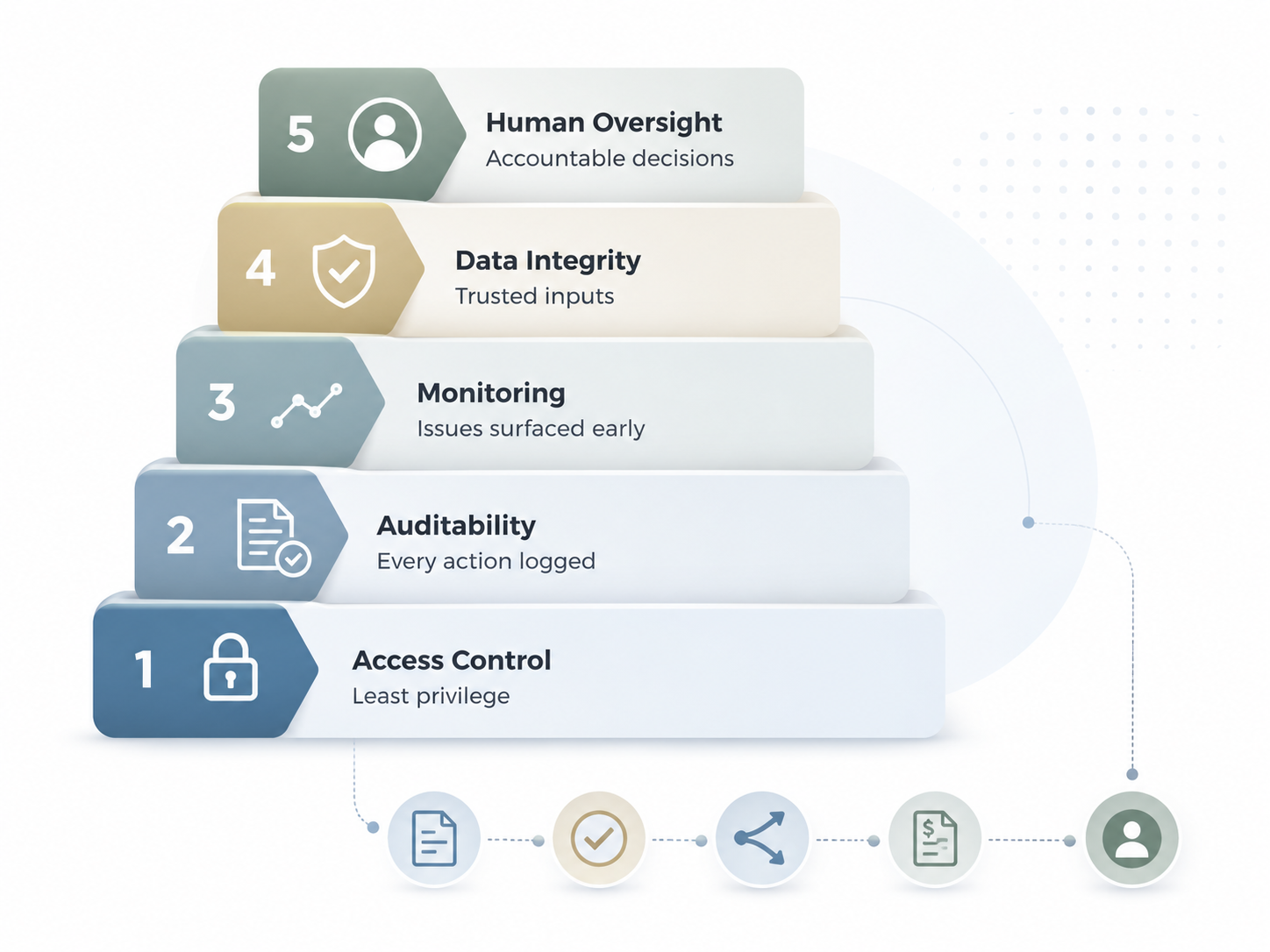
That starts with controlled access and governance. AI agents should only have access to the workflows and data required to perform their assigned tasks. This is called the Principle of Least Privilege which states that in a computing environment, every user, process, or program should be granted only the minimum level of access or permissions necessary to perform its intended function. Limiting permissions and enforcing role-based access controls reduces operational risk and ensures that automated systems operate within clearly defined boundaries. In modern billing environments, governance must apply not only to employees but also to AI-driven workflows.

Equally important is the audit trail behind every automated action. In AI-native utility billing operations, every workflow decision, billing adjustment, validation event, and exception resolution should be logged automatically with complete traceability. This creates operational transparency for internal teams, regulators, auditors, and customers while strengthening accountability across the organization. Compliance is no longer something assembled manually during an audit. It becomes a continuous operational output built directly into the platform itself.
AI governance also requires continuous monitoring. The greatest operational risk is often not a major system failure, but a subtle issue that goes unnoticed over time. A small percentage of billing exceptions classified incorrectly, an unnoticed workflow change, or an anomaly that slowly impacts customer accounts. Modern AI governance requires real-time monitoring, anomaly detection, escalation procedures, and human oversight designed specifically for AI-driven operations.

Data integrity is equally critical. AI systems are only as reliable as the data they receive. [3] Secure integrations, encrypted data flows, authentication controls, and validation layers ensure that billing decisions are based on trustworthy information. Without strong data governance, even advanced AI systems cannot produce reliable outcomes.
Security in utility billing is no longer just about compliance. It is about customer trust. Utilities manage highly sensitive customer and financial data, and the organizations that demonstrate operational accountability, transparency, and strong governance will increasingly differentiate themselves in the market. As AI adoption accelerates, trustworthiness becomes a competitive advantage.
“Security is not an added feature layered onto modernization. It is the foundation that makes modernization possible.”
This is where AI-native platforms separate themselves from legacy systems. MultiBilling was designed with governance, auditability, operational transparency, and AI oversight built into the platform architecture from the start. The goal is not simply to automate billing operations faster. It is to help utilities operate more securely, more intelligently, and with greater confidence in every automated action.
The future of utility billing will belong to organizations that combine AI innovation with disciplined governance and operational trust. Security is not an added feature layered onto modernization. It is the foundation that makes modernization possible.


Schedule a personalized live demo of the new MultiBilling platform today and explore how AI-driven workflow orchestration, operational intelligence, and governed automation can transforming your utility billing operations.
Citations:
[1] National Institute of Standards and Technology. Artificial Intelligence Risk Management Framework (AI RMF 1.0). U.S. Department of Commerce, 2023.
[2] National Institute of Standards and Technology. Towards a Standard for Identifying and Managing Bias in Artificial Intelligence. U.S. Department of Commerce, 2023.
[3] EDM Council. Data Management Capability Assessment Model (DCAM). EDM Council.