Jai Lewis
Best Utility Billing Software for Property Management: What to Compare
The best utility billing software for property management is the one that bills every utility you pass through to residents, connects to your property management system, lets residents view and pay online, and gives your team clear reporting. Those four capabilities decide whether billing runs itself each cycle or turns into a monthly scramble of spreadsheets, rekeyed readings, and resident calls.
This guide walks through what to compare when evaluating utility billing software for multifamily and residential portfolios, where property teams most often struggle, and a checklist you can use in vendor demos.

What Is Utility Billing Software for Property Management?
Utility billing software for property management is a system that bills residents for the utilities they use or share. It imports meter and submeter readings, allocates shared and common-area costs, generates resident statements, collects payments, and reports on it all.
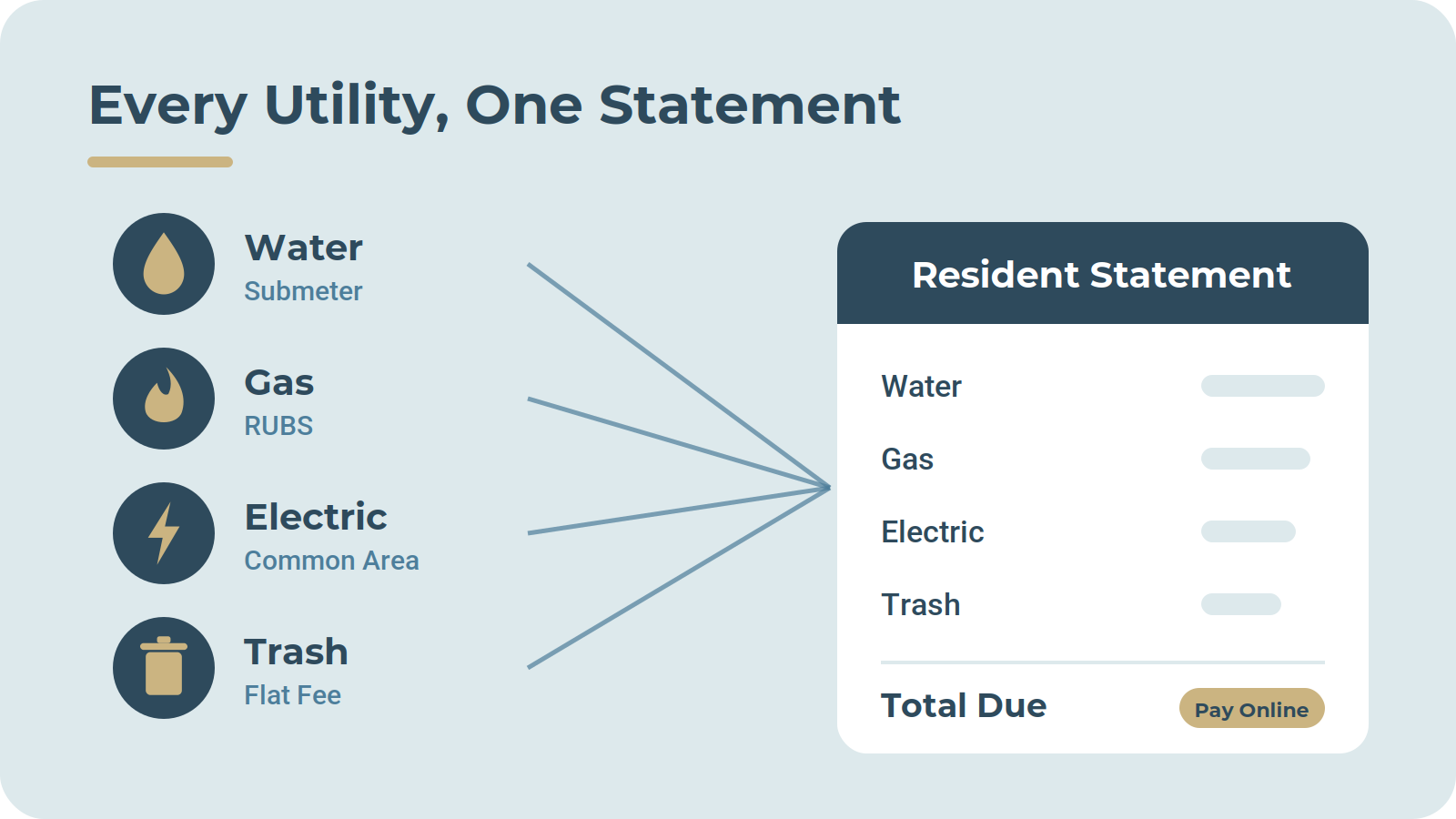
In a multifamily portfolio, that often means handling water, gas, electricity, sewer, and trash billing at the same time, each with its own measurement or allocation method. The right system manages every utility in one billing cycle instead of spreading the work across separate tools.
Why Do Property Managers Struggle With Utility Billing Software?
Property managers usually struggle with utility billing software when it only solves part of the process. A tool that calculates bills but doesn't connect to leasing, accounting, or payments still leaves the team moving data by hand.
The most common pain points include:
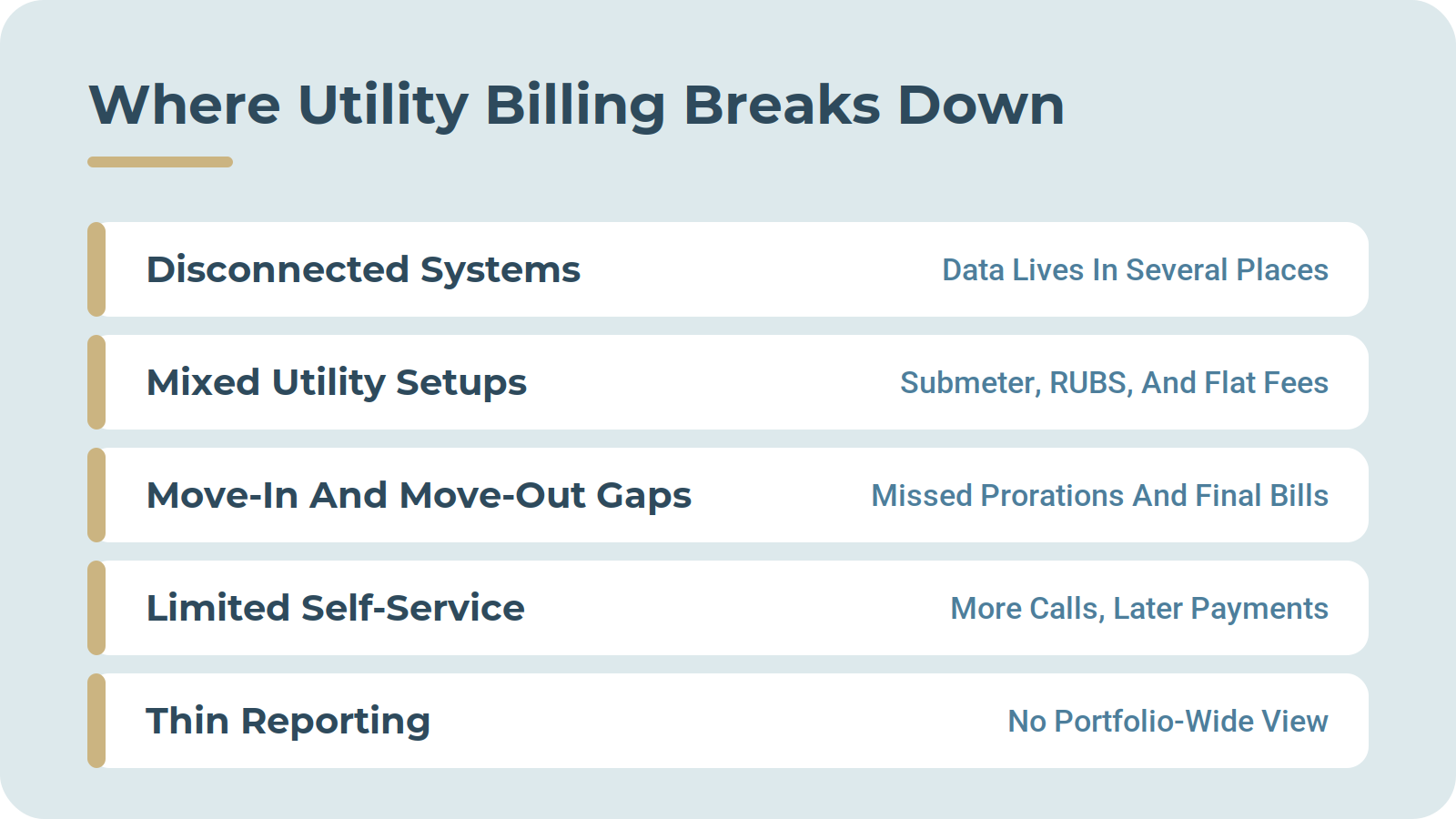
- Disconnected systems. Readings, resident records, payments, and accounting live in different places, so every cycle requires reconciliation.
- Mixed utility setups. A single property may submeter water, allocate trash and sewer by occupancy, and split common-area electric, which basic tools don't handle well.
- Move-in and move-out gaps. When billing doesn't update from the property management system, prorations and final bills get missed.
- Limited resident self-service. Without online statements and payments, residents call the office with questions and pay late.
- Thin reporting. Teams can't easily see collections, recovery rates, or problem units across a portfolio.
Each of these gaps creates manual work, and manual work is where billing errors and resident disputes start.
What Features Should the Best Utility Billing Software Have?
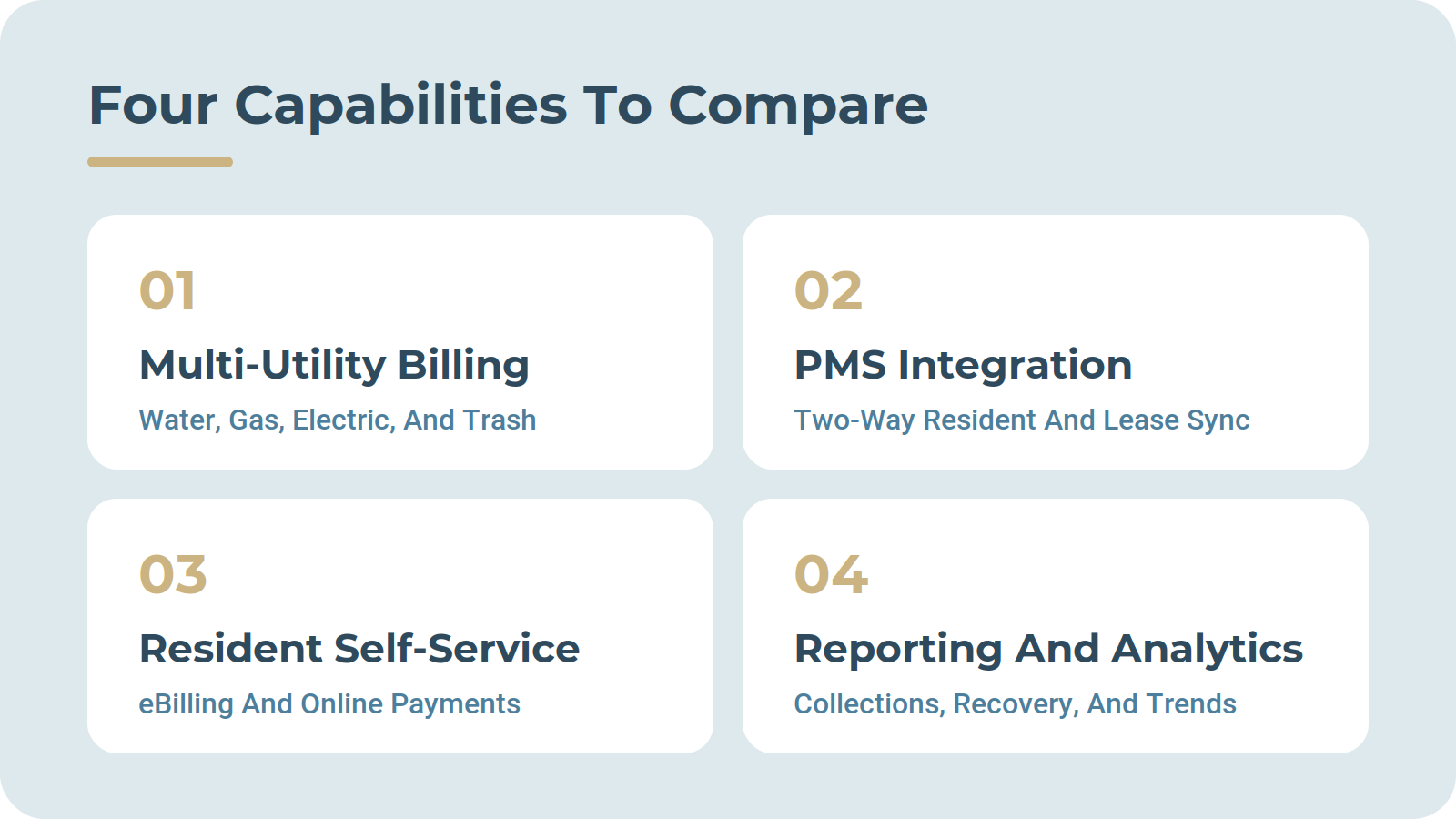
The best multifamily utility billing software combines four capabilities: multi-utility billing, property management system integration, resident self-service, and reporting and analytics. Weakness in any one of them pushes work back onto your team.
Multi-Utility Billing for Water, Gas, Electricity, and Trash
Most portfolios bill more than one utility, and each may use a different method. Look for software that supports submeter billing, ratio utility billing (RUBS) by square footage or occupancy, flat fees, and common-area allocation, all within the same billing cycle. It should also handle vacancy and dormancy rules so owners recover costs on empty units correctly.
Property Management System Integration
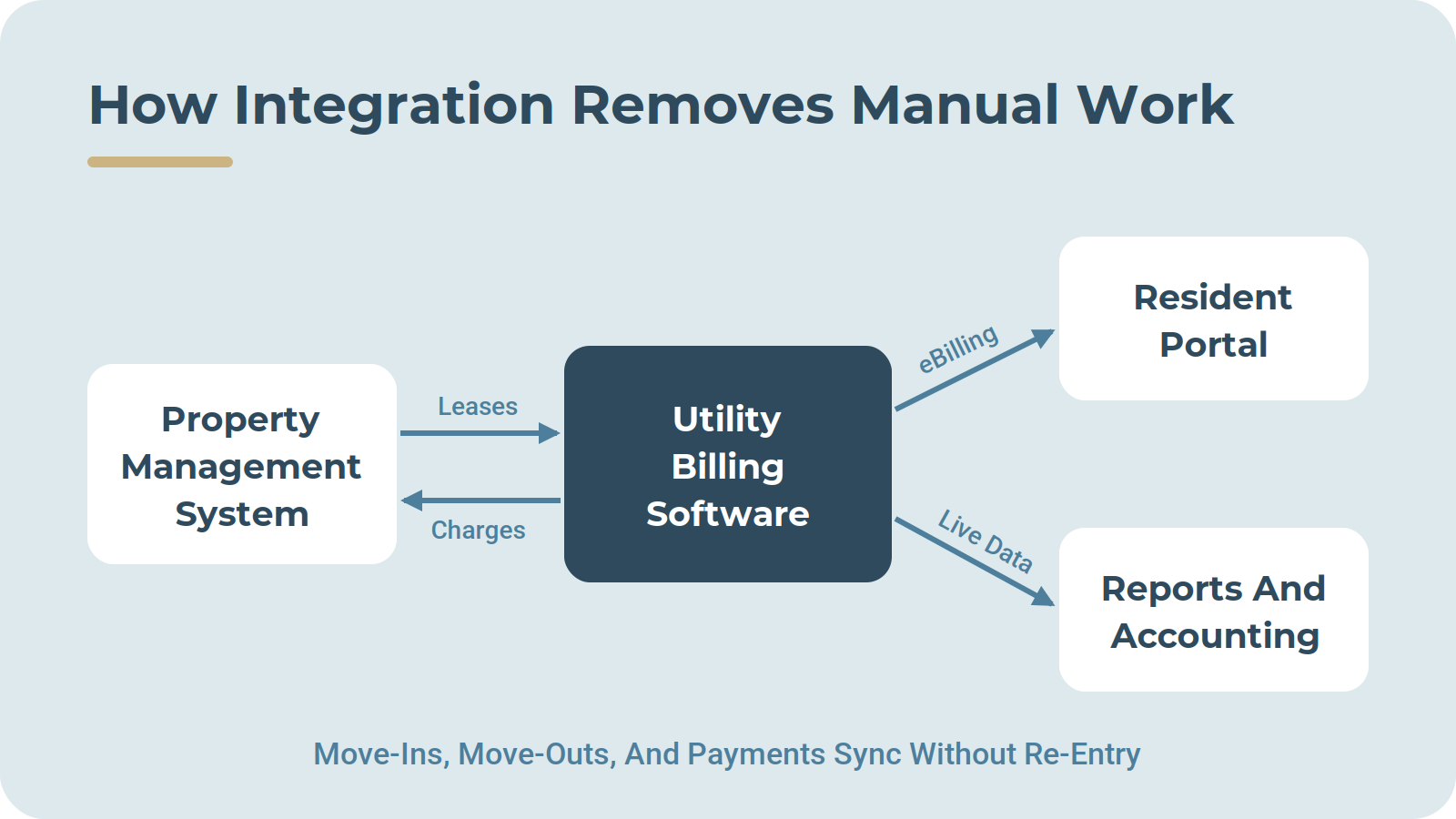
Integration determines how much manual work remains. When utility billing connects to your property management system, move-ins, move-outs, and lease changes update billing automatically, and charges and payments flow to the resident ledger without re-entry.

Resident Utility Billing Self-Service
Residents expect to see and pay utility bills the same way they pay everything else. eBilling and online payments let residents view itemized statements, pay by card or eCheck, and set up autopay through a portal. Clear, itemized charges also answer many billing questions before a resident ever calls the office.
Utility Billing Reporting and Analytics
Reporting shows whether your utility program is actually working. Strong utility billing reporting and analytics should cover collections, aging, cost recovery by property, consumption trends, and exceptions such as zero reads or unusual spikes. Real-time reports let managers catch problems during the cycle instead of after bills go out.
Which Utility Billing Software Integrates Easily With Property Management Systems?
Utility billing software integrates easily when it syncs resident and unit data from your property management system automatically and posts charges and payments back without manual exports. The easiest integrations run on a schedule, need no file uploads from your team, and flag mismatches instead of silently skipping them.
When evaluating property management system integration, ask vendors:
- Which property management platforms do you integrate with today, and is the connection two-way?
- How often do resident, lease, and unit changes sync?
- Do charges post to the resident ledger automatically, or does someone import a file?
- How are sync errors surfaced, and who resolves them?
- What does onboarding look like for a new property?
The answers show whether integration truly removes duplicate data entry or just moves it to a different screen.
How to Compare Utility Billing Software Vendors
Use this checklist to compare vendors side by side during demos. A strong option meets every item without workarounds.
|
Capability |
What to Look For |
Question to Ask in the Demo |
|---|---|---|
|
Multi-utility billing |
Water, gas, electricity, sewer, and trash in one cycle |
Can you bill submetered and RUBS utilities on the same statement? |
|
Allocation flexibility |
Square footage, occupancy, flat fee, and common-area splits |
Can each utility use a different method at the same property? |
|
Meter and submeter imports |
Automated reading imports with exception flags |
What happens when a read is missing or out of range? |
|
PMS integration |
Two-way sync of residents, leases, charges, and payments |
Do move-outs trigger final bills automatically? |
|
eBilling and online payments |
Resident portal, autopay, card and eCheck |
What share of residents typically adopt the portal? |
|
Statements |
Itemized, customizable, and easy to read |
Can residents see how each charge was calculated? |
|
Reporting and analytics |
Collections, aging, cost recovery, and consumption trends |
Are reports real time, and can they roll up across properties? |
|
Scalability |
Adding properties without adding staff |
What changes when we add 20 more properties? |
|
Support |
Named contacts and billing expertise |
Who do we call when a billing cycle has an issue? |
How MultiBilling Approaches Multifamily Utility Billing
MultiBilling is built for property management teams that bill multiple utilities across a growing portfolio. It brings reading imports, RUBS and dormancy rules, customizable resident invoices, a resident portal for eBilling and online payments, and real-time reporting into one platform.
The newest MultiBilling platform adds AI-driven workflow orchestration, operational intelligence, and governed automation. That means routine billing steps run automatically while your team keeps control over approvals and exceptions.
Choosing the Right Utility Billing Software
The best utility billing software for property management handles every utility you bill, integrates with your property management system, gives residents a simple way to view and pay online, and shows your team what is happening across the portfolio. Compare vendors against all four areas, not just price or a single feature, and you'll choose a system that removes manual work instead of relocating it.
Schedule a personalized demo of MultiBilling to see how it handles your properties' utility setup.
Explore MuniBilling's utility billing software features to see how a modern platform can help your team spend less time working around its software—and more time improving billing operations.
Ready to see what modern utility billing can look like? Schedule a MuniBilling demo.
Frequently Asked Questions
What is the best utility billing software for multifamily properties?
The best utility billing software for multifamily properties supports multiple utilities and allocation methods in one cycle, integrates with your property management system, offers resident eBilling and online payments, and provides real-time reporting across properties.
Why do property managers struggle with utility billing software?
Property managers struggle when their software only covers part of the process. Disconnected systems, mixed utility setups, missed move-out bills, and limited resident self-service all force teams back into manual work.
Which utility billing software integrates easily with property management systems?
Software integrates easily when it syncs residents, leases, and units automatically and posts charges and payments back to the resident ledger without file imports. Ask vendors which platforms they support and whether the sync is two-way.
What makes it hard to manage utilities without integrated billing software?
Without integration, teams maintain the same resident and billing data in several systems and reconcile it by hand. That duplication causes missed prorations, payment posting errors, and resident disputes.
How do companies streamline resident utilities with utility billing software?
Companies streamline resident utilities by automating reading imports, cost allocation, statement generation, and payment collection in one system connected to their property management software.
Can one system bill water, gas, electricity, and trash? Yes. Multifamily utility billing software can bill water, gas, electricity, sewer, and trash on a single resident statement, even when each utility uses a different billing or allocation method.