
 Douglas Strickland
Know the Answer Before the Vote: Model Your Rate Changes Against Real Usage
Once the books are closed, the harder question arrives almost immediately: what should next year's rates be? Costs have gone up — wholesale power, treatment chemicals, labor, debt service — and somewhere in the new budget is a rate adjustment that has to cover them. But a rate change isn't a line item you can simply pencil in. It's a bet on how thousands of customers will be billed under a new structure, and you're expected to make that bet, then stand in front of a council or a board and defend it.
The utilities that navigate this well don't guess. Before a proposed rate ever reaches an agenda, they run it against their own real usage history and see exactly what it would have produced. Here's why that step is the difference between a rate change that holds up and one that comes back to haunt you.
A Rate Change Is a Bet — So Test It Before You Place It
Every rate structure is a set of assumptions: that a given tier design, a seasonal rate, or a new fixed charge will recover a target amount of revenue across your customer base. The only way to know whether those assumptions hold is to apply the proposed rate to actual consumption data and see what comes out the other side.
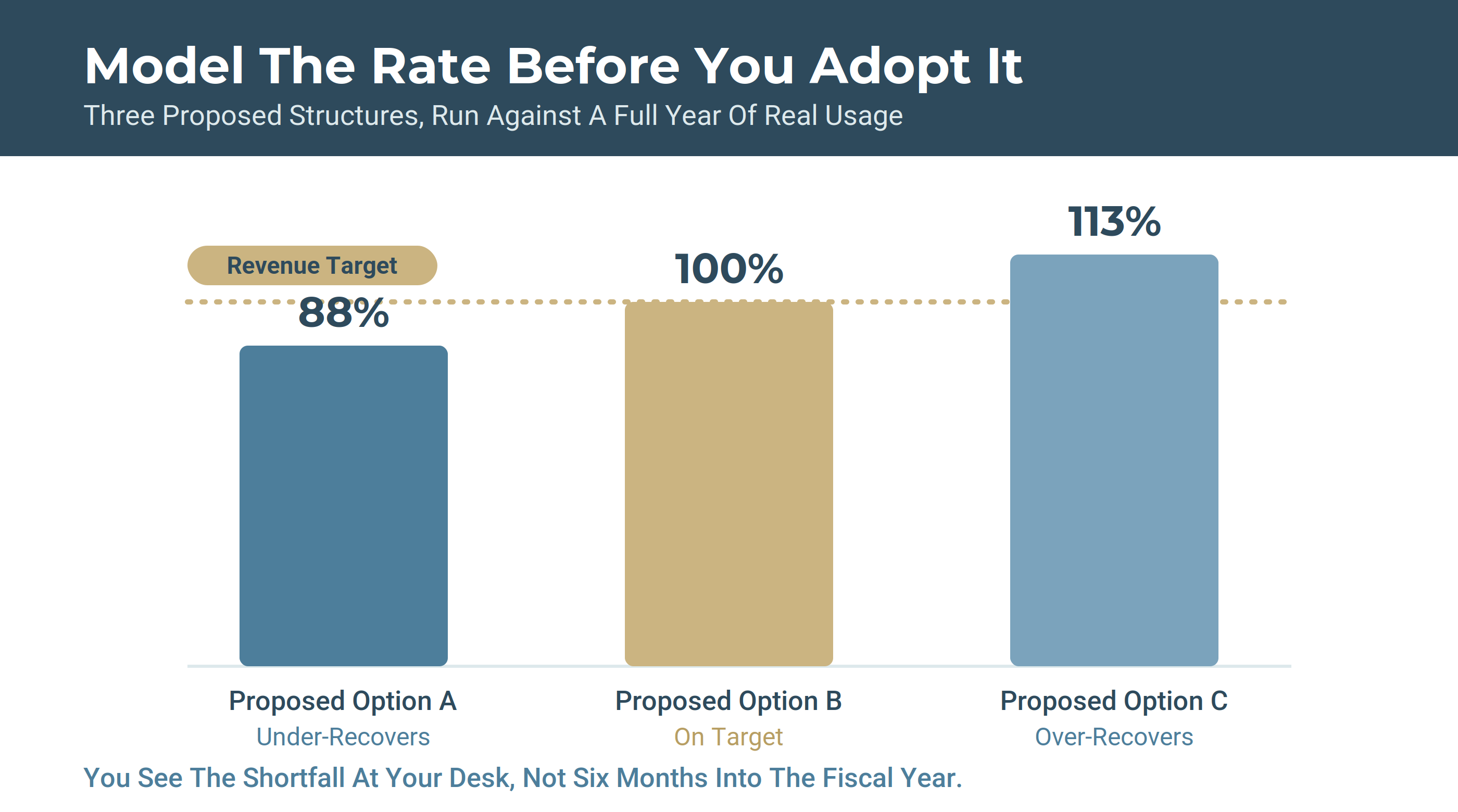
That's what modeling does. Take the structure you're considering, run it against the last year of real billing and usage data, and the system tells you what you would actually have collected — not an estimate, but the number your own customers' usage would have produced. If the proposed rate under-recovers, you find out now, at your desk, instead of six months into the fiscal year when the revenue isn't there. If it over-recovers and hands you an unnecessary customer backlash, you find that out too, while it's still just a draft.
The alternative — designing a rate on a spreadsheet, adopting it, and hoping the revenue lands — is how utilities end up reopening a rate case they thought they'd settled.
Know Who It Hits Before They Tell You
Total revenue is only half the picture. The other half is distribution: which customers see their bills go up, by how much, and whether any group gets hit harder than you intended. A tier change that looks reasonable in aggregate can land painfully on a specific class — high-usage households, small commercial accounts, irrigation customers — and those are precisely the people who show up to the public hearing.
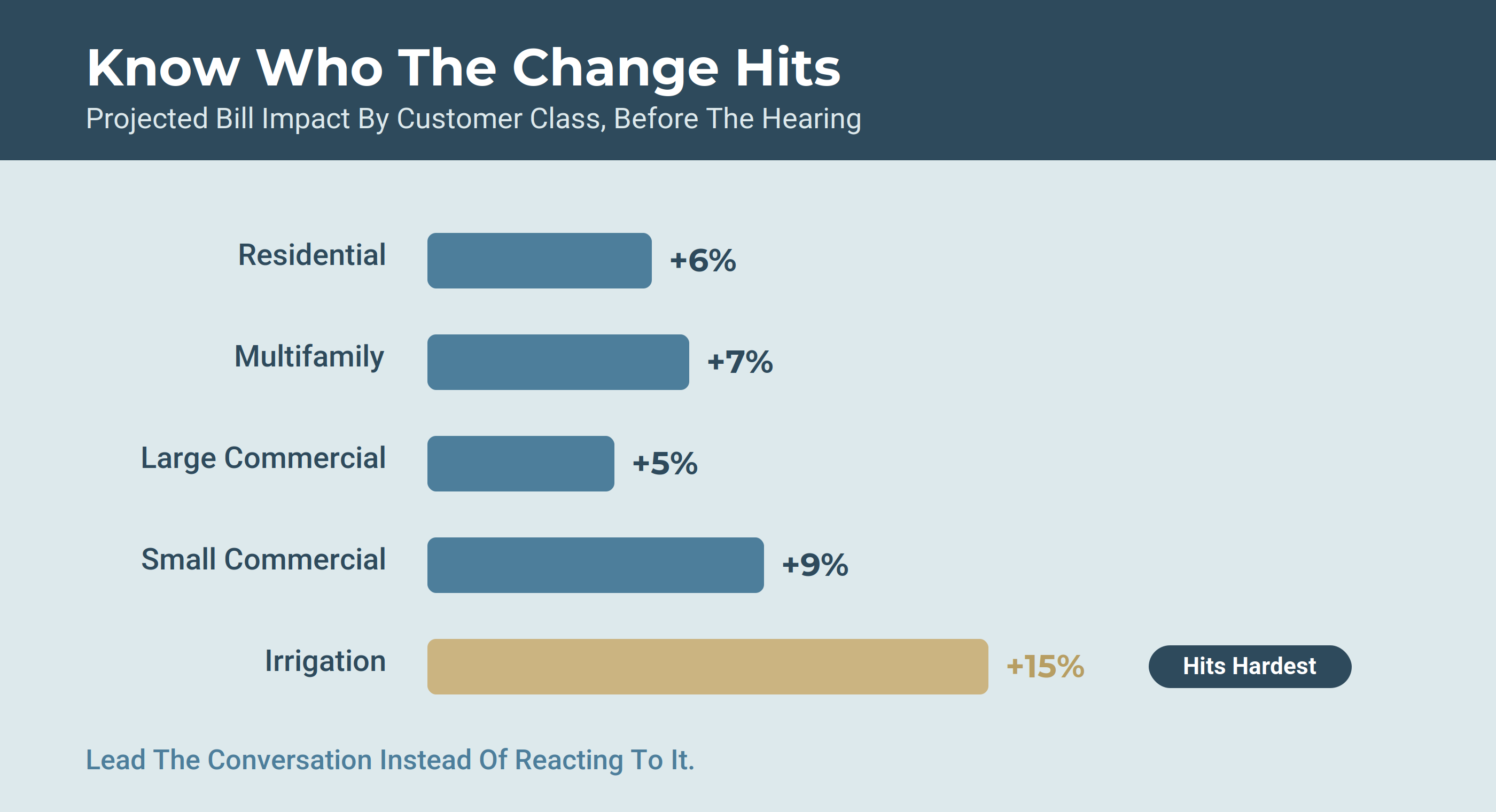
Modeling against real usage lets you see that impact by customer class and usage level before you commit. You can compare structures, adjust the tiers, and shape the change so it recovers what you need without an unfair surprise for one group. When you walk into the hearing already knowing "the typical residential bill moves by this much, and here's the one class that sees more and why," you're leading the conversation instead of reacting to it.
Walk Into the Hearing With the Answers
Rate decisions are public, and they invite scrutiny. Someone on the council will ask why the increase is what it is, who it affects, and whether you considered an alternative. The strength of your position rests entirely on whether you can answer with evidence.
A rate backed by modeling against real data is far harder to challenge than one backed by a projection. You can show what the structure recovers, demonstrate the bill impact across the customer base, and explain the alternatives you tested and set aside. And when a board member pushes back with a scenario you didn't present, being able to model it on the spot — or having already run it — turns a difficult question into a demonstration of rigor. You're not defending a guess; you're showing your work.

The Cost of Guessing
It's worth being honest about what the seat-of-the-pants version costs. A rate that under-recovers means a shortfall you'll have to explain and, often, a second rate action to fix it — which erodes exactly the credibility you need for the next request. A rate that lands unfairly on one class means a contentious hearing, angry customers, and sometimes a reversal. And a rate you can't clearly defend means a harder vote, a deferred decision, or an approval granted grudgingly rather than with confidence.
None of these are failures of judgment. They're failures of information — the predictable result of adopting a structure without first seeing what it does to real accounts.
The Same Data That Closed Your Year Builds the Next One
The clean, reconciled data that let you close the year cleanly is the same data that makes this possible. Accurate usage and billing history isn't just a record of where you've been — it's the test bed for where you're going. When your system can take a proposed rate and run it against that history in a few clicks, rate-setting stops being an annual leap of faith and becomes what it should be: a decision you've already stress-tested before anyone votes on it.
Close the year on numbers you can trust, then use those same numbers to build a rate you can defend. That's how year-end turns from your team's hardest stretch into the foundation for a confident new year.

Schedule a personalized live demo of the new MultiBilling platform today and explore how AI-driven workflow orchestration, operational intelligence, and governed automation can transform your utility billing operations.