
 Paul Kelly
The Operation That Cannot Be Commoditized
Here's what you'll learn when you read this story:
• How leading utilities are combining AI with operational disciplines to create more resilient and scalable billing systems.
• Why real-time validation, automated exception handling, and governed workflows are replacing traditional batch-based billing processes.
• How AI-native platforms integrate governance, analytics, and workforce expertise into a continuous improvement operating model.
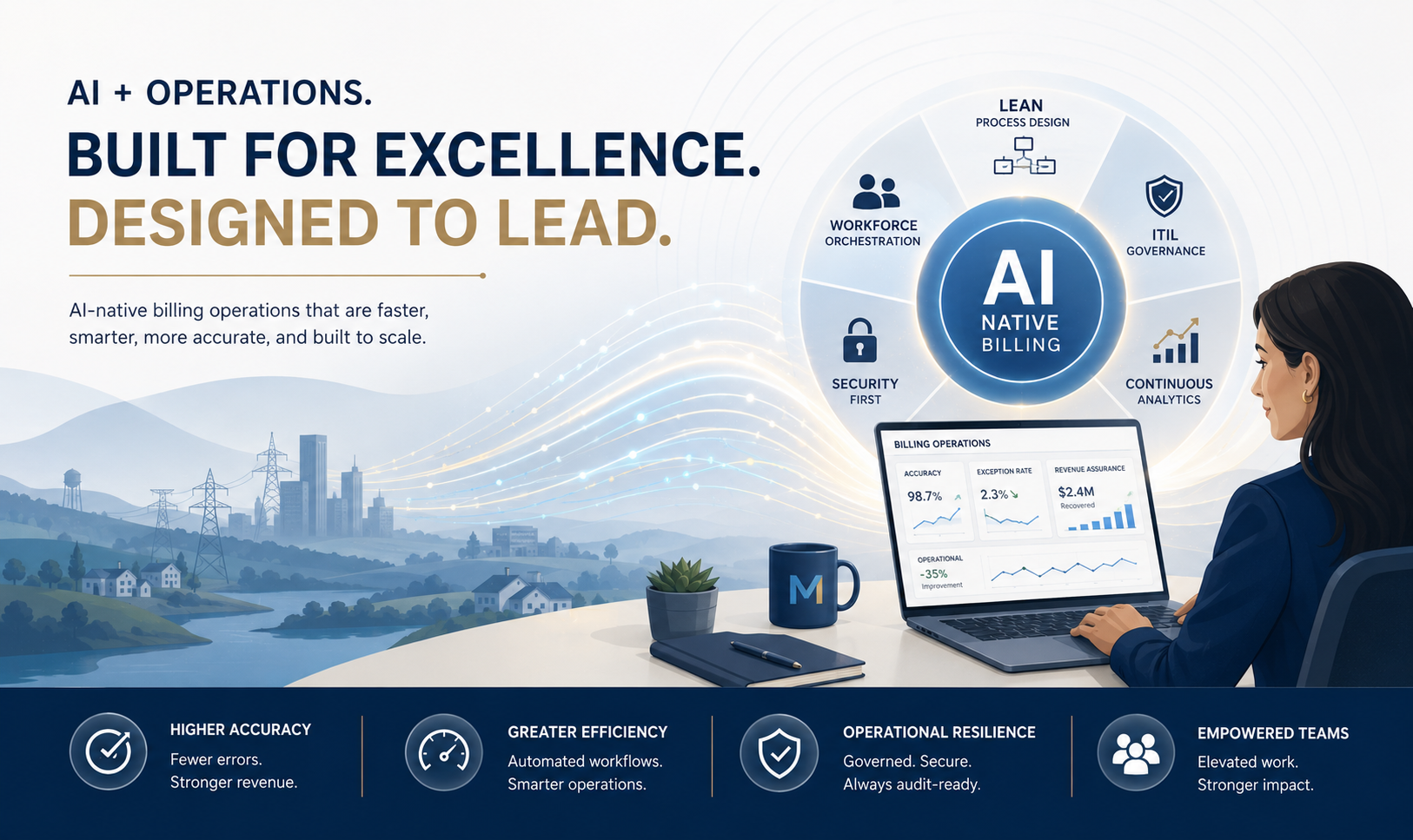
AI alone does not create operational excellence in utility billing. The organizations leading the next era of the industry are combining AI with disciplined operational frameworks, Lean process design, ITIL governance, continuous analytics, and security-first architecture to build billing operations that are faster, more accurate, more resilient, and significantly harder to replicate. [1]
In traditional billing environments, teams spend much of their day reacting to problems: reviewing exception queues, correcting billing errors, reconciling disconnected systems, responding to customer disputes, and managing delays created by batch-based workflows. Even modern software platforms often automate only fragments of this process, leaving organizations dependent on manual intervention to keep operations moving.
AI-native utility billing changes the model entirely.
In a modern operational environment built for AI, billing workflows are continuously monitored, validated, and improved in real time. Exceptions are classified automatically. Low-risk issues are resolved autonomously within governance boundaries. [2] High-risk or ambiguous cases are escalated to specialists with complete context already assembled. Billing cycles no longer depend on overnight processing windows or manual coordination between disconnected systems. They move at the pace of validated data.
This is the operational foundation MultiBilling was built to enable.
At MuniBilling, we view AI not as a feature layered onto billing software, but as the operational intelligence layer that connects governance, automation, analytics, and workforce orchestration into a single continuous system. That system is built on several core disciplines working together.
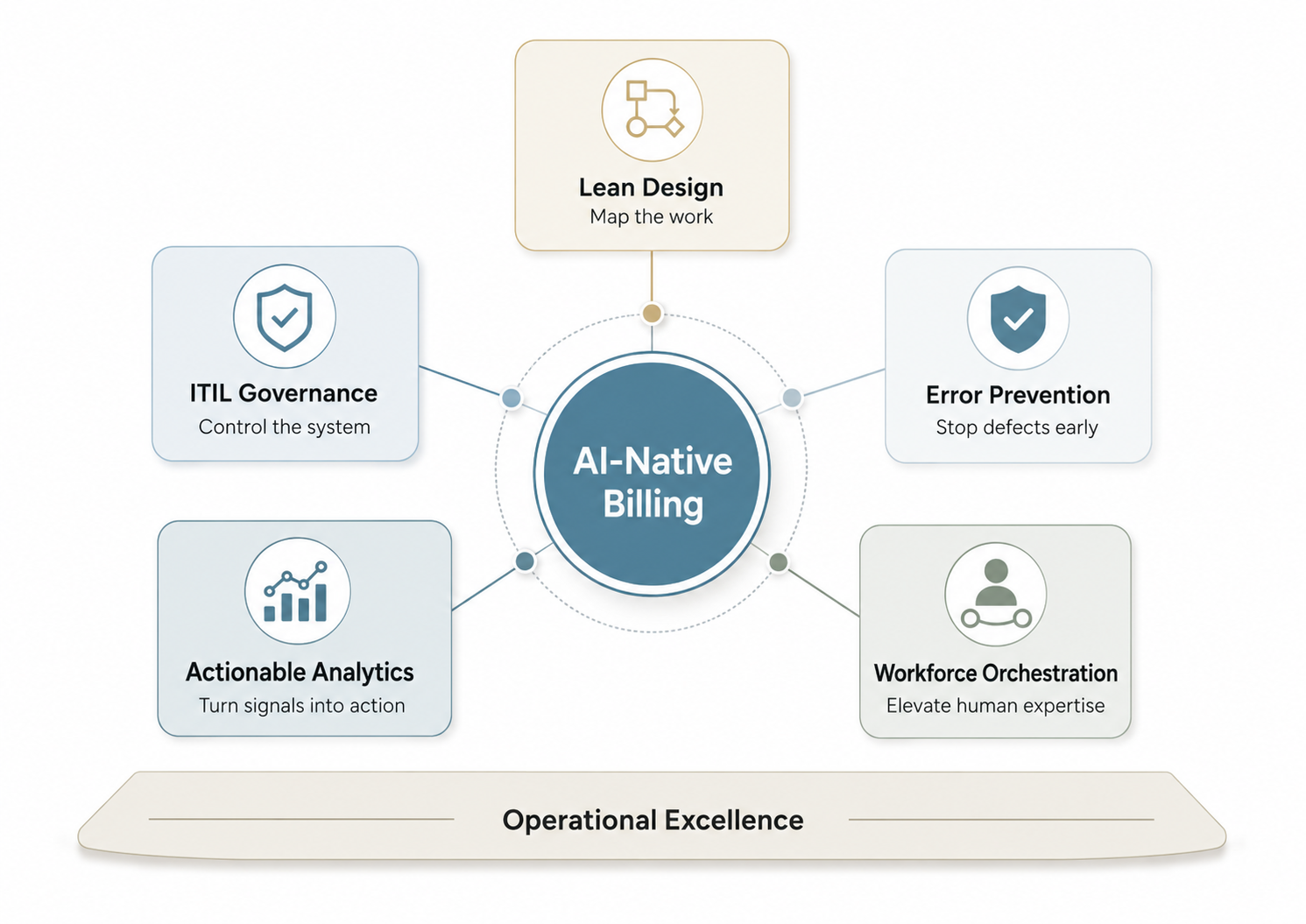
Lean value stream mapping identifies where work should be automated, augmented, or protected by human oversight. ITIL governance establishes how AI-driven workflows are governed through incident management, change control, release discipline, and audit readiness. [3] Poka Yoke principles embed error prevention directly into workflows so issues are prevented before they become disputes, write-offs, or compliance risks. Actionable analytics continuously monitor billing, usage, payment, operational, and rate-management activity to detect emerging issues before they become operational failures.
When these systems operate together, utility billing becomes a continuous improvement engine rather than a reactive administrative process.
“The future of utility billing will belong to organizations that combine AI with disciplined operational governance, continuous analytics, and human expertise.”
The impact is operationally significant. AI-enabled validation improves first-pass billing accuracy across every account, every cycle. Continuous revenue assurance reduces leakage caused by rate misapplication, delayed exception handling, and unbilled usage. Intelligent workflow orchestration reduces queue accumulation and eliminates many of the handoffs that historically slowed billing operations. Real-time monitoring surfaces anomalies early enough for organizations to intervene proactively rather than recover reactively. Most importantly, AI elevates the role of the billing professional instead of reducing it.
In high-performing AI-enabled operations, specialists spend less time performing repetitive transactional work and more time governing workflows, resolving complex exceptions, analyzing operational trends, improving customer outcomes, and refining the logic that powers the system itself. The operational knowledge of experienced utility billing professionals becomes embedded into AI governance models, creating an organization that compounds in capability over time.
This is one of the most important distinctions between commodity billing software and AI-native operational infrastructure.
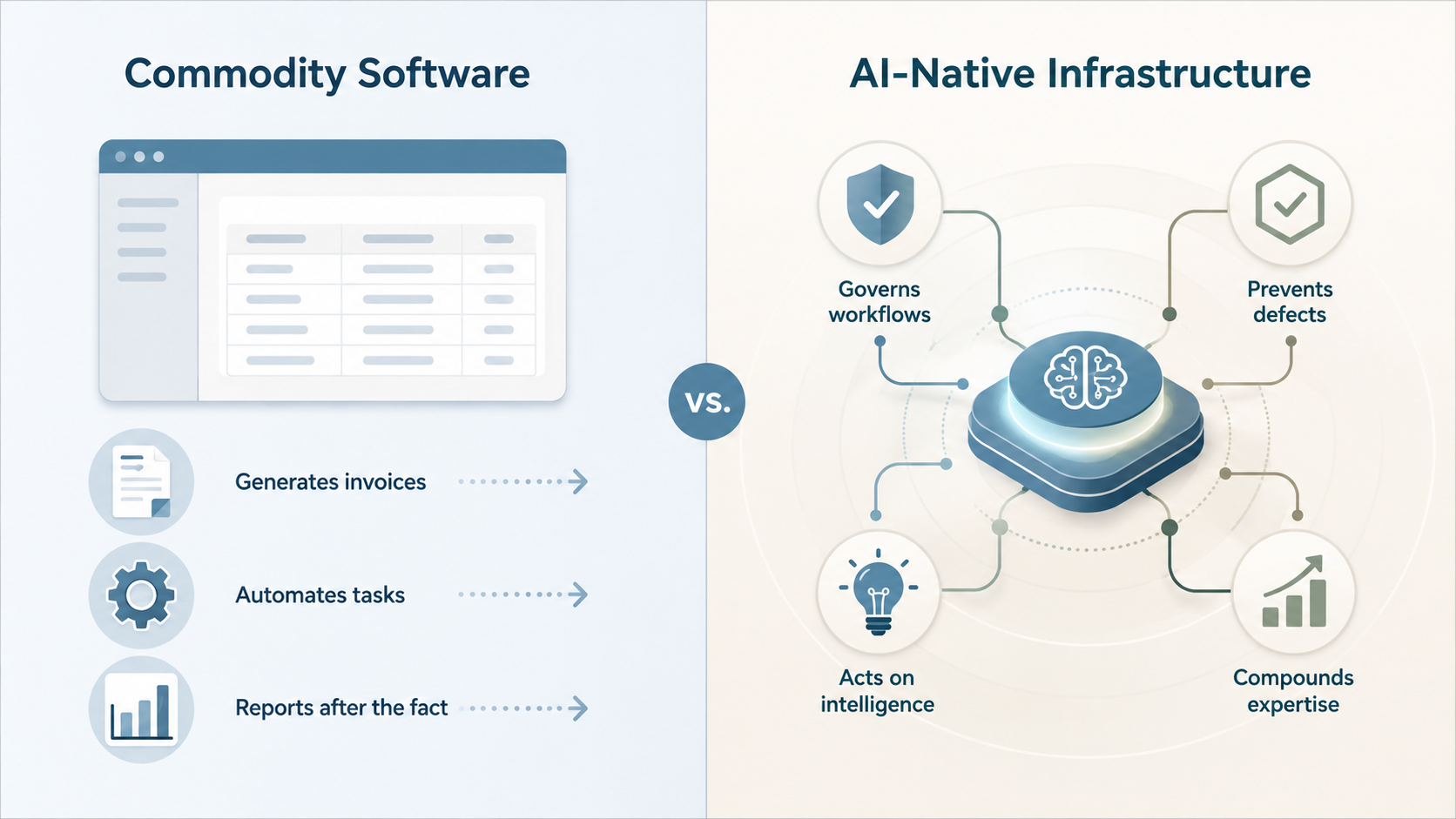
Commodity platforms can replicate features. They cannot quickly replicate organizational intelligence built through governed automation, continuous learning, institutional expertise, and operational discipline. A lower-cost billing platform or module within a monolithic ERP platform may generate invoices. It does not necessarily create continuous revenue assurance, proactive operational visibility, integrated governance, or scalable workforce intelligence.
That is why the future leaders in utility billing will not be defined simply by the software they purchase. They will be defined by the operational systems they build around it.

The organizations leading the next decade of utility billing will share several characteristics. They will operate with continuous compliance rather than periodic audit preparation. [4] They will govern AI workflows with the same rigor historically applied to core infrastructure systems. They will monitor operations in real time instead of through static manual reporting cycles. They will use AI to reduce defects before they occur rather than correct them afterward. And they will invest deliberately in workforce development so employees can govern increasingly intelligent operational systems.
This is the operating model MultiBilling was designed to support from the beginning.

MultiBilling was built as an AI-native utility billing platform for organizations that want more than transactional software and an expensive billing calculator. The platform was designed to help utilities, municipalities, and property management organizations create billing operations that are continuously improving, operationally resilient, audit-ready, and capable of scaling intelligently as complexity grows.
The future of utility billing will belong to organizations that combine AI with disciplined operational governance, continuous analytics, and human expertise. Not because automation replaces operational excellence but because it finally makes operational excellence scalable.
That is the operating system modern utility billing requires.


Schedule a personalized live demo of the new MultiBilling platform today and explore how AI-driven workflow orchestration, operational intelligence, and governed automation can transforming your utility billing operations.
Citations:
[1] - National Institute of Standards and Technology. Artificial Intelligence Risk Management Framework (AI RMF 1.0).U.S. Department of Commerce, 2023.
https://www.nist.gov/itl/ai-risk-management-framework
[2] - McKinsey & Company. The State of AI: How Organizations Are Rewiring to Capture Value. McKinsey Global Institute, 2024.
https://www.mckinsey.com/capabilities/quantumblack/our-insights/the-state-of-ai
[3] - AXELOS. ITIL® 4 Foundation: IT Service Management Best Practices. AXELOS, 2019.
https://www.axelos.com/itil
[4] - National Institute of Standards and Technology. AI RMF Playbook. NIST, 2024.
https://airc.nist.gov/AI_RMF_Knowledge_Base/Playbook