
 Douglas Strickland
How Utility Billing Software Simplifies Resident Utilities
Property management teams have automated rent collection, maintenance, leasing, and resident communications.
Yet utility billing is often still managed with spreadsheets, manual calculations, meter reads, and repetitive data entry.
Why?
Because utility billing is complicated and it's rarely the most urgent task on a property manager's desk.
Until something goes wrong.
Why Utility Billing Gets Put Off
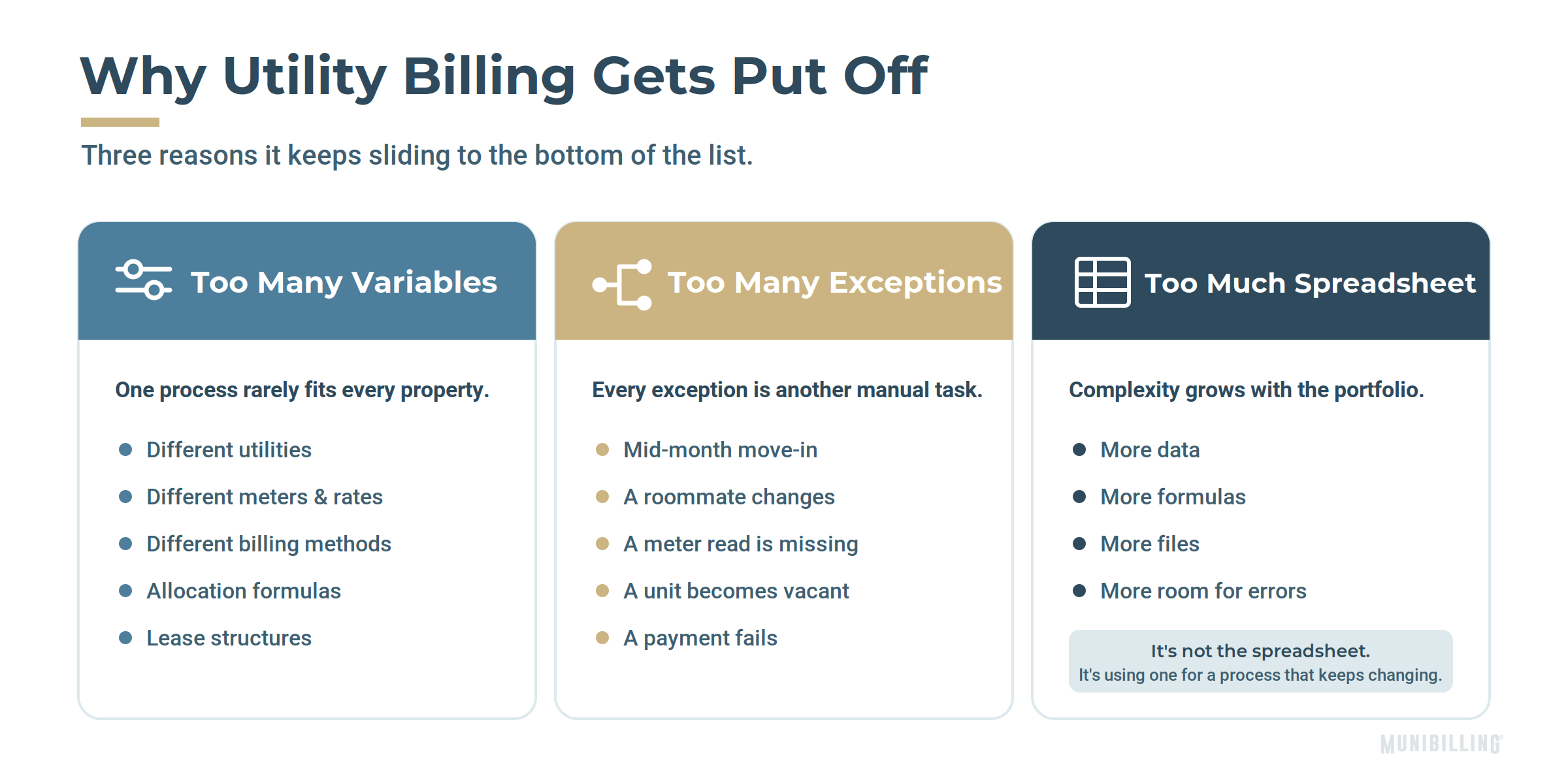
Too Many Variables
Properties may use different:
- Utilities
- Meters
- Rates
- Billing methods
- Allocation formulas
- Lease structures
One process rarely works for every property.
Too Many Exceptions
A resident moves in mid-month. A roommate changes. A meter read is missing. A unit becomes vacant. A payment fails.
Every exception creates another manual task.
Too Much Spreadsheet Work
Spreadsheets may seem flexible, but as properties grow, so does the complexity.
More properties mean more data, more formulas, more files, and more opportunities for errors.
The problem isn't the spreadsheet. It's relying on a spreadsheet to manage a process that keeps changing.
The Cost of Delaying Utility Billing
The expense doesn't always appear on one line item. It shows up as:
Staff time + billing errors + unrecovered costs + resident disputes + slower collections.
A manual process can also make it difficult for management to see what's happening across an entire portfolio.
When "Good Enough" Stops Working
A process that works for a few hundred units can become difficult at thousands of units.
As a portfolio grows, so do the number of:
- Residents
- Properties
- Utility providers
- Billing methods
- Transactions
- Exceptions
At some point, the question changes from:
"Can we get this month's billing done?"
to:
"Why does this take so much of our team's time?"
The Answer Isn't Another Spreadsheet
Modern utility billing software can automate:
- Meter and utility data imports
- Usage calculations
- Rates and allocations
- Roommate billing
- Move-in/move-out proration
- Statements
- Payments and collections
- Exception management
- Portfolio reporting
Instead of manually managing every transaction, teams can focus on the exceptions that actually require attention.
From Reactive to Proactive
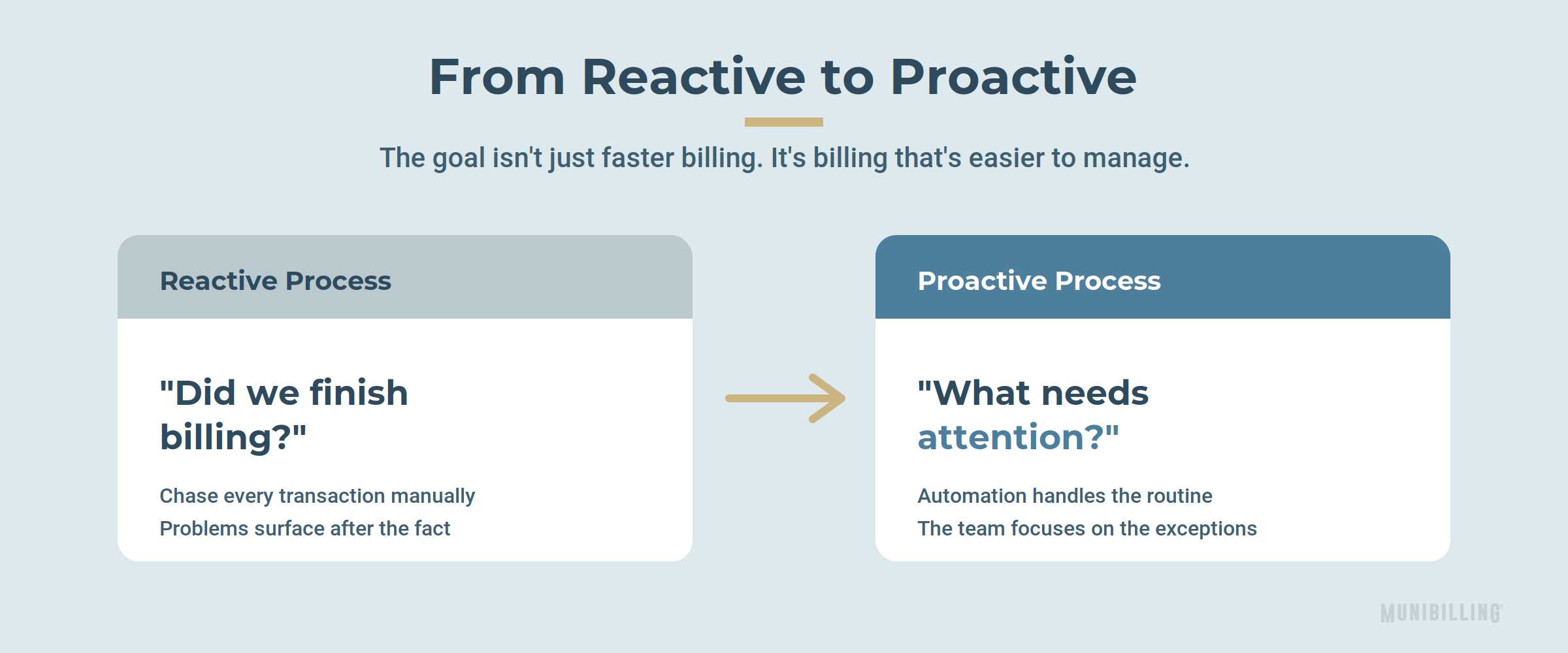
The goal isn't simply to make billing faster.
It's to make it easier to manage.
A reactive process asks:
"Did we finish billing?"
A proactive process asks:
"What needs attention?"
That shift can reduce repetitive work, improve visibility, and help prevent billing problems before they become larger issues.
Stop Putting Utility Billing Off
Utility billing may not be the most exciting part of property management, but it directly impacts revenue, operating costs, staff productivity, and resident experience.
If your team keeps putting utility billing off, it may be time to change the process, not simply work harder at it.

Simplify Property Management Utility Billing
MultiBilling helps property management teams automate utility billing across properties and billing methods—from submetering and RUBS to roommate allocations, proration, payments, collections, and reporting.
Less manual work. More visibility. A better way to manage utility billing.


Schedule a personalized live demo of the new MultiBilling platform today and explore how AI-driven workflow orchestration, operational intelligence, and governed automation can transforming your utility billing operations.