
 Ryan Duvall
Winter Changes the Rules: Running Collections When the Season Is Working Against You
Collections is never simple, but in most of the year it at least runs on familiar terms: a bill goes past due, a reminder goes out, an arrangement gets made, and the escalation ladder is there if it's needed. Winter changes those terms. Cold-weather shutoff rules take effect and remove tools you'd normally rely on. Assistance programs open their heaviest enrollment of the year. The season's largest bills land right as holiday spending tightens every household budget. And the customers falling behind aren't strategic non-payers — they're people caught between a heating bill and everything else December demands. The playbook that works in July doesn't quite fit the winter, and running it unchanged is how utilities end up recovering less while frustrating more.
The good news is that winter's constraints are predictable. They arrive on roughly the same schedule every year, which means they can be planned for rather than absorbed as a surprise. Here's how the season reshapes collections, and how to run it well when the rules, the weather, and your customers' budgets are all working against you.
The Season Rewrites What You Can Do
The defining feature of winter collections is that some of your usual escalation options are simply off the table. Cold-weather protections exist so no one has to choose between staying warm and staying current, and they mean the pressure you might otherwise apply to a stubborn balance isn't available for months. That's not a loophole to work around; it's the operating reality of the season, and often a legal one.
Running collections well in that environment starts with accepting the constraint and shifting the emphasis accordingly. If the later rungs of the escalation ladder are unavailable, the earlier ones matter more than ever: the prompt reminder, the easy payment, the payment arrangement offered before a balance grows. Winter rewards utilities that lean into the tools they can use rather than straining against the ones they can't. The account you keep current with a well-timed arrangement in November is the account you're not trying to collect on, under restricted rules, in February.
Work It Even Earlier Than Usual
In any season, the biggest lever in collections is time — a small, fresh balance is easy to resolve, and an old, large one is not. Winter sharpens that math. Because the season limits how forcefully you can act later, the window to work an account gently and effectively is front-loaded into the moment right after the bill goes past due, before both the balance and the season's constraints have hardened.
That makes early, proactive outreach the single most valuable move of the winter. A reminder that reaches a customer while the balance is still one manageable bill, paired with an easy way to pay or set up a plan, resolves the account before it becomes a winter-long problem. Waiting isn't neutral in the cold months; it's expensive, because every week of delay moves the account further into a period where your options to recover it are narrower. The utilities that handle winter well don't ease off in December — they get ahead of it.
Assistance Isn't Charity — It's Your Collections Strategy
Here's the shift that changes everything about winter collections: for a large share of past-due accounts this time of year, the fastest path to recovering the money runs through assistance, not enforcement. The customer who can't cover a heating bill that ran higher than they budgeted for won't be moved by another notice — but they may well be able to pay if connected to the energy-assistance program they didn't know they qualified for.
Winter is precisely when those programs open their heaviest enrollment: federal and state energy assistance, local hardship funds, seasonal relief. A utility that actively connects struggling customers to that help isn't being lenient at the expense of recovery — it's using the single most effective recovery tool the season offers. Money that arrives through an assistance program is money recovered, often money that no amount of collections effort would have produced otherwise. Treating assistance as part of the collections strategy, rather than as something separate from it, is what separates utilities that recover well in winter from those that simply write more off in spring.
Sort Who Needs Help From Who Needs a Nudge
None of this means treating every winter delinquency the same. As in any season, past-due accounts split roughly into those who simply didn't pay and those who genuinely can't — and the winter response to each is different. The forgot-to-pay account needs a reminder and an easy way to settle up. The can't-pay account needs a payment plan they can actually meet, or a pointer to assistance, because a reminder alone will only produce a balance that ages until spring.
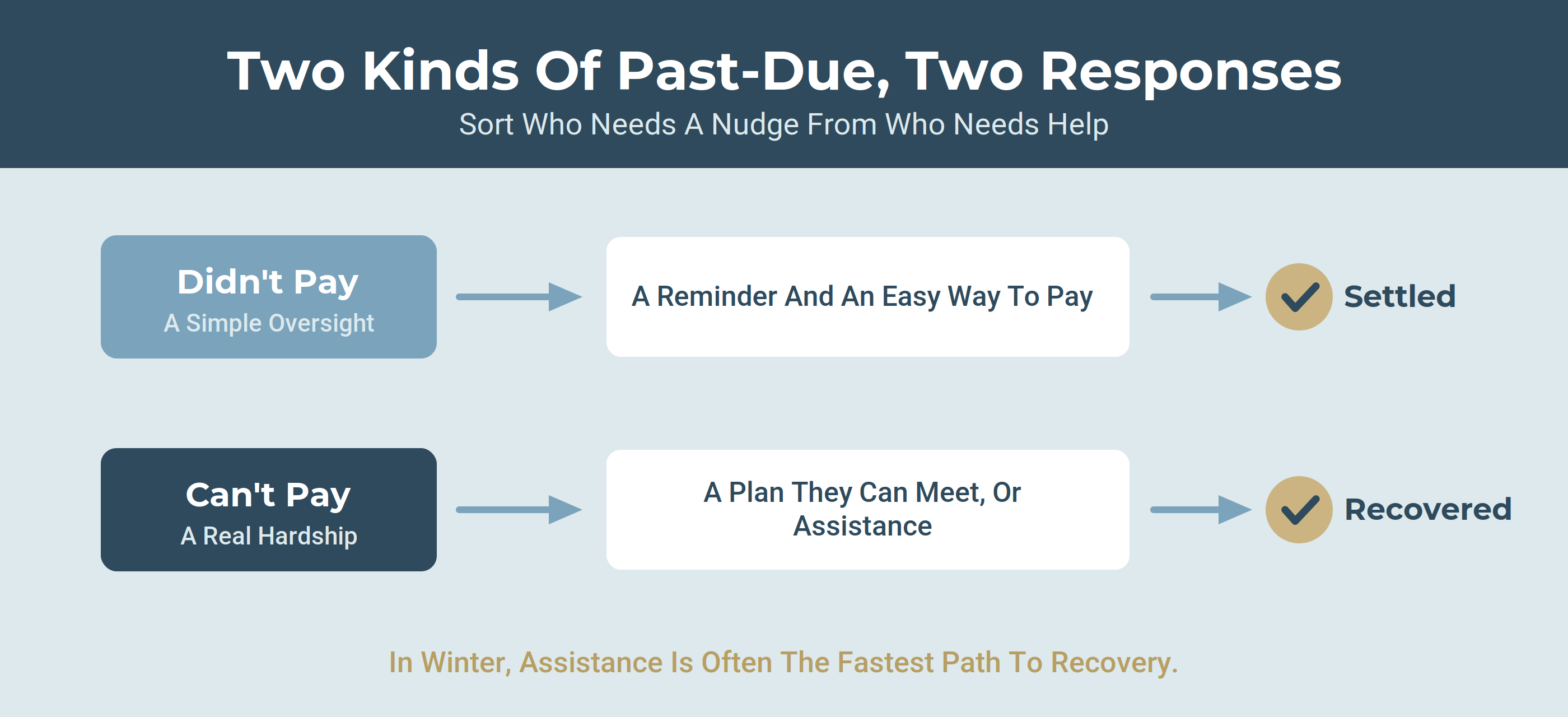
The distinction matters more in winter because the stakes are higher on both sides: enforcement options are limited, so misfiring on the can't-pay accounts wastes the season's narrow window, while the didn't-pay accounts are still easy recoveries if you don't over-escalate them into resentment. Sorting the two quickly, and routing each to the right response, is what keeps the whole effort effective when the season gives you less room to maneuver.
Keep the Record Straight Through a Complicated Season
Winter collections involve more moving parts than any other time of year: accounts under cold-weather protection, customers mid-application for assistance, payment plans in progress, balances that can't be escalated yet but will need attention when the season lifts. Tracking all of that by hand is where winter collections quietly breaks down — accounts under protection get pursued anyway, customers waiting on assistance get a shutoff notice, plans get lost, and the utility ends up looking either heartless or disorganized, sometimes to a council member.
A system that tracks the status of each delinquent account — what's owed, what protections apply, what assistance is pending, what arrangement is in place — is what keeps a complicated season coherent and defensible. It ensures the right accounts get worked, the protected ones are left alone until the rules allow, and no customer who's actively getting help gets a notice that undercuts it. Consistency isn't just efficiency here; in a season this scrutinized, it's what keeps the utility's collections practices fair and above reproach.
When the Season Lifts, Be Ready
Cold-weather protections don't last forever, and the accounts that couldn't be escalated during the season don't disappear — they're waiting when the rules relax. A utility that used the winter well arrives at that point with far fewer of them: many balances resolved early, many customers connected to assistance, many accounts on plans that are being met. A utility that simply waited out the moratorium arrives at spring with a backlog of aged balances and a harder, more adversarial recovery effort right when customers are least braced for it.
That's the quiet payoff of running winter collections thoughtfully. The work you do in the restricted season — the early outreach, the assistance connections, the plans set up and tracked — is what determines whether spring brings a manageable set of remaining accounts or a wave of write-offs and hard conversations. Winter collections isn't a holding pattern; it's the setup for how the rest of the year goes.
Recover the Balance, Keep the Community's Trust
Winter is the season when collections is hardest and most visible — the rules are tighter, the bills are bigger, the customers are more stretched, and the whole community is paying closer attention to how its utility treats people who are struggling. That visibility is exactly why the season rewards a thoughtful approach: recover what you can through early outreach and assistance, protect the customers the rules protect, keep the record straight, and you come out the other side having collected well and kept the trust of the community you serve. Run the winter playbook, not the summer one, and the season that works against every utility works a little less against yours.



Schedule a personalized live demo of the new MultiBilling platform today and explore how AI-driven workflow orchestration, operational intelligence, and governed automation can transform your utility billing operations.