
 Kimberly Wrenn
Best Service Work Order Apps for Small Cities
For small cities, the best utility service work order app is one connected directly to the utility billing system, so a service request, the field work, and the customer account all stay in sync without re-entering data. MuniBilling's MuniServicePro fits that description: a mobile service order app that integrates with MuniBilling at no additional cost and gives field crews instant work orders, GIS route mapping, photo documentation, and offline access.
In a small city, the same few people often take the call, create the order, drive to the meter, and update the account. When those steps live on paper or in a spreadsheet, requests get lost, crews make extra trips, and residents call back to ask what happened. A good utility service work order app closes that loop.
This guide compares the service work order apps small cities most often consider, focusing on four questions: how well each handles utility request tracking, how it fits municipal workflows, how it works in the field, and how it connects to the rest of your local government software.
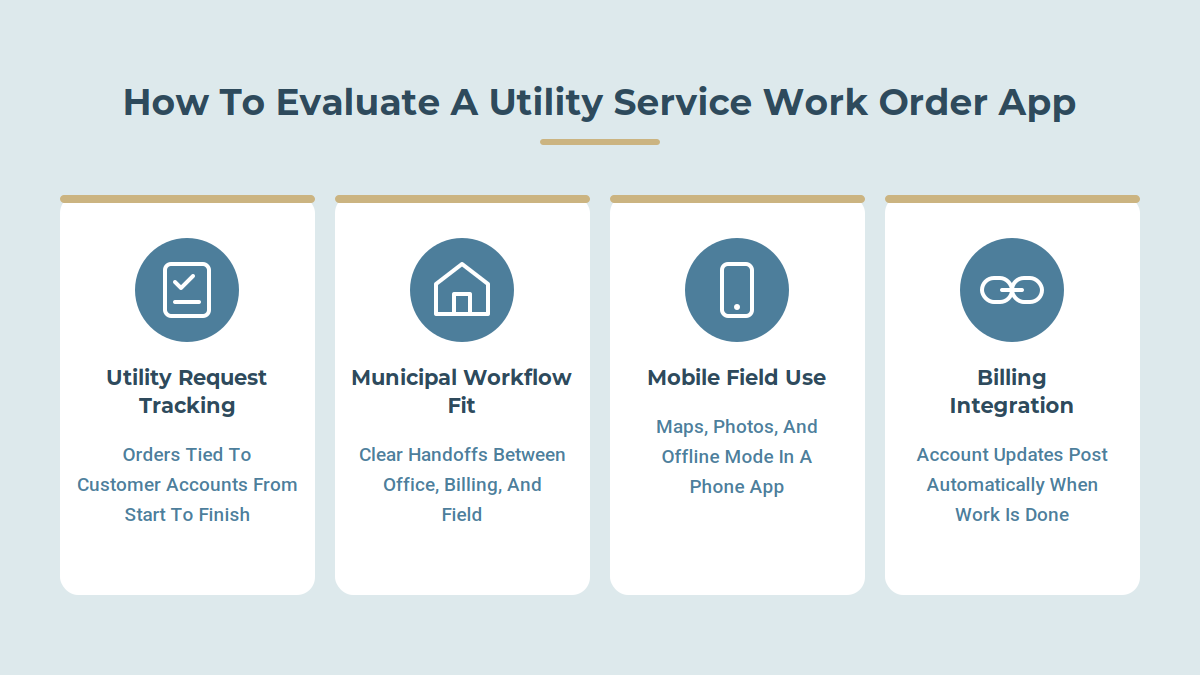
How to Evaluate a Utility Service Work Order App
1. Utility Request Tracking
Utility work is tied to accounts and service addresses: connects, disconnects, meter rereads, leak checks, and final reads at move-out. The app should create an order from the customer record, show its status at every step, and keep a history staff can pull up when a resident calls.
2. Municipal Workflow Fit
General maintenance apps are built for facilities and equipment. Small cities need municipal work orders that match how utility departments actually run, with clear handoffs between the front office, the billing clerk, and the field crew. If staff have to bend the software to fit, it will end up back in a spreadsheet.
3. Mobile Field Use
Crews need orders on the phone they already carry, with maps to the service address, a camera to document the job, and the ability to keep working where cell coverage drops out. Apps that require dedicated tablets or proprietary devices add cost a small city may not need.
4. Integration Relevance
The most important integration for a utility work order app is the billing system. When a meter is swapped or service is shut off, the customer account should update automatically. Ask each vendor what connects out of the box, what requires a custom interface, and what it costs.
Service Work Order Apps at a Glance
|
App |
Built For |
Utility Request Tracking |
Mobile Field Use |
Utility Billing Connection |
Best Fit |
|---|---|---|---|---|---|
|
MuniBilling MuniServicePro |
Utility service orders |
Orders tied to customer accounts in MuniBilling |
Smartphone app with GIS routing, in-app camera, and offline mode |
Integrated with MuniBilling at no additional cost |
Small cities that want utility work orders and billing in one connected system |
|
gWorks Operations |
Public works operations |
Work orders, 311 requests, and 811 locate compliance |
Cloud-native mobile access |
gWorks Financials is a separate, non-integrated system, with integration on the roadmap |
Public works departments that need job costing, fleet, and 811 compliance |
|
iWorQ |
Community development and public works |
Work orders and citizen requests |
Mobile access |
No financial or utility billing system |
Departments focused on permits, code enforcement, and general public works |
|
eWorkOrders |
Maintenance management (CMMS) |
Service requests and work orders across departments |
Mobile app with offline, barcode, and GPS |
Not a utility billing system |
Departments focused on asset and preventive maintenance |
Sources: MuniBilling, gWorks, eWorkOrders.

App-by-App Breakdown
1. MuniBilling MuniServicePro: Best for Utility Service Requests
MuniServicePro is a mobile service order app built specifically for utility service management. It consolidates every service request into one app and connects directly to MuniBilling, so orders start from the customer record and results flow back to the account.
Utility request tracking: Work orders update instantly and sync in real time, so the front office can see where every order stands while a resident is still on the phone.
Municipal workflow fit: The app was designed around the problems small utility departments describe most: communication gaps between the office and the field, paper-based workflows, inaccurate information, and inefficient routing. It improves communication between support staff, administration, and technicians in one place.
Mobile field use: Crews use the smartphones they already have, with no proprietary hardware to buy. GIS mapping plans efficient routes, the in-app camera documents assets and completed work, and offline functionality keeps crews working in areas without cell coverage.
Integration relevance: MuniServicePro integrates with MuniBilling at no additional cost. Pair it with MuniReadPro, MuniBilling's meter reading app, and a small city can run billing, meter reading, and service orders on one connected platform.
Watch for: MuniServicePro is built for utility service orders. Cities that also need fleet management, job costing, or 811 locate compliance in the same tool should weigh a broader public works platform alongside it.
2. gWorks Operations: Best for Broad Public Works Operations
gWorks Operations covers work orders, asset management, GIS, fleet, inspections, 311 citizen requests, job costing, and 811 utility locate compliance for small local governments.
Watch for: gWorks also sells utility billing through gWorks Financials, but by gWorks' own description, Financials and Operations are currently separate, non-integrated systems. Utility work orders and customer accounts will not stay in sync automatically until that integration ships.
3. iWorQ: Best for Community Development Departments
iWorQ has served local governments since 2001 with work orders, citizen requests, permits, and code enforcement, using modular pricing with no per-seat fees.
Watch for: iWorQ has no financial or utility billing system, so utility work orders must be re-entered or manually matched to customer accounts in a separate billing platform.
4. eWorkOrders: Best for Asset-Focused Maintenance Teams
eWorkOrders is a web-based CMMS used by municipalities, counties, and other organizations to manage service requests, work orders, preventive maintenance, and assets, with a mobile app for field crews.
Watch for: As a general maintenance platform, it is not built around utility accounts. Connects, disconnects, and meter work still need a separate path back to your billing system.

Why MuniServicePro Is the Best Fit for Small Cities
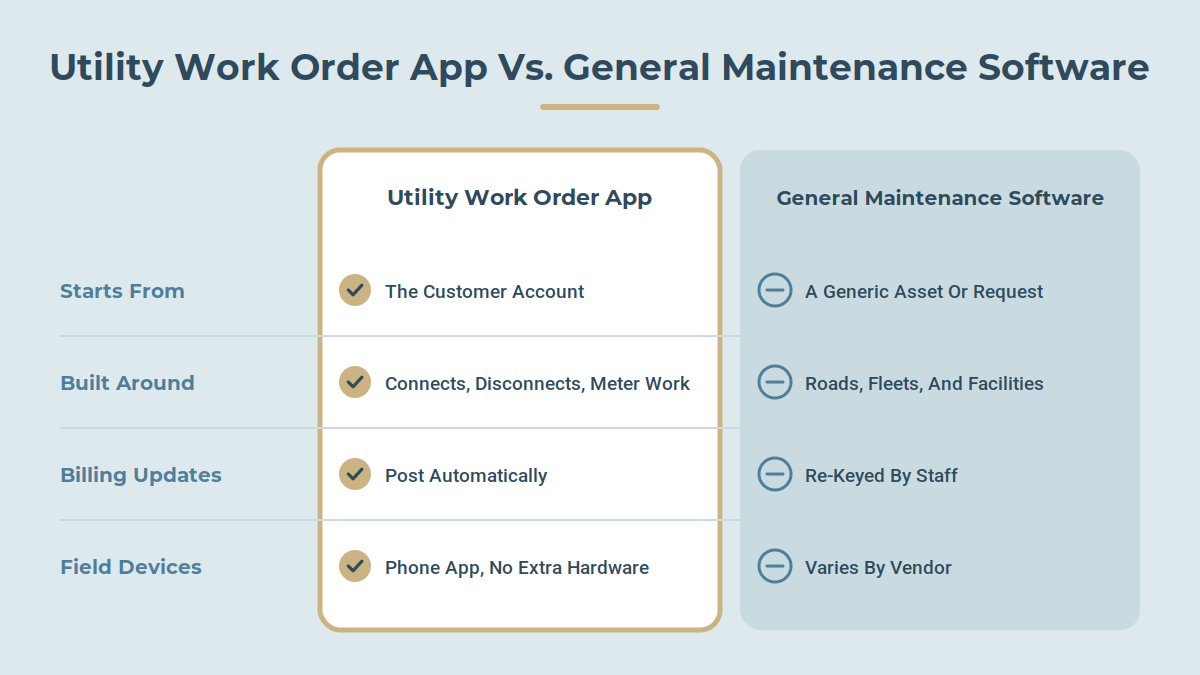
Public works platforms and maintenance apps are built for roads, fleets, and facilities. Utility service requests are different: every one of them starts and ends with a customer account. That is where MuniServicePro stands apart:
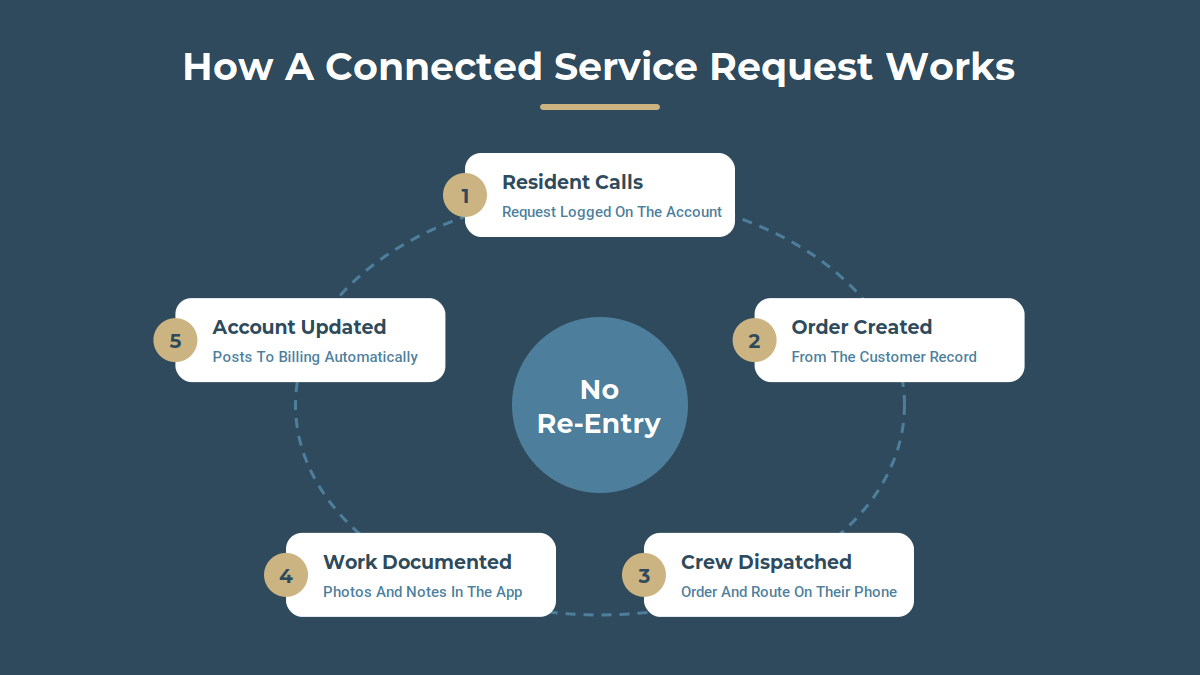
- Connected to billing from day one. Orders start from the customer record in MuniBilling and update the account when the job is done, with no re-entry and no separate integration project.
- No added software cost. The integration with MuniBilling comes at no additional cost.
- Built for the phones crews already carry. No proprietary devices or tablets to buy and maintain.
- Works where your crews work. GIS routing, photo documentation, and offline mode cover the realities of small-city fieldwork.
- One platform for the whole utility. Billing, the customer portal, meter reading with MuniReadPro, and service orders with MuniServicePro all run on the same system.
- A partner that knows utilities. MuniBilling has supported small and mid-sized utilities since 2007, with implementation, training, and a dedicated Client Success Manager.
Choose a Work Order App That Closes the Loop
For small city utility management, the right service work order app does more than send jobs to the field. It connects the resident's call, the crew's work, and the customer account so nothing falls through the cracks. Broad public works platforms and general maintenance apps each solve part of the problem. MuniServicePro solves the utility part completely, because it is built into the billing system your staff already uses.
Request a MuniBilling demo to see MuniServicePro in action.
Frequently Asked Questions
Which service work order app should small cities adopt for utility requests?
Small cities should choose a utility service work order app that connects directly to their utility billing system, works on standard smartphones, and supports offline use in the field. MuniBilling's MuniServicePro meets all three and integrates with MuniBilling at no additional cost.
What is the difference between a utility work order app and public works software?
Public works software manages roads, fleets, facilities, and infrastructure assets. A utility service work order app focuses on customer-driven requests like connects, disconnects, meter rereads, and leak checks, and ties each one to the customer's utility account.
Why does integration with utility billing matter for municipal work orders?
Most utility service requests change something on the customer's account, such as a new meter, a final read, or a shutoff. When the work order app and billing system are connected, those changes post automatically instead of being re-keyed by staff.
Do small cities need special devices for a service work order app?
Not necessarily. Apps like MuniServicePro run on everyday smartphones, which avoids the cost of buying and maintaining dedicated tablets or handhelds.
How does a work order app improve service request management?
It replaces paper and spreadsheets with one place to create, assign, track, and close requests. Crews get orders and routes on their phones, the office sees status in real time, and residents get faster, more accurate answers.

Schedule a personalized live demo of the MuniBilling platform today and explore how AI-driven workflow orchestration, operational intelligence, and governed automation can transform your utility billing operations.